Back Pain Doctor
Pubic-Related Groin Pain (Osteitis Pubis)
Written by Dr Joshua Hatch, Musculoskeletal GP, RACGP Fellow, Diploma in Musculoskeletal Medicine (FSEM UK).
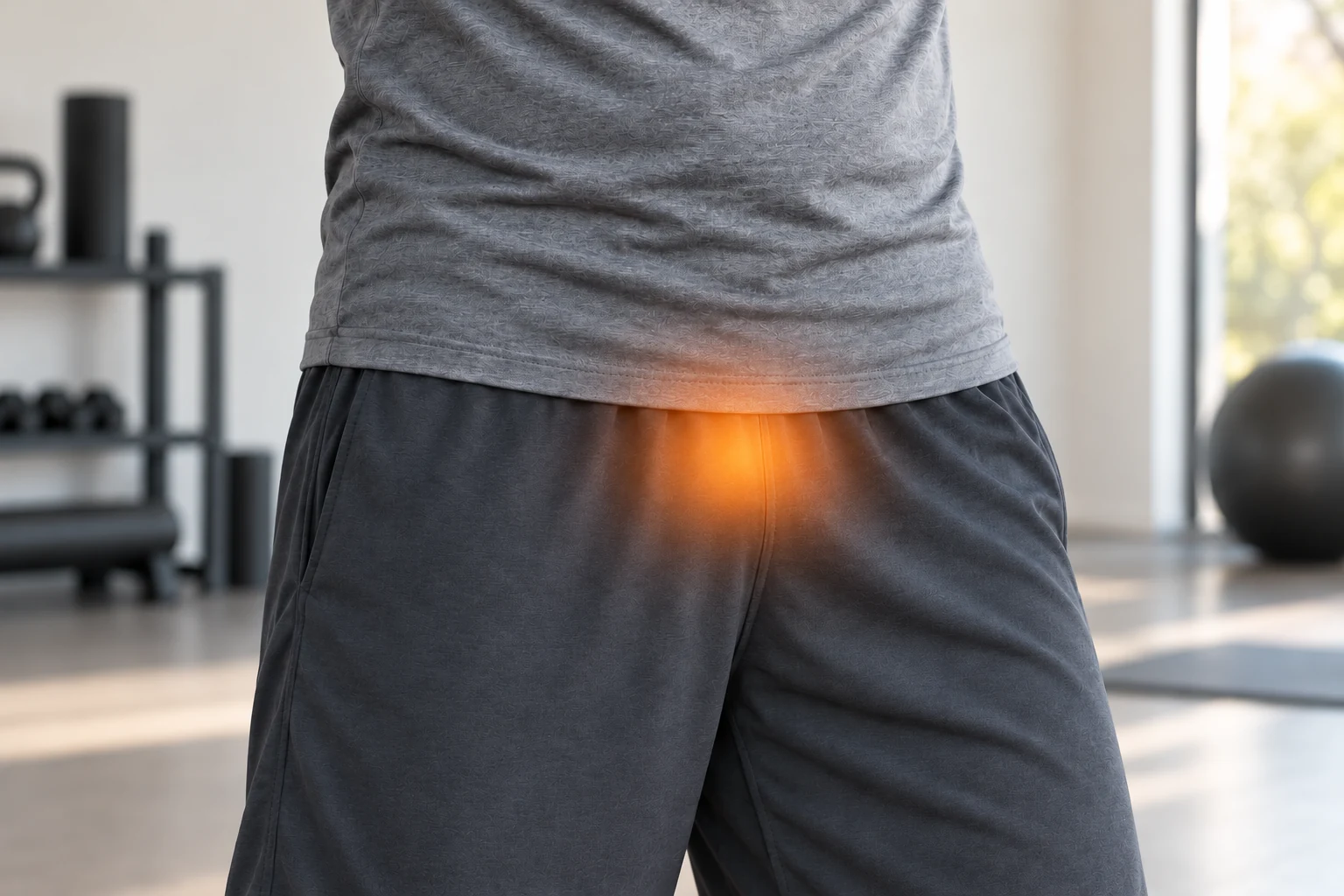
Groin pain in athletes is not one condition. The Doha classification separates adductor-related, iliopsoas-related, inguinal-related, pubic-related and hip-related groin pain, because more than one can be present at once. Pubic-related groin pain is defined by local tenderness of the pubic symphysis and the adjacent bone.
Assessment focuses on the training history, palpation of the pubic symphysis, and examination of the adductors, hip, iliopsoas and inguinal region. Imaging does not decide the diagnosis because pubic changes are common in people without pain, but it is used for persistent or atypical symptoms or when another cause is suspected.
First-line care is a supervised, progressive rehabilitation program that rebuilds adductor, trunk and hip capacity and then reintroduces sprinting, kicking and cutting against agreed criteria. Much of the supporting evidence is indirect or from small uncontrolled studies. Shockwave added to exercise looked promising in a systematic review but the studies were limited, and injection evidence is low level, so these are not a substitute for rehabilitation. Surgery is rarely needed. This page is educational information only; please see your GP if groin pain persists, or promptly if there is fever, severe night pain or a groin lump.
Common symptoms
- Aching or sharp pain over the pubic bone, sometimes spreading to the inner thigh or lower abdomen
- Pain with sprinting, kicking, sit-ups and changing direction
- Tenderness when pressing over the pubic symphysis
- Stiffness or soreness after training or the next morning
Commonly seen in
Evidence for twelve treatment options in pubic-related groin pain (osteitis pubis)
This is not a fixed ladder or a package of treatments. Every option is assessed independently against this diagnosis, including treatments with limited direct research that may still be reasonable for a clearly defined tissue target. The evidence level, likely benefit, risks, cost and alternatives are weighed at consultation.
Foundation — diagnosis, education and rehabilitation
The part of care with the broadest relevance. For many people it is enough on its own; other options are judged against it, not automatically added after it.
Diagnosis, education and progressive rehabilitation Working out what is driving the pain, explaining what your imaging does and does not mean, and building a graded loading plan you can actually follow. First line, much of it indirect
What it involves
Assessment to identify the likely pain source, an explanation of what the diagnosis means, adjustment of the loads that aggravate it, and a progressive strength and conditioning plan — with weight management where that is clinically relevant.
What the evidence shows
The sources reviewed for this page were the 2015 Doha agreement (Weir, Br J Sports Med) and a 2026 narrative review of osteitis pubis and pubic-related groin pain (J Clin Med 2026). Supervised active rehabilitation is first-line, but much of the support is indirect, drawn from adductor-related groin pain. In 14 academy footballers with longstanding pubic-related pain, a six-level criteria-based program had a high return-to-play rate and one recurrence at a mean of about 135 days, in a small uncontrolled cohort. A 2024 adolescent randomised trial found a modified active program and traditional physiotherapy both improved outcomes over 12 weeks, with greater strength and function gains in the modified program and a larger pain reduction in the traditional group. Reported nonoperative failure thresholds range from 3 to 6 months and none is validated.
Pairing reviewed 2026-10-17.
Where it fits for you
Where care starts: assessment of the pubic symphysis, adductors, hip and abdominal wall, then a graded program with criteria-based return to sprinting and kicking. I am upfront that the evidence is small and partly borrowed from adductor-related groin pain, and that recovery is usually months.
Muscle and symptom-modifying options
Useful only when the examination identifies the tissue they target or when short-term pain control creates a useful rehabilitation window.
Wet needling and trigger point injection (trigger point injection) A fine needle into a tender band of muscle, with a small volume of dilute glucose solution injected through it. Only a separate muscle target
What it involves
The needle is placed into the tender muscle band and a small volume of 5% glucose with 0.02-0.08% lignocaine is injected. Often done in the same visit as your assessment, and usable where the tender area sits deeper. Dry needling — the same technique with nothing injected — is not offered here.
What the evidence shows
The sources reviewed for this page were the 2015 Doha agreement (Weir, Br J Sports Med) and a 2026 narrative review of osteitis pubis and pubic-related groin pain (J Clin Med 2026). Neither source evaluates needling for pubic-related groin pain. It would only apply to a separately confirmed tender adductor or abdominal muscle target.
Pairing reviewed 2026-10-17.
Where it fits for you
Not a treatment for pubic-related pain. Considered only for a separate, examined muscle problem, with the evidence gap stated.
Ultrasound-guided injections Guidance means we can see the needle reach the target. What goes into the needle depends on the diagnosis. Low-level evidence
What it involves
The injection is performed under ultrasound so the needle can be watched into the target structure. What is injected is decided by the diagnosis — and corticosteroid is used sparingly, for the reasons set out below.
What the evidence shows
The sources reviewed for this page were the 2015 Doha agreement (Weir, Br J Sports Med) and a 2026 narrative review of osteitis pubis and pubic-related groin pain (J Clin Med 2026). A 2011 systematic review reported that about 59 per cent of injected athletes returned to sport and roughly a fifth did not respond; all included treatment studies were low level. A 2025 retrospective, non-randomised cohort found no significant difference in return to sport between corticosteroid, platelet-rich plasma and no-injection groups for chronic adductor longus lesions. The 2026 review proposes injection as an intermediate step only after a documented failed rehabilitation program.
Pairing reviewed 2026-10-17.
Where it fits for you
Worth a careful discussion only after a proper rehabilitation course has not settled the problem, alongside continued rehabilitation. The evidence is low level and the uncertainty is explained before any treatment.
V-ACTOR vibration therapy (vibration therapy) Low-frequency vibration applied over tender muscle. Not a shockwave, despite sharing the machine. Only a separate muscle target
What it involves
A vibration handpiece is moved over the tender muscle and fascia for a few minutes. It runs from the same STORZ MASTERPULS icon console as radial shockwave but is a separate handpiece delivering a different, gentler form of energy. No needles, no anaesthetic, no downtime.
What the evidence shows
The sources reviewed for this page were the 2015 Doha agreement (Weir, Br J Sports Med) and a 2026 narrative review of osteitis pubis and pubic-related groin pain (J Clin Med 2026). Neither source evaluates vibration devices for pubic-related groin pain. The rationale would be short-term modulation of a separate tender adductor or abdominal muscle.
Pairing reviewed 2026-10-17.
Where it fits for you
Not a treatment for pubic-related pain. Considered only as a short-term adjunct to rehabilitation where a tight muscle limits it.
Energy-based treatment options
Radial pressure wave, focused shockwave and EMTT have different targets and different evidence. They are assessed separately rather than treated as one category.
Radial or focused shockwave? Read the overviewRadial shockwave (radial pressure wave) Broad treatment across tender muscle and fascia, close to the surface. No radial trial identified
What it involves
A handpiece is moved over the tender tissue while ballistic pressure pulses are delivered, using a transmitter head chosen for the tissue — including heads shaped for fascia and for the muscle either side of the spine. The pulse is strongest at the skin and weakens with depth, so this is mainly a myofascial treatment, though it can reach deeper in some areas. No anaesthetic, no downtime, usually a course of sessions about a week apart.
What the evidence shows
The sources reviewed for this page were the 2015 Doha agreement (Weir, Br J Sports Med) and a 2026 narrative review of osteitis pubis and pubic-related groin pain (J Clin Med 2026). The randomised trial described in the 2026 review used focused shockwave. A 2024 systematic review found promising results when shockwave was combined with exercise but noted heterogeneous protocols and limited study quality. No radial-shockwave trial for pubic-related groin pain was identified in those sources.
Pairing reviewed 2026-10-17.
Where it fits for you
Not a first-line option. Could be discussed alongside rehabilitation, with the thin evidence stated, and never implied to improve on exercise alone.
Focused shockwave (ESWT) A true shock wave converging at depth — for tendon, joint, ligament and bone. One sham-controlled trial, thin overall
What it involves
A focused system generates an acoustic shock wave that converges at a focal point set at a defined depth, concentrating the energy where the target is. This is the form we use for tendon, joint, ligament and bone. Typically four to six sessions about a week apart, no anaesthetic and no formal downtime.
What the evidence shows
The sources reviewed for this page were the 2015 Doha agreement (Weir, Br J Sports Med) and a 2026 narrative review of osteitis pubis and pubic-related groin pain (J Clin Med 2026). In one randomised trial, 44 footballers received rehabilitation plus focused shockwave (n=26) or sham (n=18); a 2024 systematic review found promising results when shockwave was combined with exercise but with heterogeneous protocols and limited quality. The evidence is too limited to say shockwave improves outcomes.
Pairing reviewed 2026-10-17.
Where it fits for you
Could be discussed as an adjunct to, never a replacement for, rehabilitation. The evidence is described as thin and mixed.
EMTT (magnetotransduction therapy) High-energy magnetic pulses applied over the area. Painless, no contact. No studies identified
What it involves
You sit with the applicator positioned over the area for a short session. Painless, no gel or contact required, and usually delivered as a course — commonly alongside shockwave.
What the evidence shows
The sources reviewed for this page were the 2015 Doha agreement (Weir, Br J Sports Med) and a 2026 narrative review of osteitis pubis and pubic-related groin pain (J Clin Med 2026). Neither source describes magnetotransduction therapy for pubic-related groin pain.
Pairing reviewed 2026-10-17.
Where it fits for you
Not a first-line option. Any use would be described as emerging and unproven.
Biologic and joint injection options
Each injection is assessed independently for the named diagnosis. Cost, uncertainty, likely benefit, risks and alternatives are part of the decision.
Platelet-rich plasma (PRP) Your own blood, concentrated and injected under ultrasound guidance. Minimal evidence
What it involves
Blood is taken from your arm, spun to concentrate the platelets, and injected into the target under ultrasound guidance in the same appointment.
What the evidence shows
The sources reviewed for this page were the 2015 Doha agreement (Weir, Br J Sports Med) and a 2026 narrative review of osteitis pubis and pubic-related groin pain (J Clin Med 2026). Evidence for platelet-rich plasma is minimal: a 2022 case report described improvement, and a 2025 retrospective cohort found no significant difference in return to sport between steroid, PRP and no-injection groups, with non-random allocation.
Pairing reviewed 2026-10-17.
Where it fits for you
Not a first-line option. If discussed, the absence of controlled evidence is stated plainly.
Prolotherapy (dextrose) A course of dextrose injections into and around the structure and its attachments. Uncontrolled series only
What it involves
Hypertonic dextrose is injected at the tender ligament and tendon attachments, and into the joint where relevant, usually as a series of treatments a few weeks apart.
What the evidence shows
The sources reviewed for this page were the 2015 Doha agreement (Weir, Br J Sports Med) and a 2026 narrative review of osteitis pubis and pubic-related groin pain (J Clin Med 2026). Dextrose prolotherapy has only uncontrolled elite-athlete case series support, per the 2026 review.
Pairing reviewed 2026-10-17.
Where it fits for you
Not a first-line option. If discussed, it is described as unproven and used alongside rehabilitation.
Viscosupplementation (hyaluronic acid) A gel-like injection into an arthritic joint. Widely used, and genuinely contested. Wrong problem
What it involves
One or a short series of hyaluronic acid injections into the joint under ultrasound guidance.
What the evidence shows
Hyaluronic acid injection is studied in synovial joint osteoarthritis. The pubic symphysis is a fibrocartilaginous joint and the sources reviewed describe no such use.
Pairing reviewed 2026-10-17.
Where it fits for you
Not offered for pubic-related groin pain.
Nerve-targeted options
Relevant when examination identifies a superficial neuropathic pattern or a compressed peripheral nerve—not simply because pain is present.
Lyftogt perineural therapy (perineural injection therapy) A series of small dilute dextrose injections just under the skin, over tender superficial nerves. Different diagnosis
What it involves
Small injections of low-concentration dextrose, usually 5%, placed just beneath the skin along tender superficial nerves. Given as a series of short sessions.
What the evidence shows
The sources reviewed for this page were the 2015 Doha agreement (Weir, Br J Sports Med) and a 2026 narrative review of osteitis pubis and pubic-related groin pain (J Clin Med 2026). Nerve-related groin pain is a separate diagnosis within the Doha framework and the sources describe no perineural treatment for pubic-related pain. Pulsed radiofrequency and botulinum toxin appear in the 2026 review only as isolated reports or extrapolation.
Pairing reviewed 2026-10-17.
Where it fits for you
Not offered for pubic-related groin pain.
Ultrasound-guided nerve hydrodissection Fluid placed around a nerve to free it from the surrounding tissue. Different diagnosis
What it involves
Under ultrasound, fluid is placed in the plane around the nerve to separate it from the tissue that is tethering or compressing it.
What the evidence shows
The sources reviewed for this page were the 2015 Doha agreement (Weir, Br J Sports Med) and a 2026 narrative review of osteitis pubis and pubic-related groin pain (J Clin Med 2026). Hydrodissection addresses nerve entrapment, which is not what pubic-related groin pain describes.
Pairing reviewed 2026-10-17.
Where it fits for you
Not offered for pubic-related groin pain.
This is general information only and suitability is assessed individually. Treatments with limited or condition-dependent evidence may still be discussed, but only with clear explanation of the uncertainty, the expected benefit, risks, cost and alternatives. Red flags, progressive neurological symptoms or suspected serious pathology require a different pathway.
Every treatment above is described in full on the non-surgical treatments page, including what each one is used for and what the evidence supports. Ratings apply to the named diagnosis; an adjacent muscle, tendon, joint or nerve problem is assessed as a separate target. The method behind the ratings, and the treatments we do not offer, are set out on the evidence page.
Corticosteroid injection is reviewed separately for each diagnosis.
Cortisone reliably reduces pain in the short term, and that can be genuinely useful when pain is stopping you sleeping or moving enough to rehabilitate. Beyond that window the picture changes. A systematic review of 41 randomised trials and 2,672 participants found that corticosteroid injection reduced pain in the short term but that the effect reversed at intermediate and long term; in pooled analysis for lateral epicondylalgia the short-term effect was large (SMD 1.44, 95% CI 1.17 to 1.71) while no intervention was favoured at 26 weeks (-0.40, -0.67 to -0.14) and at 52 weeks (-0.31, -0.61 to -0.01) (Coombes, Lancet 2010). In a randomised trial in lateral epicondylalgia, 83 per cent of the corticosteroid group had completely recovered or much improved at one year against 96 per cent given a placebo injection, and recurrence ran at 54 per cent against 12 per cent; adding physiotherapy made no significant difference at one year (Coombes, JAMA 2013). In joints, repeated corticosteroid injections have been associated with cartilage loss. It does not repair anything.
So we do not build treatment plans around it. Where an injection is the right call, we review the specific diagnosis and target, discuss what is being injected and why, keep the number low, and pair it with the loading work that changes the longer-term course.
When we would still consider it
- Pain severe enough to block rehabilitation
- A clear inflammatory or bursal target on imaging
- A specific short-term goal — a trip, a procedure, a return to work
- Diagnostic use, where the response tells us where the pain is coming from
When a cortisone injection is worth doing, and when it is not
Other hip & pelvis conditions
Pain in the same area can come from more than one source, and the label matters less than what the examination and history point to. These are the other guides for this region.
Frequently asked questions
Is this the same as osteitis pubis?
Do I need an MRI?
What helps, and how long does it take?
Ready for a clearer plan for your back or musculoskeletal pain?
Book an assessment with Dr Joshua Hatch.
Your assessment focuses on understanding the likely source of your pain and the most appropriate non-surgical options for your diagnosis, with the aim of reducing pain and improving function.
Book an appointment