Back Pain Doctor
Focused Shockwave Therapy (ESWT) Brisbane
What it can help with
- Plantar fasciitis
- Calcific & non-calcific rotator cuff tendinopathy
- Tennis & golfer's elbow
- Greater trochanteric pain syndrome
- Proximal hamstring tendinopathy
- Achilles tendinopathy
Suitability depends on your individual diagnosis and is assessed at consultation.
Extracorporeal shockwave therapy (ESWT) delivers focused acoustic pressure waves to an area of injured tendon, soft tissue or bone. The mechanical stimulus is thought to promote local healing responses — including cell signalling, new blood-vessel formation and tissue remodelling — in tissues that have stalled in their recovery.
ESWT is most established for chronic tendinopathies that have persisted despite first-line measures such as activity modification, physiotherapy and time. It is non-invasive, performed in the clinic, and usually does not require an anaesthetic.
Shockwave is generally used as part of a wider management plan that continues to address the underlying load and biomechanics, rather than as a treatment given in isolation. Whether ESWT is appropriate for you depends on your specific diagnosis, and this is assessed at consultation.
If you are not yet sure whether focused or radial suits your problem, our shockwave therapy overview compares the two side by side.
How it works
Focused shockwave and radial pressure wave are not the same thing, even though both are often called "shockwave" and are sometimes grouped together. The difference is physical. A focused system (piezoelectric, electromagnetic or electrohydraulic) generates a true acoustic shock wave that converges at a focal point set at a defined depth within the tissue — so energy is concentrated where the target is. A radial (ballistic) pressure wave device generates a pressure wave with its maximum intensity at the applicator surface, spreading out and weakening with depth — which is why the international shockwave society notes it is more accurate to call it a pressure wave than a shock wave. In practice, focused devices suit deeper or more precisely localised targets; radial devices are more superficial and broad-field.
How the energy is thought to help. The leading theory for both is mechanotransduction — the acoustic energy is sensed by cells and converts into biological signals, rather than simply "breaking things up." Proposed effects that recur across the literature include release of nitric oxide and growth factors, new blood-vessel formation (angiogenesis), improved local blood flow, reduced sensitisation of pain nerves, and stimulation of tissue remodelling. In laboratory and animal studies there is also evidence for improved peripheral nerve regeneration and remyelination, which is part of the rationale for using shockwave in some nerve-related conditions. These mechanisms are well described in principle; the exact device, dose and protocol that work best for a given condition are still being refined.
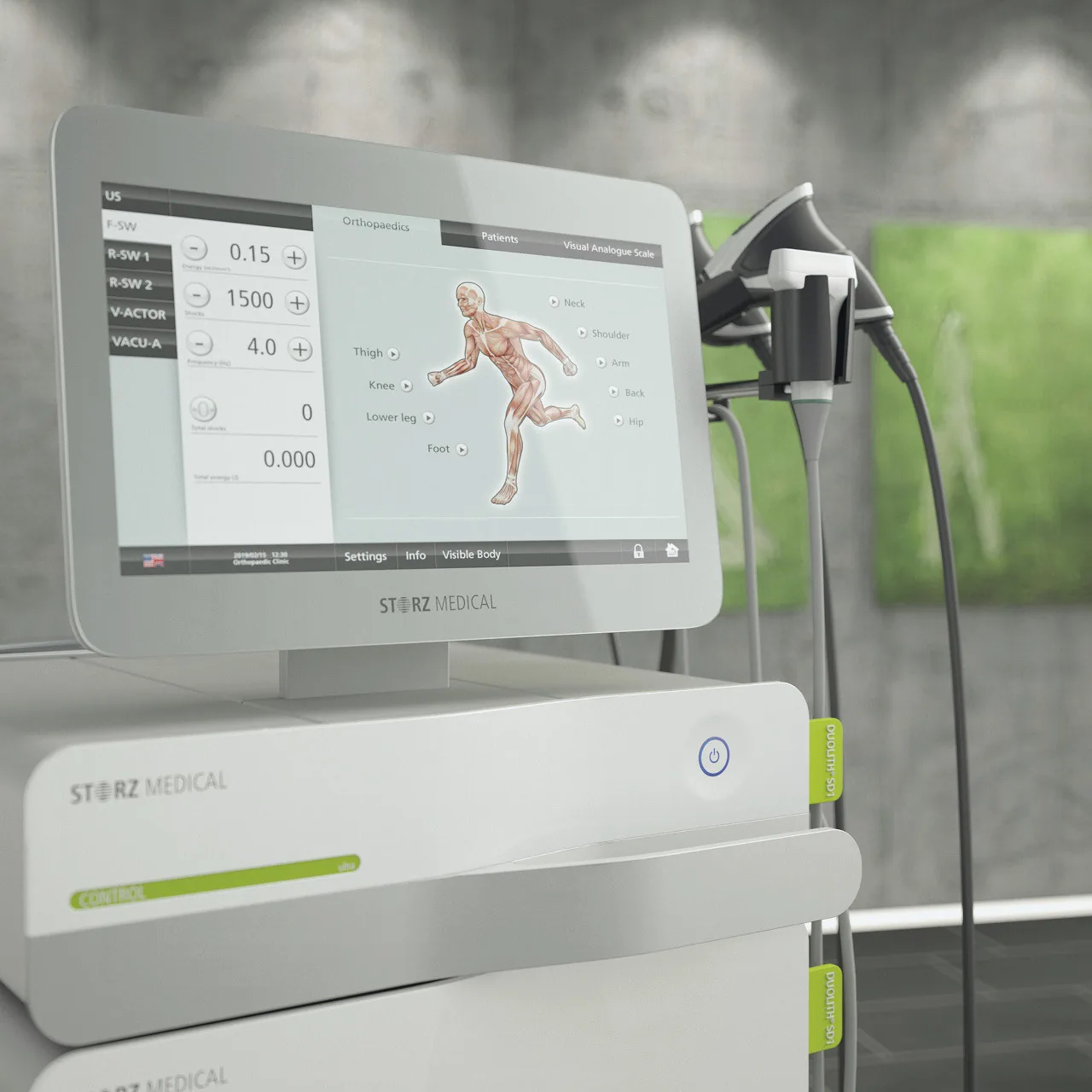
We use a focused shockwave system, which allows the energy to be directed to deeper target tissues such as tendon attachments.
What the evidence shows
Sources: ESWT for upper-limb tendinopathy — systematic review & meta-analysis (Frontiers in Medicine, 2024) , Focused vs radial shockwave in carpal tunnel syndrome — updated systematic review & meta-analysis (J Clin Med, 2023) , ISMST clinical guidelines for ESWT (2024) — focused vs radial, indications & contraindications (PDF)
What to expect
Conditions reviewed for this treatment
The evidence for a treatment can be different for every diagnosis. The conditions below reach a discussable level in our diagnosis-specific review. This is not a recommendation for you; suitability still depends on your diagnosis, what has already been tried, and the benefits, risks, costs and alternatives.
- Achilles Tendinopathy Evidence position for this diagnosis: Good support
- Greater Trochanteric Pain Syndrome (Hip) Evidence position for this diagnosis: Good support
- Knee Osteoarthritis Evidence position for this diagnosis: Good support
- Plantar Fasciitis Evidence position for this diagnosis: Good support
- Proximal Hamstring Tendinopathy Evidence position for this diagnosis: Good support
- Shin Splints Evidence position for this diagnosis: Good support
- Shoulder Calcific Tendinopathy Evidence position for this diagnosis: Good support
- Adductor-Related Groin Pain Evidence position for this diagnosis: Worth discussing
- Frozen Shoulder Evidence position for this diagnosis: Worth discussing
- Osteonecrosis of the Hip (Avascular Necrosis) Evidence position for this diagnosis: Worth discussing
- Osteonecrosis of the Knee (Avascular Necrosis) Evidence position for this diagnosis: Worth discussing
- Sacroiliac Joint (SIJ) Pain Evidence position for this diagnosis: Worth discussing
- Stress Fractures of the Foot and Ankle Evidence position for this diagnosis: Worth discussing
Frequently asked questions
What is the difference between focused and radial shockwave?
Does shockwave therapy hurt?
How many sessions will I need?
Is there any downtime?
Is it covered by Medicare?
When will I know if it has worked?
Ready for a clearer plan for your back or musculoskeletal pain?
Book an assessment with Dr Joshua Hatch.
Your assessment focuses on understanding the likely source of your pain and the most appropriate non-surgical options for your diagnosis, with the aim of reducing pain and improving function.
Book an appointment