Back Pain Doctor
Radial Shockwave Therapy Brisbane
Written by Dr Joshua Hatch, Musculoskeletal GP, RACGP Fellow, Diploma in Musculoskeletal Medicine (FSEM UK).
What it can help with
- Tender, tight muscle and fascia — paraspinal, gluteal, calf, forearm
- Myofascial pain contributing to neck, back or hip symptoms
- Broad surface tenderness around a painful joint or tendon
- Plantar heel pain across the sole and calf
- Mid-portion Achilles pain, which sits shallow enough to reach
Suitability depends on your individual diagnosis and is assessed at consultation.
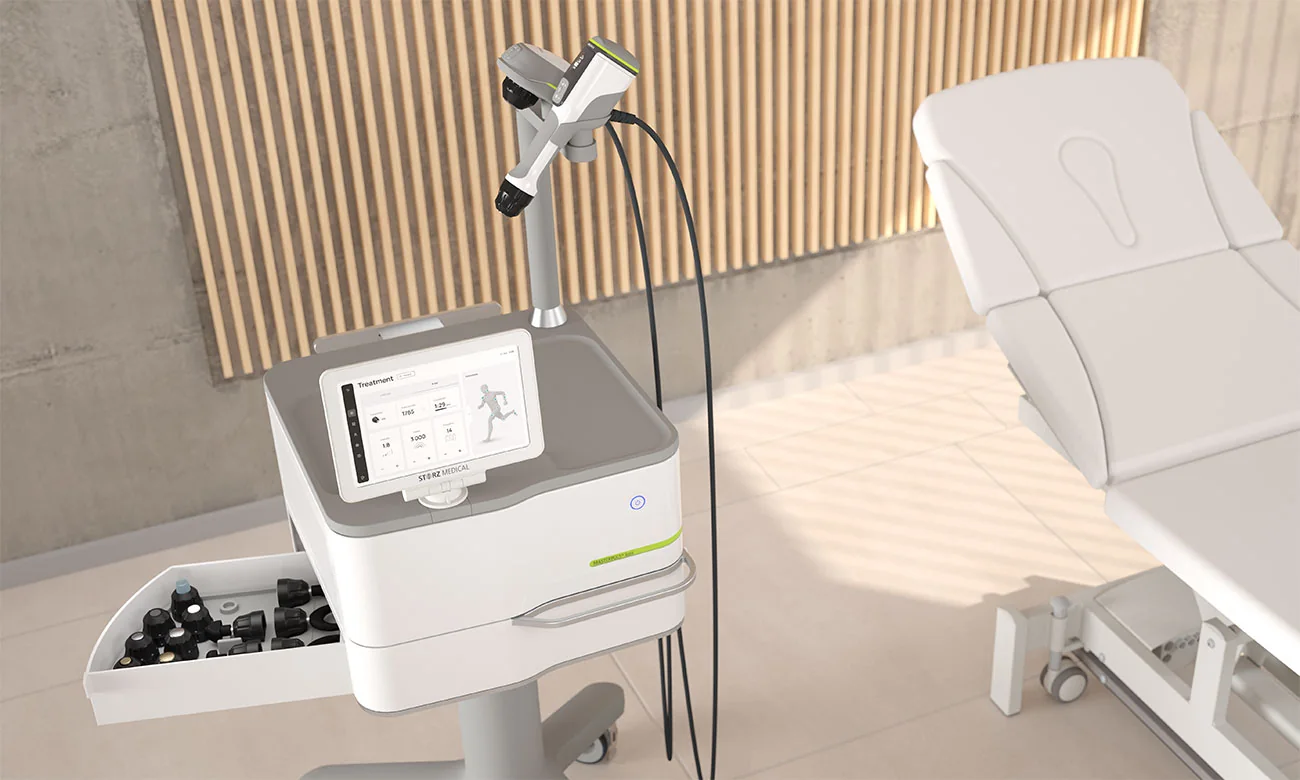
STORZ Medical MASTERPULS icon
Interchangeable transmitters, matched to the tissue being treated.
The handpiece takes interchangeable transmitters chosen for the tissue in front of us. Standard radial heads cover the conventional indications; PERI-ACTOR transmitters are shaped for fascial treatment; SPINE-ACTOR transmitters are designed for the muscle either side of the spine. Intensity, frequency and total pulse count are set for the area and adjusted during the session to a level you can tolerate. The energy is greatest at the skin and falls away with depth, which is why this is primarily a treatment for muscle and fascia.
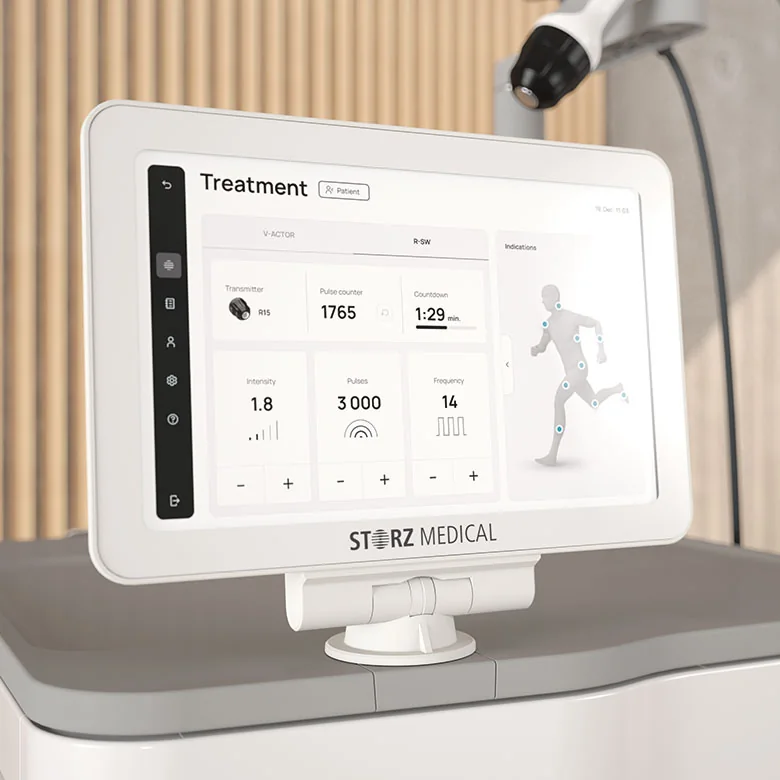
Radial shockwave therapy is a non-invasive, in-clinic treatment for tendon and soft-tissue pain. A handpiece is moved over the tender tissue while pressure pulses are delivered through the skin, with the aim of reducing pain and improving how the area tolerates load.
It sits at stage three of our treatment pathway. That means it is considered once the diagnosis is clear and a progressive loading programme has been given a genuine trial, usually around three months. For many people the loading work is enough on its own, and shockwave is not needed.
If you are not yet sure which form suits your problem, our shockwave therapy overview compares the two side by side.
Radial and focused shockwave are different treatments and are used for different targets. Radial energy is strongest at the surface, making it well suited to broad, superficial tenderness such as the mid-portion Achilles or the soft tissue around a painful knee. Focused shockwave concentrates energy at depth, and is preferred where the painful structure is deeper or precisely localised — an insertional tendon attachment, for example.
Whether shockwave is appropriate for your problem is assessed at consultation, along with the current evidence for your specific diagnosis, the expected benefit, the cost and the alternatives.
How it works
We use a STORZ Medical MASTERPULS icon radial system. A radial device accelerates a projectile against an applicator held on the skin, producing a pressure wave that spreads out from the contact point. The wave is strongest at the surface and weakens with depth — which is the key difference from focused shockwave, where the energy converges at a set depth inside the tissue. The two are commonly both called "shockwave", but they are not the same treatment, and we list them separately for that reason.
That difference decides which one you get. Radial suits muscle and fascia, because that is the tissue sitting where the energy is greatest. Tendon, joint, ligament and bone all sit deeper, and for those we generally use focused shockwave. Radial can be taken deeper in some areas — the mid-portion Achilles is one place where a superficial tendon makes it reasonable — but that is the exception rather than the rule.
Newer radial systems, including ours, are built to extend further into the tissue than earlier radial devices, and the manufacturer describes this as narrowing the gap between radial and focused treatment. That claim rests on laboratory testing rather than on clinical trials comparing the two in patients, so we treat it as a reason to keep an open mind about depth, not as a reason to use radial where a focused device is the better tool.
The proposed mechanism is mechanotransduction: cells sense the acoustic energy and respond with signalling that can improve local blood flow and reduce pain sensitisation. This is a plausible and reasonably well-studied idea in tendon tissue, though it does not follow that every painful structure responds.
What the evidence shows
What to expect
Conditions reviewed for this treatment
The evidence for a treatment can be different for every diagnosis. The conditions below reach a discussable level in our diagnosis-specific review. This is not a recommendation for you; suitability still depends on your diagnosis, what has already been tried, and the benefits, risks, costs and alternatives.
- Plantar Fasciitis Evidence position for this diagnosis: Good support
- Proximal Hamstring Tendinopathy Evidence position for this diagnosis: Good support
- Acute Hamstring Strain Evidence position for this diagnosis: Worth discussing
- Carpal Tunnel Syndrome Evidence position for this diagnosis: Worth discussing
- Cervical Spondylosis (Neck Arthritis) Evidence position for this diagnosis: Worth discussing
- Coccydynia (Tailbone Pain) Evidence position for this diagnosis: Worth discussing
- Deep Gluteal Syndrome (Piriformis Syndrome) Evidence position for this diagnosis: Worth discussing
- Hip Osteoarthritis Evidence position for this diagnosis: Worth discussing
- Knee Osteoarthritis Evidence position for this diagnosis: Worth discussing
- Low Back Pain Evidence position for this diagnosis: Worth discussing
- Neck Pain Evidence position for this diagnosis: Worth discussing
- Rotator Cuff Partial Tear Evidence position for this diagnosis: Worth discussing
- Tennis & Golfer's Elbow Evidence position for this diagnosis: Worth discussing
- Whiplash & Neck Sprain Evidence position for this diagnosis: Worth discussing
Related articles
Shorter articles that answer the questions patients ask most often about this.
- Radial vs Focused Shockwave Therapy: What Is the Difference?Radial and focused shockwave are different treatments with different physics, targets and evidence. How to tell which one you are being offered.
- Shockwave Therapy: What to Expect at an AppointmentFocused shockwave therapy is used for selected chronic tendon and soft-tissue problems. Learn what an appointment usually involves.
Frequently asked questions
What is the difference between radial and focused shockwave?
Does radial shockwave hurt?
How soon might I notice a change?
Can I keep training?
Who should not have shockwave?
Is it covered by Medicare?
Ready for a clearer plan for your back or musculoskeletal pain?
Book an assessment with Dr Joshua Hatch.
Your assessment focuses on understanding the likely source of your pain and the most appropriate non-surgical options for your diagnosis, with the aim of reducing pain and improving function.
Book an appointment