Back Pain Doctor
EMTT (Magnetotransduction Therapy)
What it can help with
- Only ever as an adjunct, alongside a treatment that has evidence behind it
- Most often added to a course of shockwave therapy
- Considered where a chronic problem has not settled with loading and time
- Never offered as the treatment on its own, or as a reason to delay one that works
Suitability depends on your individual diagnosis and is assessed at consultation.
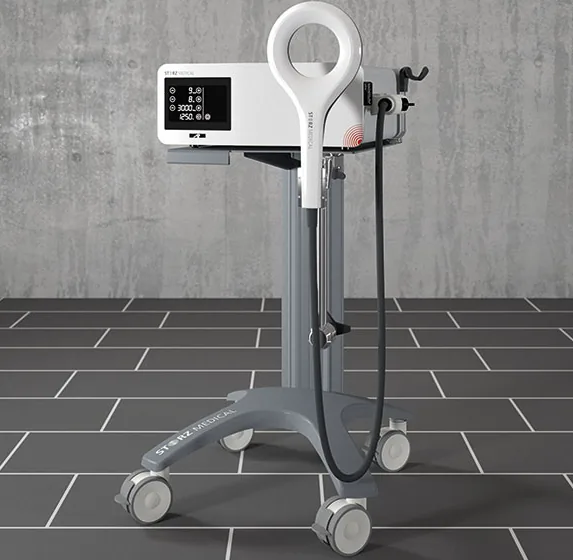
EMTT (extracorporeal magnetotransduction therapy) applies high-intensity, rapidly alternating magnetic field pulses to musculoskeletal tissue. It operates at a substantially higher field strength and frequency range than conventional pulsed electromagnetic field (PEMF) devices, with the aim of stimulating cellular processes involved in tissue repair.
In practice, EMTT is most often used as an adjunct to shockwave therapy rather than on its own. It is non-invasive and does not require needles or anaesthetic.
Because the evidence for EMTT is still developing, we are deliberately cautious about how we describe it. It may be a reasonable option as part of a broader plan for certain chronic conditions, but it is not a guaranteed or established treatment. Whether it is suitable for you is assessed at consultation, with a clear discussion of the current evidence, the expected benefits and the alternatives.
How it works
EMTT is often mentioned alongside shockwave therapy, but it works by an entirely different physical principle. Shockwave uses acoustic (sound) energy; EMTT is electromagnetic. The device generates a rapidly oscillating, high-intensity magnetic field — in the current clinical platform, in the order of tens of millitesla oscillating at high frequency — which, by induction, produces small electrical fields within the tissue.
The proposed biological idea is magnetotransduction: these induced fields are thought to influence cellular signalling and repair processes. The strongest laboratory support so far is in bone cells, where EMTT has been shown to increase bone-forming (osteoblast) gene activity and matrix mineralisation. It is important to be clear that these are evolving hypotheses — the mechanism is less settled than for shockwave, and the laboratory findings have not been translated into proof of benefit for nerve or many soft-tissue conditions.
What the evidence shows
Sources: EMTT for musculoskeletal disorders — double-blind, placebo-controlled RCT (J Back Musculoskelet Rehabil, 2025) , EMTT mechanism — osteoblast gene upregulation & matrix mineralisation in bone healing (Biomedicines, 2024)
What to expect
Conditions reviewed for this treatment
There are no available studies of this treatment in any condition we see. The mechanism is plausible and it is reasonable to offer on that basis, but plausibility is not evidence, and listing conditions here would imply an indication the published literature does not support. It may still be offered as an adjunct alongside treatment that does have evidence, once that gap has been explained — never as the plan on its own.
Frequently asked questions
Is EMTT a proven treatment?
How is EMTT different from shockwave therapy?
Does it hurt?
Is it covered by Medicare?
Ready for a clearer plan for your back or musculoskeletal pain?
Book an assessment with Dr Joshua Hatch.
Your assessment focuses on understanding the likely source of your pain and the most appropriate non-surgical options for your diagnosis, with the aim of reducing pain and improving function.
Book an appointment