Back Pain Doctor
PRP Injections Brisbane
Written by Dr Joshua Hatch, Musculoskeletal GP, RACGP Fellow, Diploma in Musculoskeletal Medicine (FSEM UK).
What it can help with
- Symptomatic knee osteoarthritis — the best-studied joint indication
- Persistent tennis elbow (lateral elbow tendinopathy)
- Selected chronic tendon conditions
- Selected plantar heel pain
- Selected nerve entrapment conditions
Suitability depends on your individual diagnosis and is assessed at consultation.
We provide two leading PRP treatment systems.
ACP Max™ Platelet-Rich Plasma System
Concentration of platelets and growth factors from platelet-rich plasma.
The ACP Max™ system uses a larger blood draw and a double-syringe, double-spin process to prepare PRP at the point of care. A processing system can change platelet, white-cell and plasma composition, but the brand of system alone does not predict a clinical result. The preparation chosen must still be matched to the diagnosis and discussed with you.
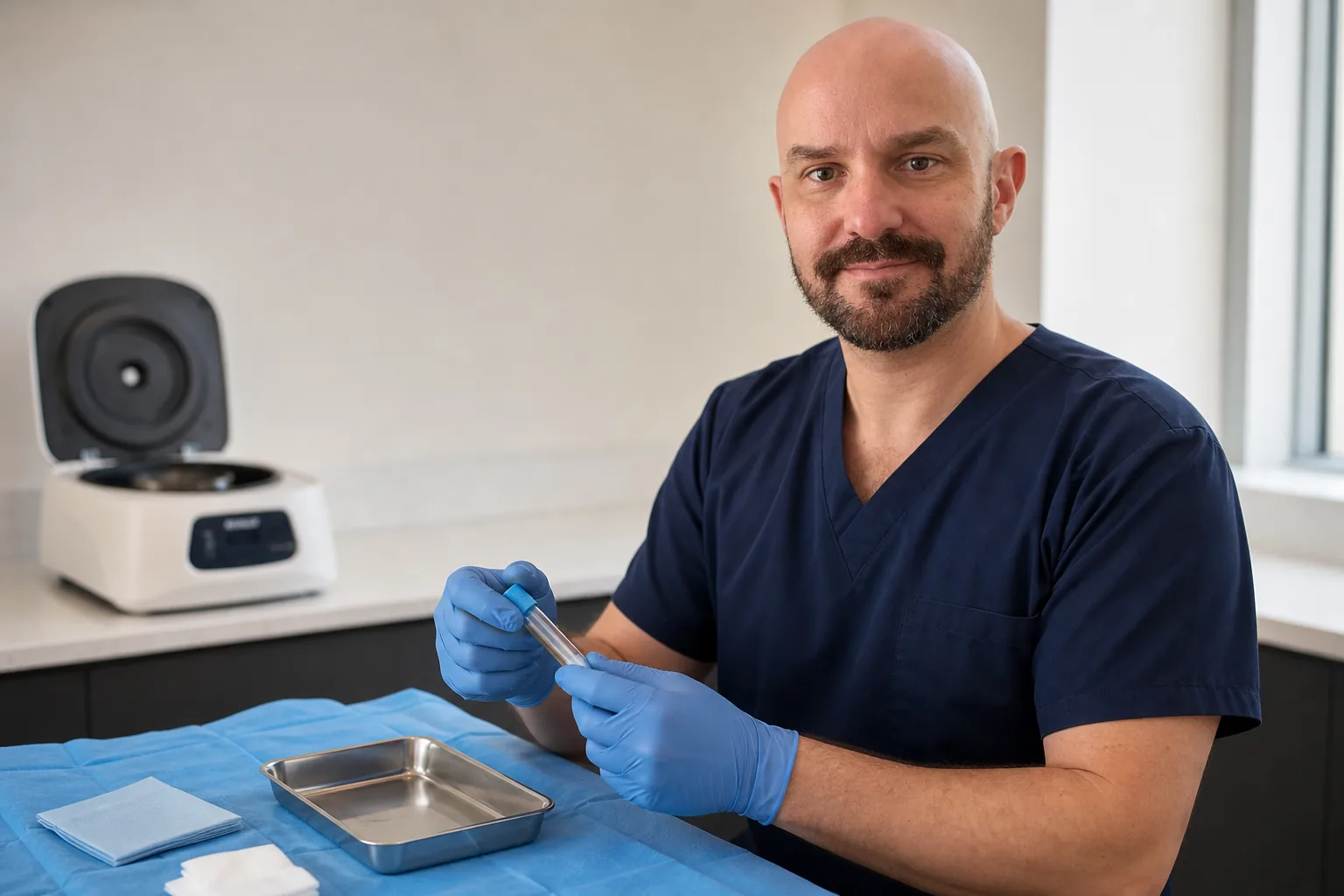
The Arthrex Angel PRP System
Processing higher blood volumes with an adjustable preparation.
The Arthrex Angel PRP System processes a larger blood volume and uses sensor-guided separation to produce an adjustable PRP preparation. This gives the clinician more control over cellular composition. Research has not established one ideal concentration for every condition, so customisation is a technical capability rather than a guarantee of a better outcome.
The short answer
Platelet-rich plasma, usually shortened to PRP, is an injection prepared from a sample of your own blood. The blood is separated in a centrifuge, a platelet-containing plasma fraction is collected, and that preparation is injected into a selected joint, tendon or other target.
PRP has been studied extensively, especially for knee osteoarthritis and several tendon conditions. The evidence is neither a simple success story nor a dismissal. Some trials and meta-analyses report meaningful improvements; credible placebo-controlled trials and guidelines remain cautious. Results differ by diagnosis, disease severity, comparator, PRP preparation and rehabilitation.
At Back Pain Doctor in Milton, Brisbane, PRP is considered after the diagnosis is established and first-line treatment has been given a genuine opportunity. It is not presented as a guaranteed way to regrow cartilage, repair a torn tendon or avoid every operation.
What is platelet-rich plasma?
Whole blood contains red blood cells, white blood cells, platelets and plasma. Platelets are best known for their role in clotting, but they also release proteins involved in cell signalling and normal tissue repair.
A PRP system separates blood into fractions and allows a clinician to collect plasma with a platelet concentration above the starting blood level. Depending on the system and settings, the preparation may contain different concentrations of:
- platelets;
- white blood cells;
- red blood cell contamination;
- plasma proteins; and
- total injected volume.
This is why PRP is not a single standardised medicine. Two products both called “PRP” can be biologically different.
PRP is autologous—but that does not make it risk-free
Autologous means the product comes from your own body. That removes some risks associated with donor tissue and means allergy to the platelet component is not expected. It does not eliminate risks from the needle, skin bacteria, local anaesthetic, equipment or treatment of the wrong target.
PRP is not a stem-cell injection
PRP is prepared from peripheral blood and concentrates platelets and plasma. It is not a stem-cell product. The terms should not be used interchangeably.
What is PRP intended to do?
The proposed aim is to alter the local biological environment around a symptomatic joint or tissue. Platelets release mediators involved in inflammation, vascular responses and tissue repair. Laboratory studies show effects on cartilage cells, tendon cells and inflammatory signalling.
Those findings provide a rationale for clinical trials, not proof of clinical regeneration. A person can improve because pain signalling, inflammation, rehabilitation confidence or tissue loading has changed without a scan showing new tissue. Conversely, a change in a laboratory biomarker may not produce a noticeable benefit.
The defensible patient-facing claim is that PRP may improve pain and function in selected conditions. Claims that it predictably rebuilds cartilage, heals all tendon tears or permanently reverses ageing are not supported.
Why PRP results vary between studies
Heterogeneity is the central issue in PRP research. Studies differ in:
- the diagnosis and severity treated;
- participant age and general health;
- whether PRP is leukocyte-poor or leukocyte-rich;
- platelet concentration and total platelet dose;
- blood volume processed;
- activation method;
- injection volume and number of injections;
- whether ultrasound guidance is used;
- whether local anaesthetic is mixed with the preparation;
- the comparator—saline, corticosteroid, hyaluronic acid, exercise or no injection;
- rehabilitation after injection; and
- follow-up duration.
These differences make it difficult to convert “PRP worked in this trial” into “any PRP works for this condition”. They also explain why guidelines can reach different conclusions from overlapping research.
Knee osteoarthritis: where PRP has been studied most
Knee osteoarthritis is the most researched musculoskeletal use of PRP. Many randomised trials compare PRP with saline, corticosteroid or hyaluronic acid. Numerous meta-analyses report improvements in pain and function, particularly over three to six months, and some comparisons favour PRP over corticosteroid or hyaluronic acid at later follow-up.
However, results are inconsistent. The Australian RESTORE randomised clinical trial compared three weekly leukocyte-poor PRP injections with saline in people with mild-to-moderate radiographic knee osteoarthritis. At 12 months, it found no statistically significant difference in pain and no benefit in medial tibial cartilage volume.
A 2025 meta-analysis limited to placebo-controlled trials included 11 randomised trials and 1,616 participants. It found average improvements in some pain and function measures at three to six months, but not at 12 months, with high heterogeneity. The authors judged the average efficacy weak and questioned its clinical relevance.
Other recent meta-analyses reach more favourable conclusions, especially when active comparators such as corticosteroid are included. This is not necessarily a contradiction: comparator choice, outcome measure, PRP formulation and follow-up can materially change the pooled result.
How major guidelines describe knee PRP
The American Academy of Orthopaedic Surgeons guideline says PRP may reduce pain and improve function in symptomatic knee osteoarthritis, but grades the recommendation as limited because of heterogeneous and mixed evidence.
The American College of Rheumatology/Arthritis Foundation guideline recommends against routine PRP in knee or hip osteoarthritis, emphasising poor standardisation of preparations and techniques.
NICE guidance reports no major safety concern but considers efficacy evidence limited in quality. It recommends special arrangements for governance, informed consent and outcome audit.
These positions matter. A balanced consent discussion should not cite positive meta-analyses while omitting credible trials or guidelines that are less certain.
Our interpretation for knee osteoarthritis
PRP can be reasonable to discuss when:
- symptoms remain limiting despite education, exercise and load management;
- weight management has been addressed where relevant;
- the diagnosis and pain source are reasonably clear;
- expectations are symptom and function improvement, not cartilage regrowth;
- the person understands the cost and uncertainty; and
- there is a plan to continue rehabilitation.
It is less compelling when arthritis is end-stage, severe deformity dominates, an urgent surgical opinion is needed or the person is being promised that PRP will restore the knee to normal.
Read our knee osteoarthritis guide for the full non-surgical pathway.
What about hip and shoulder osteoarthritis?
Evidence for knee osteoarthritis should not be transferred automatically to the hip or shoulder. The anatomy, disease behaviour and injection target differ.
Clinical evidence for intra-articular PRP in hip osteoarthritis is smaller and guidelines remain cautious. For shoulder osteoarthritis, there is not a comparable PRP trial base. Much of the shoulder PRP literature concerns the rotator cuff rather than the glenohumeral joint.
If someone has “hip arthritis” plus lateral hip pain, the symptomatic target may be the gluteal tendons rather than the joint. If someone has shoulder arthritis plus weakness and painful elevation, rotator cuff disease may also be present. The diagnosis needs to identify what is being treated instead of using the word arthritis as a broad justification for PRP.
Tennis elbow
Lateral elbow tendinopathy is one of the more frequently studied tendon uses. Some meta-analyses find corticosteroid gives greater early relief while PRP performs better at six months or later. Other reviews find no clear advantage once trials are pooled across different comparators and preparations.
A key practical point is that tennis elbow often improves with time, load modification and progressive strengthening. An injection should be considered only after reviewing whether the diagnosis is correct and whether rehabilitation has been appropriately dosed.
PRP may be discussed for persistent lateral elbow tendinopathy that remains functionally limiting. Alternatives include continued loading, focused shockwave therapy, prolotherapy and, less commonly, surgical review.
Rotator cuff tendinopathy and tears
“Rotator cuff pain” includes tendinopathy, bursitis, partial tears, full-thickness tears and pain driven by other shoulder structures. These are not interchangeable.
A systematic review of 33 ultrasound-guided PRP trials found no clear between-group benefit across rotator cuff and several other tendinopathies. Individual trials and other reviews sometimes report favourable outcomes, particularly in selected partial tears or specific protocols, but certainty remains uneven.
PRP cannot mechanically reattach a full-thickness tendon tear. A person with substantial weakness, trauma, acute loss of function or a tear that may benefit from repair needs an appropriate surgical opinion rather than a promise that an injection will close the gap.
For persistent non-operative rotator cuff pain, rehabilitation remains central. PRP may be discussed selectively after the diagnosis, prognosis and alternatives are clear.
Achilles, patellar, gluteal and hamstring tendinopathy
Tendons respond to site-specific loading and have different natural histories. PRP evidence in one tendon cannot be assumed to apply to all.
- Achilles tendinopathy: randomised trials and meta-analyses have not shown a consistent advantage over placebo. PRP also failed to improve recovery in a large trial of acute Achilles rupture, which is a different condition but a useful warning against broad healing claims.
- Patellar tendinopathy: evidence is mixed and protocol-dependent. A carefully progressed loading programme remains first-line.
- Gluteal tendinopathy: there are some favourable trials, but lateral hip pain needs to be distinguished from hip-joint osteoarthritis, referred spinal pain and other causes.
- Proximal hamstring tendinopathy: evidence is limited, and injections near the sciatic nerve require careful diagnosis and technique.
For these conditions, PRP is not presented as a routine first treatment. It may be considered after a genuine loading programme when symptoms remain limiting and the available evidence has been discussed honestly.
Plantar heel pain
Plantar heel pain may involve the plantar fascia, but diagnosis also considers nerve irritation, heel-fat-pad pain, stress injury and referred symptoms.
PRP trials compare the treatment with corticosteroid, saline, dextrose prolotherapy and shockwave. Some reviews report better medium-term outcomes than corticosteroid; others find no clear between-group difference. Protocol variation is substantial.
The practical sequence is to confirm the diagnosis, address load, calf and foot capacity, footwear and relevant health factors, then discuss adjuncts if progress stalls. PRP is one possible injection option, while shockwave therapy provides a non-injection alternative with its own evidence base.
PRP for nerve conditions
PRP has been studied in carpal tunnel syndrome and a small number of other nerve presentations. Some trials report improvements in pain or symptom scores, but evidence certainty is low and preparation methods differ.
Nerve pain requires diagnostic precision. Carpal tunnel syndrome, cervical radiculopathy, ulnar neuropathy and superficial sensory-nerve irritation are different problems. An encouraging trial at the wrist does not justify PRP for every painful or compressed nerve.
The alternatives may include activity modification, splinting, rehabilitation, medication, corticosteroid injection, dextrose perineural injection or hydrodissection, and surgery when there is significant or progressive nerve compromise.
How PRP is prepared
The broad preparation sequence is:
- blood is collected into a sterile tube or syringe containing the required anticoagulant;
- the sample is placed in a centrifuge;
- spinning separates components according to density;
- the desired platelet-containing plasma fraction is collected; and
- the final preparation is injected promptly using sterile technique.
Some systems use one spin and others two. Some process a small sample; others process a larger blood volume. Some are designed to reduce white cells, while others allow adjustment.
The technical sophistication of a machine should not be confused with proof of a better patient outcome. The relevant questions are what preparation is being produced, why it suits the target and what evidence supports that choice.
ACP Max and Arthrex Angel at our Brisbane clinic
We use two PRP preparation systems because a single fixed product does not suit every clinical question.
The ACP Max system uses a larger blood draw than simpler small-volume systems and a double-spin process. The Arthrex Angel system processes a larger volume and uses optical sensing to allow adjustment of the cellular composition.
These capabilities allow preparation choices. They do not guarantee that a higher platelet number or a particular white-cell concentration will improve every condition. Research into dose and composition is evolving, and findings from one diagnosis may not transfer to another.
Why ultrasound guidance is usually used
Ultrasound allows the clinician to visualise the target, surrounding anatomy and needle path in real time. It is especially useful for deeper joints, tendon defects and areas close to nerves or vessels.
Where the target is one ultrasound cannot reach safely or reliably — too deep, behind bone, or immediately alongside structures that have to be avoided with certainty — the injection is referred to a radiologist to perform under CT guidance rather than approximated here.
Guidance improves confidence that the selected structure was reached. It does not solve uncertainty about whether PRP is effective for that condition. Accurate delivery and treatment efficacy are separate questions, and both need to be addressed.
Assessment before PRP
The consultation should establish:
- the most likely diagnosis;
- whether symptoms match imaging findings;
- what first-line treatment has been tried;
- whether an injection could realistically change function;
- relevant medications and health conditions;
- the safest target and approach;
- alternatives, including no injection; and
- measurable goals for review.
Old imaging may be reviewed, and new imaging is requested only when it is likely to change management. Ultrasound findings are interpreted alongside symptoms and examination rather than treated as a diagnosis by themselves.
What happens on treatment day?
A typical PRP procedure includes:
- reviewing consent, medications and any health changes;
- collecting the required blood volume;
- processing the sample in the selected system;
- positioning and cleaning the treatment area;
- identifying the target with ultrasound;
- inserting the needle and delivering the PRP; and
- providing aftercare and rehabilitation instructions.
The blood draw and processing add time compared with a conventional injection. The injection itself may feel like pressure or aching, particularly when a tendon or confined joint is treated.
Local anaesthetic and other additives
Local anaesthetic can improve comfort but may also alter the local biological environment. Practice varies between trials and clinicians. Sometimes anaesthetic is used in the skin or along the approach rather than mixed directly with PRP.
The exact plan depends on the target and tolerance. You should be told what is being injected—not simply that you are receiving “PRP”.
What recovery is like
Local soreness, stiffness, bruising and a temporary increase in familiar pain are common over the first several days. The response varies by target and injection volume.
Most people can perform light daily activity, but driving, work and exercise plans depend on the body region and symptoms. High-impact or provocative loading is commonly reduced briefly. Rehabilitation then progresses rather than stopping for a prolonged period.
Contact the clinic promptly for escalating pain, increasing redness or warmth, fever, marked swelling, new weakness or numbness, or another unexpected change.
When might PRP start to help?
PRP is not designed to give immediate relief. Any local anaesthetic effect is temporary and does not predict the longer-term outcome.
If benefit occurs, it is usually assessed over weeks to months. Review should include function—walking, stairs, work, sleep, grip, training or another agreed goal—not pain alone.
There is no justification for repeating injections indefinitely. The diagnosis and plan should be reconsidered when meaningful progress is absent.
How many injections?
Research protocols include both one injection and short series. Knee osteoarthritis studies commonly use one to three injections; tendon studies often use one, but this is not universal.
More injections are not automatically better. The proposed course should have a clinical rationale, an expected time frame and a review point. Costs should be clear before treatment begins.
Risks and adverse effects
Common short-term effects include:
- discomfort during the blood draw or injection;
- bruising;
- local soreness and stiffness;
- temporary swelling; and
- a short flare in pain.
Uncommon but important risks include infection, bleeding, injury to a nerve or vessel, vasovagal fainting, unintended injury to another structure and persistent worsening of pain. Blood collection can be difficult in some people and may occasionally need to be abandoned.
Trials generally report few serious adverse events, but sample sizes are not large enough to rule out every rare complication.
Who may not be suitable?
Suitability is individual. Reasons to postpone or avoid PRP can include active infection, significant current illness, some blood or platelet disorders, severe anaemia, unsafe bleeding risk, certain cancers or immune conditions, pregnancy-related considerations, or a target that cannot be approached safely.
Tell us about anticoagulants, antiplatelet drugs, anti-inflammatory medicines, supplements that affect bleeding, allergies and previous reactions. Do not stop prescribed medication without medical advice. The risk of stopping a drug may be greater than any theoretical effect it has on PRP.
PRP and anti-inflammatory medicines
Some clinicians recommend avoiding non-steroidal anti-inflammatory drugs around PRP because platelet and inflammatory pathways are part of the proposed mechanism. Direct clinical evidence defining the ideal medication window is limited, and advice varies.
Medication decisions must account for why the medicine was prescribed, bleeding risk and alternatives. We provide individual instructions rather than a blanket rule copied from a generic handout.
PRP compared with corticosteroid
Corticosteroid can provide relatively fast relief in selected inflammatory or irritable conditions. In some tendon and knee studies, that early advantage diminishes and PRP performs better at later follow-up. Other high-quality studies do not find a meaningful PRP benefit.
Corticosteroid has condition-specific risks, particularly when repeated around certain tendons. PRP is more expensive, slower and less standardised. The correct choice depends on diagnosis, desired time frame, prior treatment and risk—not on labelling one injection “natural” and the other “bad”.
PRP compared with hyaluronic acid
Hyaluronic acid is an intra-articular product used mainly for osteoarthritis. Some meta-analyses favour PRP over hyaluronic acid for knee pain and function, while guideline recommendations vary for both treatments.
Neither has been proven to rebuild a normal joint. Availability, cost, disease severity and evidence for the individual patient all matter.
PRP compared with prolotherapy
Prolotherapy usually uses dextrose and is simpler and less expensive to prepare. PRP is autologous and composition varies with the system. Head-to-head evidence exists in some knee and tendon conditions but does not identify one universal winner.
If both are plausible, the discussion should compare the specific evidence, cost, number of procedures and patient preference. Sometimes the best decision is to continue rehabilitation or choose a non-injection option.
PRP compared with shockwave
Shockwave therapy is non-invasive and particularly well studied for several persistent tendinopathies. PRP uses a needle and biological preparation. Comparative trials vary by body region and follow-up.
Shockwave may suit someone who wants to avoid an injection or has a tendon indication with stronger shockwave evidence. PRP may be discussed where the diagnosis and research make it reasonable. Neither should replace progressive loading.
Questions to ask before paying for PRP
- What exact diagnosis is being treated?
- What structure will be injected?
- What evidence exists for that diagnosis, not just for PRP generally?
- What PRP system and preparation will be used?
- Will the injection be ultrasound guided?
- What are the alternatives and their costs?
- How many injections are proposed, and why?
- What result should be visible before another injection is considered?
- What rehabilitation will continue?
- What happens if it does not work?
Be cautious when the answer relies mainly on testimonials, before-and-after imaging without a control group, or a guarantee of regeneration.
PRP in Brisbane: our approach
Dr Joshua Hatch provides musculoskeletal assessment and ultrasound-guided injections at Back Pain Doctor in Milton. The first objective is to determine the diagnosis and whether a procedure is likely to add value.
When PRP is reasonable, we discuss the evidence supporting it, credible evidence that is less favourable, the preparation system, likely course, recovery, cost and alternatives. If the evidence is weak for your condition, that is stated plainly. If another treatment is more appropriate, that is the recommendation.
You can book an assessment, review our fees, or read about other non-surgical treatments.
Evidence summary
- PRP has the largest joint evidence base in knee osteoarthritis.
- Average short- to medium-term benefits are reported in many reviews, but placebo-controlled results are inconsistent and benefit is not reliably sustained at 12 months.
- Major guidelines disagree and all emphasise evidence limitations or heterogeneity.
- Tendon evidence varies by site; results should not be generalised from one tendon to another.
- PRP has not been proven to regrow normal cartilage or mechanically repair a tear.
- Preparation, diagnosis, guidance and rehabilitation all matter, but no machine brand guarantees success.
- A planned, measurable trial in a selected patient is different from selling PRP as a cure.
That evidence supports shared decision-making—not certainty.
What the evidence shows
Sources: PRP versus placebo for knee osteoarthritis — systematic review and meta-analysis of 11 RCTs (2025) , RESTORE trial — PRP versus placebo for knee osteoarthritis (JAMA, 2021) , AAOS knee osteoarthritis clinical practice guideline — limited recommendation for PRP (2021) , NICE guidance — PRP for knee osteoarthritis (2019, next review listed for 2026) , Ultrasound-guided PRP for tendinopathy — systematic review of 33 RCTs (2022) , AAPM&R guidance statement on PRP for knee osteoarthritis (2026)
What to expect
Conditions reviewed for this treatment
The evidence for a treatment can be different for every diagnosis. The conditions below reach a discussable level in our diagnosis-specific review. This is not a recommendation for you; suitability still depends on your diagnosis, what has already been tried, and the benefits, risks, costs and alternatives.
- Knee Osteoarthritis Evidence position for this diagnosis: Good support
- Patellar Tendinopathy Evidence position for this diagnosis: Good support
- Tennis & Golfer's Elbow Evidence position for this diagnosis: Good support
- Ankle Osteoarthritis (Ankle Arthritis) Evidence position for this diagnosis: Worth discussing
- Arthritis: An Overview Evidence position for this diagnosis: Worth discussing
- Baker's Cyst (Popliteal Cyst) Evidence position for this diagnosis: Worth discussing
- Carpal Tunnel Syndrome Evidence position for this diagnosis: Worth discussing
- Cervical Radiculopathy Evidence position for this diagnosis: Worth discussing
- Cervical Spondylosis (Neck Arthritis) Evidence position for this diagnosis: Worth discussing
- De Quervain Tenosynovitis Evidence position for this diagnosis: Worth discussing
- Frozen Shoulder Evidence position for this diagnosis: Worth discussing
- Iliotibial (IT) Band Syndrome Evidence position for this diagnosis: Worth discussing
- Low Back Pain Evidence position for this diagnosis: Worth discussing
- Lumbar Facet Joint Pain Evidence position for this diagnosis: Worth discussing
- Meniscus-Related Knee Pain Evidence position for this diagnosis: Worth discussing
- Neck Pain Evidence position for this diagnosis: Worth discussing
- Patellofemoral Arthritis Evidence position for this diagnosis: Worth discussing
- Pes Anserine Bursitis Evidence position for this diagnosis: Worth discussing
Related articles
Shorter articles that answer the questions patients ask most often about this.
- Cortisone vs PRP for Knee Osteoarthritis: What the Evidence SaysHow cortisone and PRP injections compare for knee osteoarthritis: what each does, what the evidence shows, and where injections fit alongside exercise.
- PRP Injections: What to Do Before and After TreatmentPlatelet-rich plasma injections require preparation and realistic aftercare. Learn what patients are commonly asked to consider.
- Why Tendon Pain Usually Needs Loading, Not Complete RestTendinopathy often improves with the right loading plan. Learn why complete rest can backfire and how gradual strengthening fits into recovery.
Frequently asked questions
What is a PRP injection?
Does PRP regrow knee cartilage?
How many PRP injections will I need?
Is PRP better than cortisone?
Is PRP covered by Medicare?
Is PRP a stem-cell treatment?
Can I exercise after PRP?
Ready for a clearer plan for your back or musculoskeletal pain?
Book an assessment with Dr Joshua Hatch.
Your assessment focuses on understanding the likely source of your pain and the most appropriate non-surgical options for your diagnosis, with the aim of reducing pain and improving function.
Book an appointment