Back Pain Doctor
Baker's Cyst (Popliteal Cyst)
Written by Dr Joshua Hatch, Musculoskeletal GP, RACGP Fellow, Diploma in Musculoskeletal Medicine (FSEM UK).
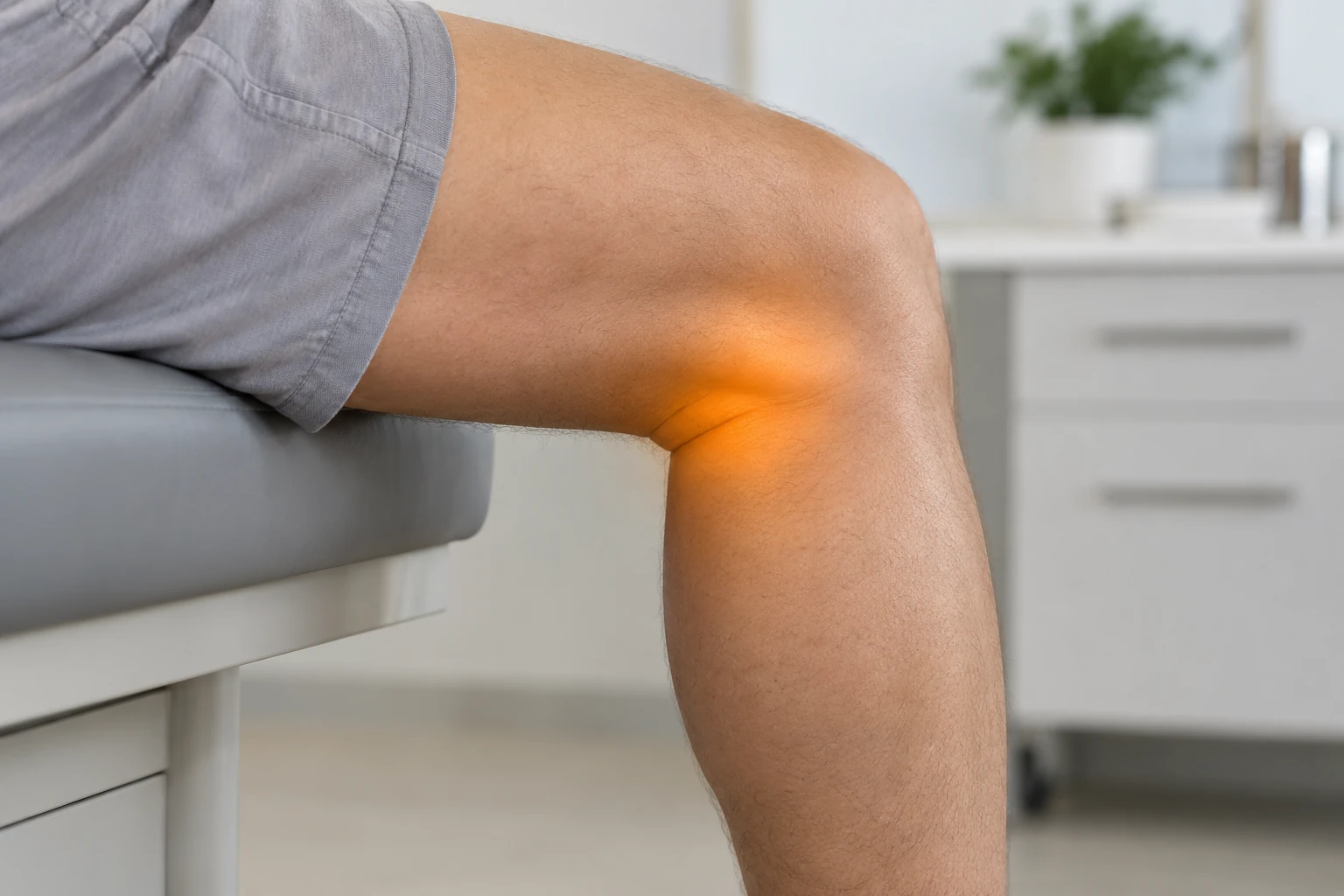
The knee makes a small amount of lubricating fluid. When it makes more than usual because of arthritis or a torn meniscus, the fluid can be pushed out through a narrow channel into a small sac behind the knee, between the calf muscle and the hamstring tendon. That swelling is a Baker’s cyst. Many people have one without symptoms, and it is often found by chance on a scan.
Assessment starts by confirming the lump is a cyst, usually with an ultrasound, and by checking that nothing more serious is going on. A swollen, painful calf needs an ultrasound for a clot the same day. A firm, growing or unusual lump behind the knee is imaged properly rather than assumed to be a cyst, because rare solid tumours can look similar. The next question is why the knee is producing the fluid, which a knee examination and an x-ray, and sometimes an MRI, usually answer.
Treatment follows the cause. For most people that is exercise-based care for the knee, attention to weight and activity, and simple pain relief, with an injection into the knee joint where it is appropriate. For a painful cyst, ultrasound-guided drainage with a steroid injection is an option, with the honest caveat that it often returns if the knee stays irritated. Keyhole surgery is reserved for cysts that stay troublesome or where a meniscal tear needs repair anyway.
Common symptoms
- A soft lump or fullness behind the knee
- Tightness at the back of the knee on full straightening or deep bending
- Aching or swelling that can extend into the calf
- Knee pain or swelling from the underlying joint problem
Evidence for twelve treatment options in baker's cyst (popliteal cyst)
This is not a fixed ladder or a package of treatments. Every option is assessed independently against this diagnosis, including treatments with limited direct research that may still be reasonable for a clearly defined tissue target. The evidence level, likely benefit, risks, cost and alternatives are weighed at consultation.
Foundation — diagnosis, education and rehabilitation
The part of care with the broadest relevance. For many people it is enough on its own; other options are judged against it, not automatically added after it.
Diagnosis, education and progressive rehabilitation Working out what is driving the pain, explaining what your imaging does and does not mean, and building a graded loading plan you can actually follow. First line, aimed at the knee
What it involves
Assessment to identify the likely pain source, an explanation of what the diagnosis means, adjustment of the loads that aggravate it, and a progressive strength and conditioning plan — with weight management where that is clinically relevant.
What the evidence shows
Standard references list rest, anti-inflammatory medicines, physiotherapy and steroid injection as the non-operative options, and treat the cyst as a marker of underlying knee disease such as osteoarthritis or a meniscal tear (StatPearls, Baker Cyst 2023; Zmerly, Cureus 2026). No randomised trial of an exercise programme for Baker's cyst itself was found, so this rests on treating the knee condition behind it. In an observational study of 130 people with knee osteoarthritis, 33 of them with a cyst, those with a cyst did worse at the start and had lost their three-month gain by six months, while those without a cyst held theirs (Abate, Med Princ Pract 2021).
Pairing reviewed 2026-10-04.
Where it fits for you
Where I start: a proper knee examination and weight-bearing x-ray to find out why the knee is making fluid, then progressive strengthening, load pacing and weight advice. A knee with a cyst is followed up more closely, because the early gain can fade.
Muscle and symptom-modifying options
Useful only when the examination identifies the tissue they target or when short-term pain control creates a useful rehabilitation window.
Wet needling and trigger point injection (trigger point injection) A fine needle into a tender band of muscle, with a small volume of dilute glucose solution injected through it. Only if relevant
What it involves
The needle is placed into the tender muscle band and a small volume of 5% glucose with 0.02-0.08% lignocaine is injected. Often done in the same visit as your assessment, and usable where the tender area sits deeper. Dry needling — the same technique with nothing injected — is not offered here.
What the evidence shows
Searches pairing popliteal or Baker's cyst with dry needling, trigger point treatment and needling returned no study treating the cyst or the knee problem with needling; the hits were case reports and MRI studies that matched only on other words.
Pairing reviewed 2026-10-04.
Where it fits for you
Only where a separate tender band in the hamstring or calf is adding to the pain. A needle does not shrink the cyst or treat the knee behind it.
Ultrasound-guided injections Guidance means we can see the needle reach the target. What goes into the needle depends on the diagnosis. Short-term relief, cysts can return
What it involves
The injection is performed under ultrasound so the needle can be watched into the target structure. What is injected is decided by the diagnosis — and corticosteroid is used sparingly, for the reasons set out below.
What the evidence shows
In a randomised trial of 60 people with knee osteoarthritis and a Baker's cyst, groups given ultrasound-guided aspiration and steroid held lower pain at four weeks than before treatment, with the combination of injection and a physical therapy device doing best, but the maximum axial area of the cyst on the scan did not change in any group, although its sagittal area changed over time (Di Sante, Eur J Phys Rehabil Med 2012). Of 47 people followed after ultrasound-guided aspiration, fenestration and steroid, the average WOMAC score improved from 48.6 to 17.2 and 12.7 per cent needed re-aspiration (Smith, Sports Health 2015); in 32 people followed for six months, all six cysts that returned were the complex type (Koroglu, Eur J Radiol 2012). A systematic review of 30 studies calls intracystic steroid with fenestration effective but rests on low-level evidence (Van Nest, JBJS Rev 2020). No sham-controlled trial, and no trial of ultrasound versus landmark guidance for this cyst, was found.
Pairing reviewed 2026-10-04.
Where it fits for you
Considered for a large or painful cyst that is limiting bending, always under ultrasound because the cyst sits beside the main nerve and vessels of the knee. Relief is often short-lived if the knee behind it stays irritated, so it is paired with treatment of the knee.
V-ACTOR vibration therapy (vibration therapy) Low-frequency vibration applied over tender muscle. Not a shockwave, despite sharing the machine. Only if relevant
What it involves
A vibration handpiece is moved over the tender muscle and fascia for a few minutes. It runs from the same STORZ MASTERPULS icon console as radial shockwave but is a separate handpiece delivering a different, gentler form of energy. No needles, no anaesthetic, no downtime.
What the evidence shows
A combined search for vibration therapy with popliteal and Baker's cyst terms returned no study treating this condition.
Pairing reviewed 2026-10-04.
Where it fits for you
A comfort adjunct at most for tight hamstring or calf muscle guarding around a sore knee. It does nothing for the cyst or the joint fluid behind it.
Energy-based treatment options
Radial pressure wave, focused shockwave and EMTT have different targets and different evidence. They are assessed separately rather than treated as one category.
Radial or focused shockwave? Read the overviewRadial shockwave (radial pressure wave) Broad treatment across tender muscle and fascia, close to the surface. Not established
What it involves
A handpiece is moved over the tender tissue while ballistic pressure pulses are delivered, using a transmitter head chosen for the tissue — including heads shaped for fascia and for the muscle either side of the spine. The pulse is strongest at the skin and weakens with depth, so this is mainly a myofascial treatment, though it can reach deeper in some areas. No anaesthetic, no downtime, usually a course of sessions about a week apart.
What the evidence shows
A search pairing popliteal and Baker's cyst with shockwave and extracorporeal terms returned no study of shockwave for this condition. This is untested rather than tested and negative, and there is no recognised mechanism by which shockwave would empty a fluid-filled cyst.
Pairing reviewed 2026-10-04.
Where it fits for you
Not offered for this condition.
Focused shockwave (ESWT) A true shock wave converging at depth — for tendon, joint, ligament and bone. Not established
What it involves
A focused system generates an acoustic shock wave that converges at a focal point set at a defined depth, concentrating the energy where the target is. This is the form we use for tendon, joint, ligament and bone. Typically four to six sessions about a week apart, no anaesthetic and no formal downtime.
What the evidence shows
The same search returned no study of focused shockwave for Baker's cyst. It is untested, and a fluid collection fed by the knee joint is not a tendon or bony target.
Pairing reviewed 2026-10-04.
Where it fits for you
Not offered for the cyst. A coexisting tendon problem would be assessed and treated on its own merits.
EMTT (magnetotransduction therapy) High-energy magnetic pulses applied over the area. Painless, no contact. Not established
What it involves
You sit with the applicator positioned over the area for a short session. Painless, no gel or contact required, and usually delivered as a course — commonly alongside shockwave.
What the evidence shows
Searches for electromagnetic and magnetic therapy with popliteal and Baker's cyst terms returned no study treating this condition; the hits were MRI papers matching on the word magnetic.
Pairing reviewed 2026-10-04.
Where it fits for you
Not part of managing this condition.
Biologic and joint injection options
Each injection is assessed independently for the named diagnosis. Cost, uncertainty, likely benefit, risks and alternatives are part of the decision.
Platelet-rich plasma (PRP) Your own blood, concentrated and injected under ultrasound guidance. One small trial
What it involves
Blood is taken from your arm, spun to concentrate the platelets, and injected into the target under ultrasound guidance in the same appointment.
What the evidence shows
A randomised trial of 36 people with grade 1 to 3 knee osteoarthritis and a Baker's cyst found that aspiration followed by PRP injected into the cyst gave more pain relief and better WOMAC scores at 12 weeks than aspiration alone, with a similar change in cyst size (Akarsu, Am J Phys Med Rehabil 2026). It is a single small trial with 12 weeks of follow-up and no sham injection. Other reports are individual cases, including a PRP injection into the knee that was followed by resolution of the cyst (Song, Regen Med 2020).
Pairing reviewed 2026-10-04.
Where it fits for you
Can be discussed where the cyst keeps returning in a knee with osteoarthritis, as an option with a thin evidence base and honest limits rather than an expected result. Effect sizes you should expect are those of the trial, not of case reports.
Prolotherapy (dextrose) A course of dextrose injections into and around the structure and its attachments. Plausible — no studies
What it involves
Hypertonic dextrose is injected at the tender ligament and tendon attachments, and into the joint where relevant, usually as a series of treatments a few weeks apart.
What the evidence shows
No trial has tested prolotherapy for a Baker's cyst. The published reports are single cases of dextrose, with or without a sclerosing agent, injected into the knee joint after drainage, in which the cyst resolved (Yavuz, J Clin Diagn Res 2016; Centeno, Pain Physician 2008), and a large calf cyst that recurred after two 25 per cent dextrose injections and after doxycycline (Hassid, Am J Phys Med Rehabil 2023).
Pairing reviewed 2026-10-04.
Where it fits for you
Not offered for the cyst on current evidence. Dextrose injection aimed at an arthritic knee or a lax knee ligament is a separate question about the knee.
Viscosupplementation (hyaluronic acid) A gel-like injection into an arthritic joint. Widely used, and genuinely contested. For the knee arthritis, not the cyst
What it involves
One or a short series of hyaluronic acid injections into the joint under ultrasound guidance.
What the evidence shows
No trial has tested hyaluronic acid for the cyst. In an observational study of 130 people with knee osteoarthritis, 33 of them with a Baker's cyst, fluid withdrawal and injections of hyaluronic acid and/or steroid improved scores at three months, but the gain had declined by six months in the people with a cyst (Abate, Med Princ Pract 2021). Any benefit belongs to the knee osteoarthritis evidence, which is assessed on its own page.
Pairing reviewed 2026-10-04.
Where it fits for you
Discussed only where the knee has established osteoarthritis that would justify it anyway, not as a treatment for the cyst.
Nerve-targeted options
Relevant when examination identifies a superficial neuropathic pattern or a compressed peripheral nerve—not simply because pain is present.
Lyftogt perineural therapy (perineural injection therapy) A series of small dilute dextrose injections just under the skin, over tender superficial nerves. Only if relevant
What it involves
Small injections of low-concentration dextrose, usually 5%, placed just beneath the skin along tender superficial nerves. Given as a series of short sessions.
What the evidence shows
Searches combining popliteal and Baker's cyst with nerve block, tibial nerve and perineural terms found no study treating this condition. The cyst lies next to the tibial nerve and popliteal vessels, and large cysts can occasionally compress them (Radiopaedia, Baker cyst).
Pairing reviewed 2026-10-04.
Where it fits for you
Considered only if examination finds a separate skin or nerve pain pattern around the knee. It is not treatment of the cyst.
Ultrasound-guided nerve hydrodissection Fluid placed around a nerve to free it from the surrounding tissue. Only if relevant
What it involves
Under ultrasound, fluid is placed in the plane around the nerve to separate it from the tissue that is tethering or compressing it.
What the evidence shows
No study of hydrodissection for Baker's cyst was found in searches pairing the technique with popliteal and Baker's cyst terms. The space behind the knee holds the tibial nerve and popliteal artery and vein, and the cyst is a fluid collection rather than a nerve entrapment.
Pairing reviewed 2026-10-04.
Where it fits for you
Not used for the cyst. Considered only where a nerve behind the knee is separately irritated, and then only under ultrasound.
This is general information only and suitability is assessed individually. Treatments with limited or condition-dependent evidence may still be discussed, but only with clear explanation of the uncertainty, the expected benefit, risks, cost and alternatives. Red flags, progressive neurological symptoms or suspected serious pathology require a different pathway.
Every treatment above is described in full on the non-surgical treatments page, including what each one is used for and what the evidence supports. Ratings apply to the named diagnosis; an adjacent muscle, tendon, joint or nerve problem is assessed as a separate target. The method behind the ratings, and the treatments we do not offer, are set out on the evidence page.
Corticosteroid injection is reviewed separately for each diagnosis.
Cortisone reliably reduces pain in the short term, and that can be genuinely useful when pain is stopping you sleeping or moving enough to rehabilitate. Beyond that window the picture changes. A systematic review of 41 randomised trials and 2,672 participants found that corticosteroid injection reduced pain in the short term but that the effect reversed at intermediate and long term; in pooled analysis for lateral epicondylalgia the short-term effect was large (SMD 1.44, 95% CI 1.17 to 1.71) while no intervention was favoured at 26 weeks (-0.40, -0.67 to -0.14) and at 52 weeks (-0.31, -0.61 to -0.01) (Coombes, Lancet 2010). In a randomised trial in lateral epicondylalgia, 83 per cent of the corticosteroid group had completely recovered or much improved at one year against 96 per cent given a placebo injection, and recurrence ran at 54 per cent against 12 per cent; adding physiotherapy made no significant difference at one year (Coombes, JAMA 2013). In joints, repeated corticosteroid injections have been associated with cartilage loss. It does not repair anything.
So we do not build treatment plans around it. Where an injection is the right call, we review the specific diagnosis and target, discuss what is being injected and why, keep the number low, and pair it with the loading work that changes the longer-term course.
When we would still consider it
- Pain severe enough to block rehabilitation
- A clear inflammatory or bursal target on imaging
- A specific short-term goal — a trip, a procedure, a return to work
- Diagnostic use, where the response tells us where the pain is coming from
When a cortisone injection is worth doing, and when it is not
Other knee conditions
Pain in the same area can come from more than one source, and the label matters less than what the examination and history point to. These are the other guides for this region.
Related articles
Shorter articles that answer the questions patients ask most often about this.
Frequently asked questions
Is a Baker's cyst dangerous?
Do I need to have the cyst drained?
Will it go away on its own?
Ready for a clearer plan for your back or musculoskeletal pain?
Book an assessment with Dr Joshua Hatch.
Your assessment focuses on understanding the likely source of your pain and the most appropriate non-surgical options for your diagnosis, with the aim of reducing pain and improving function.
Book an appointment