Back Pain Doctor
Thoracic Spine Pain (Mid-Back Pain)
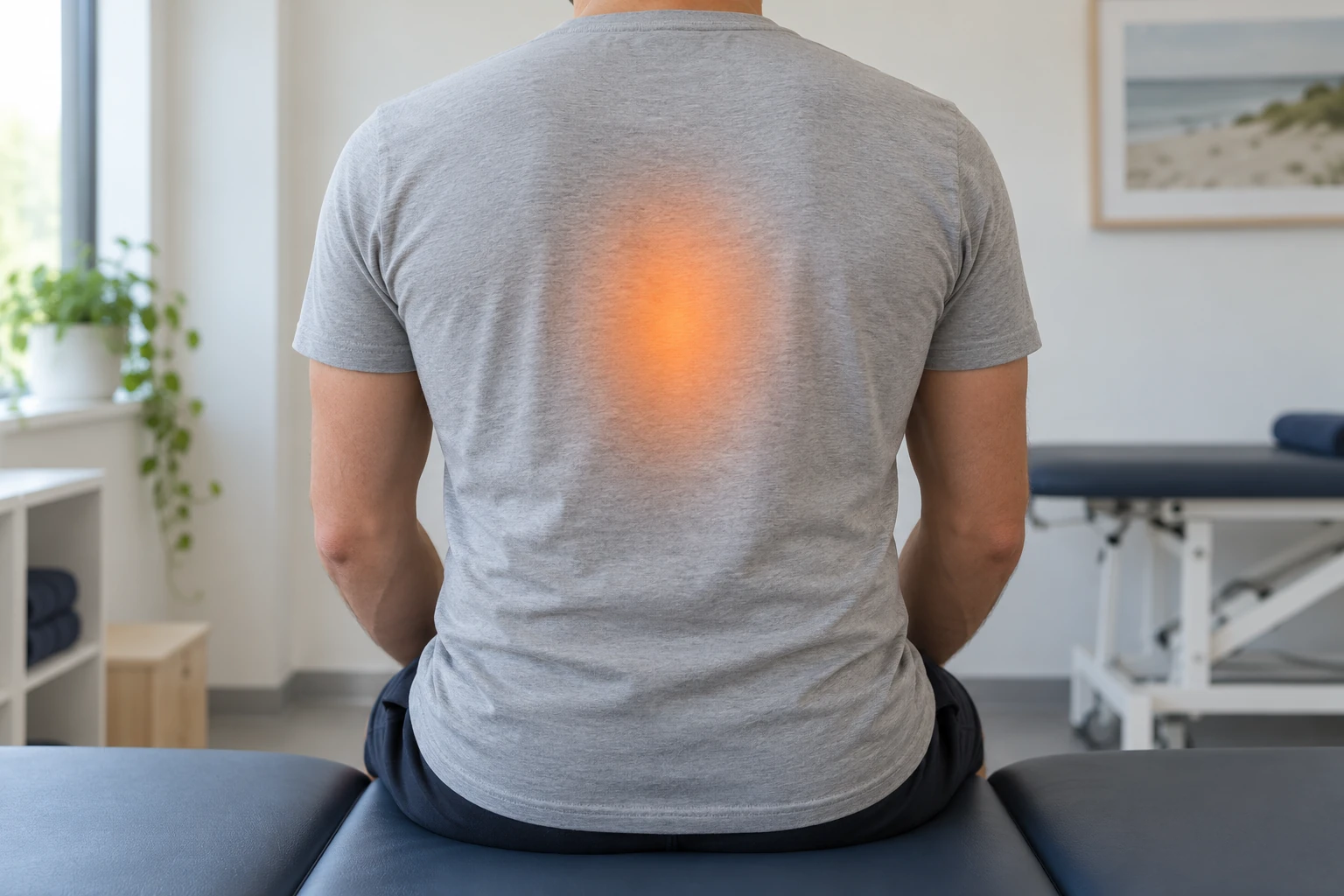
Written by Dr Joshua Hatch, Musculoskeletal GP, RACGP Fellow, Diploma in Musculoskeletal Medicine (FSEM UK).
The thoracic spine is the part of the back where the ribs attach. Twelve vertebrae each connect to a pair of ribs, which makes the region more stable than the neck or lower back and also means that breathing, coughing and twisting can all reach it. Pain here is less common than low back or neck pain, but it is not rare. Population studies put one-year prevalence at roughly one in six to one in four adults, depending on how it is defined.
Assessment focuses on working out where the pain is coming from, which is usually muscles, joints and ligaments of the back and rib cage, and on screening for the less common causes that matter more. The region sits beside the heart, lungs and aorta, and the spinal cord is closest to the bone here, so chest symptoms, fever, unexplained weight loss, night pain, a past history of cancer, a fall in an older person, or any change in leg strength or bladder and bowel control need prompt review. Imaging is used selectively.
The research on treating thoracic spine pain is thin, thinner than for the neck or lower back, and I would rather say so than imply otherwise. First-line care is education, staying active, physiotherapy-based exercise and manual therapy, and short-term pain relief where it suits. For pain that persists, a facet-joint injection or a nerve block may be considered when the examination points to a particular source, and some of the other options are discussed case by case, with the evidence and its gaps explained.
Common symptoms
- A dull ache or sharp pain in the middle of the back, often between the shoulder blades
- Stiffness after sitting for long periods or on waking
- Pain that is worse with twisting, reaching, lifting or deep breathing
- Pain that wraps around the rib cage, sometimes on one side only
Evidence for twelve treatment options in thoracic spine pain (mid-back pain)
This is not a fixed ladder or a package of treatments. Every option is assessed independently against this diagnosis, including treatments with limited direct research that may still be reasonable for a clearly defined tissue target. The evidence level, likely benefit, risks, cost and alternatives are weighed at consultation.
Foundation — diagnosis, education and rehabilitation
The part of care with the broadest relevance. For many people it is enough on its own; other options are judged against it, not automatically added after it.
Diagnosis, education and progressive rehabilitation Working out what is driving the pain, explaining what your imaging does and does not mean, and building a graded loading plan you can actually follow. Thin thoracic evidence
What it involves
Assessment to identify the likely pain source, an explanation of what the diagnosis means, adjustment of the loads that aggravate it, and a progressive strength and conditioning plan — with weight management where that is clinically relevant.
What the evidence shows
No clinical guideline is written for thoracic spine pain alone, and the trials are small. In 100 adults with thoracic spinal pain, adding manipulation to strengthening exercise gave about 1 point less pain (out of 10) than exercise alone at the end of eight sessions, with no difference at 12 weeks (Waqas, Biomed Res Int 2023, open-label). In 34 people, real and placebo mobilisation both eased pain straight away (Pecos-Martin, Physiotherapy 2016), and a pilot of 30 found manipulation beat sham ultrasound after six sessions (Schiller, J Manipulative Physiol Ther 2001). None tested exercise alone against no treatment. Education and staying active are borrowed from low back pain guidance, which states it covers low back pain only (Australian Low Back Pain Clinical Care Standard, Med J Aust 2023).
Pairing reviewed 2026-10-04.
Where it fits for you
Where I start, because it is low risk and the alternatives have less behind them, not because thoracic trials prove it. Screening for heart, lung, fracture, infection and cancer causes happens at the first visit, and exercise and manual therapy are framed as short-term helpers rather than a proven fix.
Muscle and symptom-modifying options
Useful only when the examination identifies the tissue they target or when short-term pain control creates a useful rehabilitation window.
Wet needling and trigger point injection (trigger point injection) A fine needle into a tender band of muscle, with a small volume of dilute glucose solution injected through it. Case reports only
What it involves
The needle is placed into the tender muscle band and a small volume of 5% glucose with 0.02-0.08% lignocaine is injected. Often done in the same visit as your assessment, and usable where the tender area sits deeper. Dry needling — the same technique with nothing injected — is not offered here.
What the evidence shows
No controlled trial of dry or wet needling in thoracic spine pain was found. Searching thoracic pain with needling and trigger point terms returned case reports (one 78-year-old, Perry, Physiother Theory Pract 2021; one patient, Anandkumar, Physiother Theory Pract 2017; two soldiers, Rock, Int J Sports Phys Ther 2014) and an expert review noting there is little evidence that trigger points in the thoracic region are a source of pain (Fernandez-de-las-Penas, J Man Manip Ther 2015). Lung puncture has been reported after needling or trigger point injection of the back and chest wall (Reindorf, Cureus 2025; Weagle, Cureus 2021), and in a study of 202 ribs experienced therapists found the rib by touch only 73 per cent of the time (Cushman, J Bodyw Mov Ther 2021).
Pairing reviewed 2026-10-04.
Where it fits for you
Only for a tender band in the muscles beside the spine that reproduces your pain, and not over the ribcage, where the lung lies close beneath the skin. It is a short-term muscle measure, not treatment of a joint or disc.
Ultrasound-guided injections Guidance means we can see the needle reach the target. What goes into the needle depends on the diagnosis. Small trials, no sham control
What it involves
The injection is performed under ultrasound so the needle can be watched into the target structure. What is injected is decided by the diagnosis — and corticosteroid is used sparingly, for the reasons set out below.
What the evidence shows
When a thoracic facet joint is the suspected source, imaging-guided joint injection or medial branch block is used. A randomised trial of 40 people found both eased pain over six months, with 65 per cent (joint injection) and 40 per cent (nerve block) reporting at least half their pain gone and no significant difference between them, and no sham group (Lee, Spine 2018). A 2023 review found only three randomised trials of thoracic medial branch blocks or radiofrequency and graded the evidence moderate (Laxmaiah, Pain Physician 2023), and an earlier review noted the positive nerve-block studies came from one author group (Manchikanti, Pain Physician 2012). In pain-clinic patients, diagnostic blocks pointed to the facet joints in 34 to 48 per cent but with false-positive rates of 42 to 48 per cent (Boswell, Pain Physician 2015). On guidance, a 2025 narrative review holds that facet injections need imaging (Rekatsina, Pain Ther 2025) and a cadaver study placed 80 per cent of ultrasound-guided thoracic facet injections inside the joint (Hurdle, J Ultrasound Med 2011); no thoracic trial comparing guided with landmark injection was found.
Pairing reviewed 2026-10-04.
Where it fits for you
Considered when examination points to a defined target, such as a facet joint, and pain is blocking rehabilitation. Always imaging-guided because of the lung and spinal canal nearby, and used sparingly. Not a treatment for undiagnosed pain, and serious causes are excluded first.
V-ACTOR vibration therapy (vibration therapy) Low-frequency vibration applied over tender muscle. Not a shockwave, despite sharing the machine. Only if relevant
What it involves
A vibration handpiece is moved over the tender muscle and fascia for a few minutes. It runs from the same STORZ MASTERPULS icon console as radial shockwave but is a separate handpiece delivering a different, gentler form of energy. No needles, no anaesthetic, no downtime.
What the evidence shows
A search for vibration, percussion and magnetic therapies with thoracic, mid-back and upper-back pain terms returned five records, none of them a treatment study. The hits were studies of whole-body vibration at work, which is linked with more upper back pain (for example, mining dumper operators, Upadhyay, Work 2022), not local vibration as a therapy.
Pairing reviewed 2026-10-04.
Where it fits for you
A comfort adjunct at most for tight muscle beside the spine. It does not treat a joint or a disc, and it is not part of the plan for this condition.
Energy-based treatment options
Radial pressure wave, focused shockwave and EMTT have different targets and different evidence. They are assessed separately rather than treated as one category.
Radial or focused shockwave? Read the overviewRadial shockwave (radial pressure wave) Broad treatment across tender muscle and fascia, close to the surface. Neck and upper-back muscle trials only
What it involves
A handpiece is moved over the tender tissue while ballistic pressure pulses are delivered, using a transmitter head chosen for the tissue — including heads shaped for fascia and for the muscle either side of the spine. The pulse is strongest at the skin and weakens with depth, so this is mainly a myofascial treatment, though it can reach deeper in some areas. No anaesthetic, no downtime, usually a course of sessions about a week apart.
What the evidence shows
No shockwave trial in thoracic spine pain was found. The nearest evidence is in neck and upper-back muscle pain, where results differ: a 2025 double-blind trial of 70 people found radial shockwave no better than a no-energy placebo at 4, 8 and 12 weeks (Ogbeivor, BMC Musculoskelet Disord 2025), while other trials in upper trapezius trigger points report benefit over sham or ultrasound, and a meta-analysis of 10 trials found it did not beat dry needling or trigger point injection (Zhang, Arch Phys Med Rehabil 2020). A small retrospective comparison of 68 people with interscapular and trapezius pain used shockwave only as the comparison arm (Park, J Clin Med 2024).
Pairing reviewed 2026-10-04.
Where it fits for you
Only where a tender trapezius or rhomboid muscle is clearly part of your pain. It addresses muscle, not the spine or ribs, and it is not used while a fracture, infection or tumour has not been excluded.
Focused shockwave (ESWT) A true shock wave converging at depth — for tendon, joint, ligament and bone. Upper trapezius trials only
What it involves
A focused system generates an acoustic shock wave that converges at a focal point set at a defined depth, concentrating the energy where the target is. This is the form we use for tendon, joint, ligament and bone. Typically four to six sessions about a week apart, no anaesthetic and no formal downtime.
What the evidence shows
No focused shockwave study in thoracic spine pain was found. In upper trapezius myofascial pain a sham-controlled trial of 57 people found focused and radial shockwave both gave more pain relief than sham, lasting to six months (Senlikci, Lasers Med Sci 2025), and a sham-controlled trial of 64 office workers found less pain, though the sham group also improved late (Vasvit, Complement Ther Med 2025). Both treated the neck-shoulder muscle, not the thoracic spine.
Pairing reviewed 2026-10-04.
Where it fits for you
Rarely relevant. Reserved for a specific deep tender point in muscle found on examination, and treated on those limited terms.
EMTT (magnetotransduction therapy) High-energy magnetic pulses applied over the area. Painless, no contact. Not established
What it involves
You sit with the applicator positioned over the area for a short session. Painless, no gel or contact required, and usually delivered as a course — commonly alongside shockwave.
What the evidence shows
A search for electromagnetic, magnetotransduction and magnetic stimulation therapies with thoracic and mid-back pain terms returned no study treating this condition.
Pairing reviewed 2026-10-04.
Where it fits for you
Not part of managing this condition.
Biologic and joint injection options
Each injection is assessed independently for the named diagnosis. Cost, uncertainty, likely benefit, risks and alternatives are part of the decision.
Platelet-rich plasma (PRP) Your own blood, concentrated and injected under ultrasound guidance. Not studied in the thoracic spine
What it involves
Blood is taken from your arm, spun to concentrate the platelets, and injected into the target under ultrasound guidance in the same appointment.
What the evidence shows
Searches of thoracic pain, thoracic facet and mid-back pain with PRP found no study of this treatment. A review of PRP in the spine searched for cervical and thoracic papers and found none, so it covered the lumbar spine only (Yum, Pain Physician 2024), and a 2025 review of PRP for facet joint pain found trials in the lumbar and cervical joints only (Manchikanti, Curr Pain Headache Rep 2025). In the lumbar facet, PRP was no better than corticosteroid at six months in a double-blind trial of 76 people (Geoffroy, Joint Bone Spine 2025).
Pairing reviewed 2026-10-04.
Where it fits for you
Not offered for thoracic pain. If raised, it would be described as experimental, with the absence of any thoracic evidence part of the discussion.
Prolotherapy (dextrose) A course of dextrose injections into and around the structure and its attachments. No modern thoracic trial
What it involves
Hypertonic dextrose is injected at the tender ligament and tendon attachments, and into the joint where relevant, usually as a series of treatments a few weeks apart.
What the evidence shows
A 2005 critical review of prolotherapy for spinal pain found 31 clinical studies, of which only three concerned thoracic ('dorsal') pain, most of them observational and using very different mixtures and protocols (Dagenais, Spine J 2005). A search pairing dextrose, prolotherapy and PRP with thoracic pain terms found no newer study of the treatment in this condition; the one result was a retrospective series of 28 people in which dextrose was added to radiofrequency of the thoracic medial branches, which is a different procedure (Derby, Interv Pain Med 2021).
Pairing reviewed 2026-10-04.
Where it fits for you
Not offered routinely. It could be discussed as experimental for persistent ligament-type pain after standard care, with the lack of a thoracic trial made clear.
Viscosupplementation (hyaluronic acid) A gel-like injection into an arthritic joint. Widely used, and genuinely contested. Not used here
What it involves
One or a short series of hyaluronic acid injections into the joint under ultrasound guidance.
What the evidence shows
A search pairing hyaluronic acid with thoracic pain, thoracic facet and mid-back pain terms returned no study of this treatment in this condition.
Pairing reviewed 2026-10-04.
Where it fits for you
Not offered for this problem.
Nerve-targeted options
Relevant when examination identifies a superficial neuropathic pattern or a compressed peripheral nerve—not simply because pain is present.
Lyftogt perineural therapy (perineural injection therapy) A series of small dilute dextrose injections just under the skin, over tender superficial nerves. Only if relevant
What it involves
Small injections of low-concentration dextrose, usually 5%, placed just beneath the skin along tender superficial nerves. Given as a series of short sessions.
What the evidence shows
No study of perineural dextrose injection in thoracic spine pain was found. The nearest reports are of nerve entrapment in the mid-back rather than spinal pain: a series of 14 people with posterior cutaneous nerve entrapment, in whom 81 per cent had more than half their pain relieved by a local anaesthetic injection but long-term success was 57 per cent and needed surgery in most (Maatman, J Pain Res 2019), and a retrospective comparison of 68 people in which saline injection at nerve entrapment points beat shockwave for interscapular pain (Park, J Clin Med 2024). Neither used dextrose and neither had a controlled design.
Pairing reviewed 2026-10-04.
Where it fits for you
Only where examination points to a superficial nerve pattern, such as a small area of tender, hypersensitive skin beside the spine. It does not treat a joint, disc or rib problem.
Ultrasound-guided nerve hydrodissection Fluid placed around a nerve to free it from the surrounding tissue. Retrospective reports only
What it involves
Under ultrasound, fluid is placed in the plane around the nerve to separate it from the tissue that is tethering or compressing it.
What the evidence shows
No controlled trial of hydrodissection in thoracic spine pain was found. A retrospective review of an ultrasound-guided technique that included hydrodissection of the dorsal scapular and spinal accessory nerves reported significant pain relief in interscapular and mid-thoracic myofascial pain (Modi, Interv Pain Med 2023), and a retrospective comparison of 68 people favoured saline at nerve entrapment points over shockwave (Park, J Clin Med 2024). Single case reports describe an erector spinae plane block for posterior cutaneous nerve entrapment (Minamii, BMJ Case Rep 2026). None had a control group, and the broader hydrodissection literature is mainly in limb nerve entrapment.
Pairing reviewed 2026-10-04.
Where it fits for you
Only where a peripheral nerve in the mid-back or shoulder-blade region is implicated alongside the spinal pain, and offered with those limits explained. It is not a treatment for the thoracic joints or discs.
This is general information only and suitability is assessed individually. Treatments with limited or condition-dependent evidence may still be discussed, but only with clear explanation of the uncertainty, the expected benefit, risks, cost and alternatives. Red flags, progressive neurological symptoms or suspected serious pathology require a different pathway.
Every treatment above is described in full on the non-surgical treatments page, including what each one is used for and what the evidence supports. Ratings apply to the named diagnosis; an adjacent muscle, tendon, joint or nerve problem is assessed as a separate target. The method behind the ratings, and the treatments we do not offer, are set out on the evidence page.
Corticosteroid injection is reviewed separately for each diagnosis.
Cortisone reliably reduces pain in the short term, and that can be genuinely useful when pain is stopping you sleeping or moving enough to rehabilitate. Beyond that window the picture changes. A systematic review of 41 randomised trials and 2,672 participants found that corticosteroid injection reduced pain in the short term but that the effect reversed at intermediate and long term; in pooled analysis for lateral epicondylalgia the short-term effect was large (SMD 1.44, 95% CI 1.17 to 1.71) while no intervention was favoured at 26 weeks (-0.40, -0.67 to -0.14) and at 52 weeks (-0.31, -0.61 to -0.01) (Coombes, Lancet 2010). In a randomised trial in lateral epicondylalgia, 83 per cent of the corticosteroid group had completely recovered or much improved at one year against 96 per cent given a placebo injection, and recurrence ran at 54 per cent against 12 per cent; adding physiotherapy made no significant difference at one year (Coombes, JAMA 2013). In joints, repeated corticosteroid injections have been associated with cartilage loss. It does not repair anything.
So we do not build treatment plans around it. Where an injection is the right call, we review the specific diagnosis and target, discuss what is being injected and why, keep the number low, and pair it with the loading work that changes the longer-term course.
When we would still consider it
- Pain severe enough to block rehabilitation
- A clear inflammatory or bursal target on imaging
- A specific short-term goal — a trip, a procedure, a return to work
- Diagnostic use, where the response tells us where the pain is coming from
When a cortisone injection is worth doing, and when it is not
Other back conditions
Pain in the same area can come from more than one source, and the label matters less than what the examination and history point to. These are the other guides for this region.
Frequently asked questions
Could my mid-back pain be coming from my heart or lungs?
Do I need an x-ray or MRI?
Do injections, needling or shockwave help?
Ready for a clearer plan for your back or musculoskeletal pain?
Book an assessment with Dr Joshua Hatch.
Your assessment focuses on understanding the likely source of your pain and the most appropriate non-surgical options for your diagnosis, with the aim of reducing pain and improving function.
Book an appointment