Back Pain Doctor
Gout
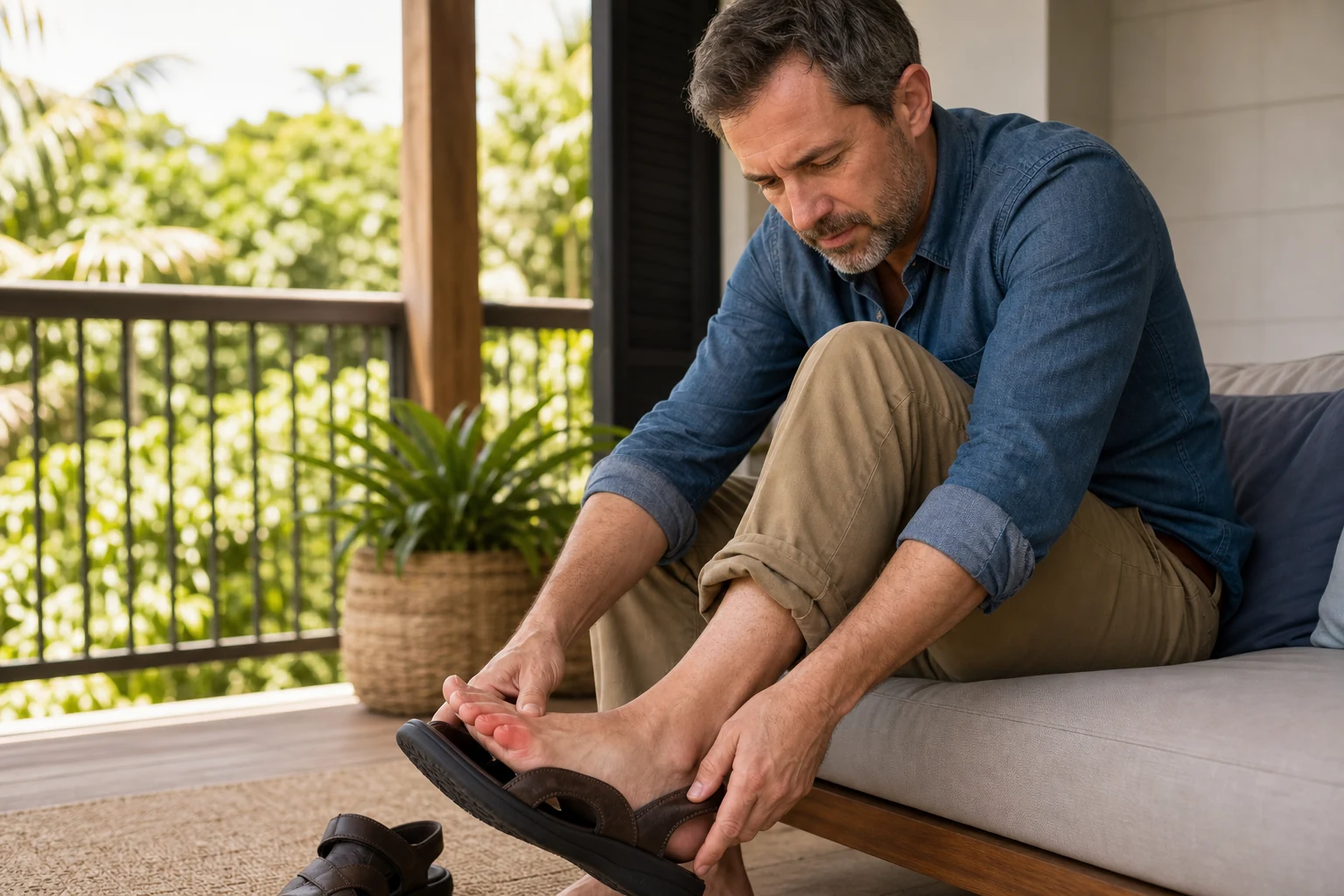
Gout is a form of inflammatory arthritis caused by uric acid crystals depositing in a joint, triggering sudden attacks of intense pain, swelling, heat and redness — most often first in the big toe, but it can affect many joints. It develops when uric acid in the blood is persistently high. Attacks settle over days, but without treatment they tend to recur, become more frequent, and can eventually cause permanent joint damage and lumps called tophi.
An acute attack can closely resemble a joint infection, so a hot, swollen joint — particularly with fever or feeling unwell — needs prompt assessment. Diagnosis uses a uric acid blood test (interpreted carefully, as it can be normal during a flare) and, where needed, examination of joint fluid for crystals.
Management has two parts: settling the acute attack (an NSAID, low-dose colchicine or a corticosteroid), and — for recurrent gout, tophi or joint damage — long-term urate-lowering therapy using a treat-to-target approach, with allopurinol first-line (febuxostat or probenecid as alternatives). The Australian serum urate target is below 0.36 mmol/L, or below 0.30 mmol/L with tophi. Lifestyle measures help, and because gout is closely linked with cardiovascular and metabolic disease, it is also an opportunity to review blood pressure, weight, diabetes and medications. This is usually managed in general practice.
Common symptoms
- A sudden, very painful, red, hot, swollen joint — classically the big toe
- Pain so severe that even light touch or bedsheets are unbearable
- Attacks that often come on overnight and last several days
- Recurrent attacks, or lumps (tophi) around joints in longstanding gout
Evidence for twelve treatment options in gout
This is not a fixed ladder or a package of treatments. Every option is assessed independently against this diagnosis, including treatments with limited direct research that may still be reasonable for a clearly defined tissue target. The evidence level, likely benefit, risks, cost and alternatives are weighed at consultation.
Foundation — diagnosis, education and rehabilitation
The part of care with the broadest relevance. For many people it is enough on its own; other options are judged against it, not automatically added after it.
Diagnosis, education and progressive rehabilitation Working out what is driving the pain, explaining what your imaging does and does not mean, and building a graded loading plan you can actually follow. Core care
What it involves
Assessment to identify the likely pain source, an explanation of what the diagnosis means, adjustment of the loads that aggravate it, and a progressive strength and conditioning plan — with weight management where that is clinically relevant.
What the evidence shows
Exercise and education sit alongside medical disease control, not instead of it. Both the ASAS-EULAR recommendations and the American College of Rheumatology guideline place education, regular exercise and physical therapy as core non-pharmacological management in axial spondyloarthritis, escalating to a biologic where disease activity stays high (Ramiro, Ann Rheum Dis 2023; Ward, Arthritis Rheumatol 2019).
Pairing reviewed 2026-09-02.
Where it fits for you
The critical point is sequencing: this does not replace rheumatological treatment, and a delay in getting disease control is the thing that causes lasting damage. Assessment here is aimed at recognising the pattern early and getting you to the right treatment, with exercise supporting it throughout.
Muscle and symptom-modifying options
Useful only when the examination identifies the tissue they target or when short-term pain control creates a useful rehabilitation window.
Wet needling and trigger point injection (trigger point injection) A fine needle into a tender band of muscle, with a small volume of dilute glucose solution injected through it. Only if relevant
What it involves
The needle is placed into the tender muscle band and a small volume of 5% glucose with 0.02-0.08% lignocaine is injected. Often done in the same visit as your assessment, and usable where the tender area sits deeper. Dry needling — the same technique with nothing injected — is not offered here.
What the evidence shows
Trigger-point injection reviews address confirmed myofascial pain and find heterogeneous, generally low-certainty results; they do not establish the technique as treatment for the underlying diagnosis. Condition reviewed: gout.
Evidence source: Debrosse et al., trigger-point injection systematic review (2022)
Pairing reviewed 2026-08-30.
Where it fits for you
For gout, this may be considered only when examination finds a separate tender muscle band reproducing part of the pain. It does not treat the primary pathology and is used to help movement or rehabilitation.
Ultrasound-guided injections Guidance means we can see the needle reach the target. What goes into the needle depends on the diagnosis. Good support
What it involves
The injection is performed under ultrasound so the needle can be watched into the target structure. What is injected is decided by the diagnosis — and corticosteroid is used sparingly, for the reasons set out below.
What the evidence shows
Ultrasound improves needle-placement accuracy, but guidance is not a treatment in itself: benefit depends on a valid injectable target and what is injected. Condition reviewed: gout.
Evidence source: Oo et al., ultrasound-guided injection systematic review (2024)
Pairing reviewed 2026-08-30.
Where it fits for you
For gout, an ultrasound-guided injection is considered only when there is a specific diagnostic question or a separate joint, bursa, sheath or nerve target. The injectate and purpose are stated before treatment.
V-ACTOR vibration therapy (vibration therapy) Low-frequency vibration applied over tender muscle. Not a shockwave, despite sharing the machine. Not offered for this
What it involves
A vibration handpiece is moved over the tender muscle and fascia for a few minutes. It runs from the same STORZ MASTERPULS icon console as radial shockwave but is a separate handpiece delivering a different, gentler form of energy. No needles, no anaesthetic, no downtime.
What the evidence shows
Not appropriate over a systemic inflammatory process, healing bone, an area of osteonecrosis or a complete tendon or ligament rupture.
Pairing reviewed 2026-08-30.
Where it fits for you
Not offered for this.
Energy-based treatment options
Radial pressure wave, focused shockwave and EMTT have different targets and different evidence. They are assessed separately rather than treated as one category.
Radial or focused shockwave? Read the overviewRadial shockwave (radial pressure wave) Broad treatment across tender muscle and fascia, close to the surface. Only if relevant
What it involves
A handpiece is moved over the tender tissue while ballistic pressure pulses are delivered, using a transmitter head chosen for the tissue — including heads shaped for fascia and for the muscle either side of the spine. The pulse is strongest at the skin and weakens with depth, so this is mainly a myofascial treatment, though it can reach deeper in some areas. No anaesthetic, no downtime, usually a course of sessions about a week apart.
What the evidence shows
Shockwave reviews in myofascial pain report a possible benefit but mix protocols and often mix radial pressure wave with focused shockwave; that evidence cannot be transferred to the underlying diagnosis. Condition reviewed: gout.
Evidence source: Wu et al., shockwave for myofascial pain review (2022)
Pairing reviewed 2026-08-30.
Where it fits for you
For gout, radial pressure wave may be considered for a distinct superficial muscle or fascial component. It is not used as evidence of benefit for the primary diagnosis.
Focused shockwave (ESWT) A true shock wave converging at depth — for tendon, joint, ligament and bone. Only if relevant
What it involves
A focused system generates an acoustic shock wave that converges at a focal point set at a defined depth, concentrating the energy where the target is. This is the form we use for tendon, joint, ligament and bone. Typically four to six sessions about a week apart, no anaesthetic and no formal downtime.
What the evidence shows
A systemic inflammatory condition managed medically. No role for shockwave in the disease process.
Pairing reviewed 2026-08-30.
Where it fits for you
Considered only for a separate mechanical problem alongside it.
EMTT (magnetotransduction therapy) High-energy magnetic pulses applied over the area. Painless, no contact. Only if relevant
What it involves
You sit with the applicator positioned over the area for a short session. Painless, no gel or contact required, and usually delivered as a course — commonly alongside shockwave.
What the evidence shows
No evidence in this condition, and the rationale offered for EMTT — an effect on tendon and soft-tissue cell behaviour — does not apply to a systemic, bone or complete structural problem.
Pairing reviewed 2026-08-30.
Where it fits for you
Not part of the plan here.
Biologic and joint injection options
Each injection is assessed independently for the named diagnosis. Cost, uncertainty, likely benefit, risks and alternatives are part of the decision.
Platelet-rich plasma (PRP) Your own blood, concentrated and injected under ultrasound guidance. Only if relevant
What it involves
Blood is taken from your arm, spun to concentrate the platelets, and injected into the target under ultrasound guidance in the same appointment.
What the evidence shows
No role for PRP in the disease process here — a systemic, bone or pressure problem rather than a tendon or joint one.
Pairing reviewed 2026-08-30.
Where it fits for you
Considered only for a separate soft-tissue problem alongside it.
Prolotherapy (dextrose) A course of dextrose injections into and around the structure and its attachments. Only if relevant
What it involves
Hypertonic dextrose is injected at the tender ligament and tendon attachments, and into the joint where relevant, usually as a series of treatments a few weeks apart.
What the evidence shows
No role for prolotherapy in the disease process itself — this is a systemic, bone or structural problem rather than a painful ligament or tendon.
Pairing reviewed 2026-08-30.
Where it fits for you
Considered only for a separate mechanical problem alongside it.
Viscosupplementation (hyaluronic acid) A gel-like injection into an arthritic joint. Widely used, and genuinely contested. Only if relevant
What it involves
One or a short series of hyaluronic acid injections into the joint under ultrasound guidance.
What the evidence shows
No trial has treated gout itself with hyaluronic acid. What the literature answers is the opposite question — whether a history of gout rules out viscosupplementation for osteoarthritis in the same joint — and the EUROVISCO consensus answers no: it supports intra-articular hyaluronic acid in knee osteoarthritis in people with a history of gout or calcium pyrophosphate deposition, while recommending against injecting during an active flare (Conrozier, Cartilage 2024). In calcium pyrophosphate disease, a different crystal arthritis, a systematic review of 22 studies and 403 patients found intra-articular hyaluronic acid associated with symptomatic improvement, but only in uncontrolled reports (Parperis, Semin Arthritis Rheum 2020).
Pairing reviewed 2026-09-12.
Where it fits for you
Not a treatment for gout, which is managed by lowering urate and settling attacks. Discussed only where a joint is left with established osteoarthritis between attacks, and not while a joint is flaring.
Nerve-targeted options
Relevant when examination identifies a superficial neuropathic pattern or a compressed peripheral nerve—not simply because pain is present.
Lyftogt perineural therapy (perineural injection therapy) A series of small dilute dextrose injections just under the skin, over tender superficial nerves. Only if relevant
What it involves
Small injections of low-concentration dextrose, usually 5%, placed just beneath the skin along tender superficial nerves. Given as a series of short sessions.
What the evidence shows
Perineural dextrose evidence is concentrated in diagnosed peripheral compression neuropathies, particularly the upper limb; no direct evidence was identified for this diagnosis itself. Condition reviewed: gout.
Evidence source: Perineural dextrose for upper-limb entrapment neuropathy review (2025)
Pairing reviewed 2026-08-30.
Where it fits for you
For gout, perineural treatment may be considered only if a separate superficial neuropathic pain pattern is found on examination. It is not treatment of the primary diagnosis.
Ultrasound-guided nerve hydrodissection Fluid placed around a nerve to free it from the surrounding tissue. Only if relevant
What it involves
Under ultrasound, fluid is placed in the plane around the nerve to separate it from the tissue that is tethering or compressing it.
What the evidence shows
Hydrodissection evidence is concentrated in ultrasound-confirmed peripheral nerve entrapment, especially carpal tunnel syndrome; no direct evidence was identified for this diagnosis itself. Condition reviewed: gout.
Evidence source: Buntragulpoontawee et al., hydrodissection injectate review (2021)
Pairing reviewed 2026-08-30.
Where it fits for you
For gout, hydrodissection may be considered only if ultrasound and examination identify a separate compressed or tethered peripheral nerve. It is not treatment of the primary diagnosis.
This is general information only and suitability is assessed individually. Treatments with limited or condition-dependent evidence may still be discussed, but only with clear explanation of the uncertainty, the expected benefit, risks, cost and alternatives. Red flags, progressive neurological symptoms or suspected serious pathology require a different pathway.
Every treatment above is described in full on the non-surgical treatments page, including what each one is used for and what the evidence supports. Ratings apply to the named diagnosis; an adjacent muscle, tendon, joint or nerve problem is assessed as a separate target.
Corticosteroid injection is reviewed separately for each diagnosis.
Cortisone reliably reduces pain in the short term, and that can be genuinely useful when pain is stopping you sleeping or moving enough to rehabilitate. Beyond that window the picture changes. A systematic review of 41 randomised trials and 2,672 participants found that corticosteroid injection reduced pain in the short term but that the effect reversed at intermediate and long term; in pooled analysis for lateral epicondylalgia the short-term effect was large (SMD 1.44, 95% CI 1.17 to 1.71) while no intervention was favoured at 26 weeks (-0.40, -0.67 to -0.14) and at 52 weeks (-0.31, -0.61 to -0.01) (Coombes, Lancet 2010). In a randomised trial in lateral epicondylalgia, 83 per cent of the corticosteroid group had completely recovered or much improved at one year against 96 per cent given a placebo injection, and recurrence ran at 54 per cent against 12 per cent; adding physiotherapy made no significant difference at one year (Coombes, JAMA 2013). In joints, repeated corticosteroid injections have been associated with cartilage loss. It does not repair anything.
So we do not build treatment plans around it. Where an injection is the right call, we review the specific diagnosis and target, discuss what is being injected and why, keep the number low, and pair it with the loading work that changes the longer-term course.
When we would still consider it
- Pain severe enough to block rehabilitation
- A clear inflammatory or bursal target on imaging
- A specific short-term goal — a trip, a procedure, a return to work
- Diagnostic use, where the response tells us where the pain is coming from
When a cortisone injection is worth doing, and when it is not
Other general conditions
Pain in the same area can come from more than one source, and the label matters less than what the examination and history point to. These are the other guides for this region.
Frequently asked questions
How is gout diagnosed?
How is an attack treated?
How are future attacks prevented?
Ready for a clearer plan for your back or musculoskeletal pain?
Book an assessment with Dr Joshua Hatch.
Your assessment focuses on understanding the likely source of your pain and the most appropriate non-surgical options for your diagnosis, with the aim of reducing pain and improving function.
Book an appointment