
Shoulder Pain: Causes, Symptoms, and Effective Treatment Strategies
Shoulder pain is a common issue that can affect your ability to perform everyday activities. Identifying which structure is involved is what determin...


Frozen shoulder is one of the more frustrating conditions I see. It comes on without warning, hurts a great deal at night, and then stiffens to the point where reaching for a seatbelt or doing up a bra strap becomes a genuine problem. Patients are often told to “just wait it out”. That advice is only half right, and a run of new research published in 2026 has sharpened what we can reasonably offer in the meantime.
This article is general information for patients, not a personal treatment recommendation.
Frozen shoulder — the medical term is adhesive capsulitis — is a condition of the shoulder joint capsule, the soft-tissue envelope that surrounds the ball-and-socket joint. In frozen shoulder, that capsule becomes inflamed and then progressively fibrotic and contracted. The joint physically loses room to move.
That distinction matters. Most shoulder problems, including rotator cuff pain, limit movement because moving hurts. In frozen shoulder, the shoulder is mechanically restricted. The classic finding is near-complete loss of external rotation — turning the forearm outwards with the elbow tucked in — that is present even when someone else moves the arm for you. That is the single most useful sign separating frozen shoulder from a cuff problem or referred neck pain.
It is usually a clinical diagnosis. Scans are mostly used to rule out other things rather than to confirm frozen shoulder, and an ultrasound showing cuff “degeneration” can easily send the diagnosis in the wrong direction.
Australian context. Shoulder pain, aching or stiffness affects roughly a quarter of the Australian population, and frozen shoulder is estimated to affect more than 250,000 Australians. Incidence is around 3–5% in the general population but up to 20% in people with diabetes, with a peak age of about 56 years. Thyroid disease, high cholesterol and hypertension are also over-represented. If you are diagnosed with frozen shoulder and have not had your HbA1c and thyroid function checked recently, that is a reasonable conversation to have with your GP.
Frozen shoulder typically moves through three overlapping phases: a painful phase (roughly 2–9 months) where pain dominates and stiffness is building; a stiff or “frozen” phase (roughly 4–12 months) where pain eases but movement is markedly restricted; and a thawing phase (12 months or more) where range gradually returns.
Treating all three the same way is a common mistake. Hard end-range stretching during the painful phase tends to flare things badly. Being too gentle during the thawing phase wastes the window where range is most recoverable.
Frozen shoulder does generally improve, but the “one to three years and it resolves completely” line oversells it. Longer-term follow-up data suggest a meaningful minority are left with residual symptoms — in one study with a mean follow-up of 4.4 years, only around 59% of patients had a normal or near-normal shoulder, and roughly 7–15% retained some degree of permanent movement loss.
So the goal is not to rescue a shoulder that would otherwise be lost. It is to shorten the miserable part, protect sleep and function, and reduce the chance of ending up in that residual group.
A 2026 meta-analysis of randomised trials compared physiotherapy alone against physiotherapy plus an intra-articular corticosteroid injection. The combination produced significantly greater short-term improvement in shoulder function and in flexion, abduction and external rotation. Interestingly, the difference in raw pain scores was not statistically significant — the benefit showed up mainly in function and movement.
That fits what corticosteroid does well. It reduces the inflammatory component of the capsule so that rehabilitation can actually happen. It is not a structural fix, and repeated injections are not a strategy. In practice, injection is most useful earlier in the course, when inflammation is driving symptoms and stiffness has not yet fully set.
Ultrasound guidance is worth mentioning here. A 2026 review of ultrasound-guided interventions in adhesive capsulitis concluded that where you put the injectate, and what is in it, appears to influence short-term outcomes — with rotator interval targeting specifically relevant to loss of external rotation. This is a reasonable argument for image guidance over landmark technique in a joint that is, by definition, tight and difficult to enter. In our clinic, cortisone injections for frozen shoulder are performed under ultrasound-guided injection precisely for this reason — a tight capsule is an easy target to miss blind.
Australian context. Corticosteroid injections and ultrasound-guided procedures are widely available in Australian primary care and radiology practices, and Medicare rebates may apply depending on the procedure and who performs it. Oral prednisolone is not a good substitute — Australian research led by Professor Rachelle Buchbinder found that any benefit is short-lived, and a Cochrane review concluded the risk-benefit balance does not support routine use.
Physiotherapy remains the backbone of management. What the new evidence pushes back on is the idea that a specific hands-on technique is the active ingredient.
A 2026 systematic review and meta-analysis compared different non-thrust joint mobilisation approaches — Mulligan, Maitland, Kaltenborn. Some techniques edged ahead on some outcomes, but the certainty of evidence was rated very low, and the authors concluded that no single mobilisation technique can currently be recommended as universally superior.
The practical read: consistency and appropriate loading matter more than the brand name on the technique. A small 2026 pilot randomised trial in adults with diabetes and adhesive capsulitis found that a supervised eight-week resistance-band program improved range, pain and disability compared with control. It was small and needs replication, but it points the same direction as the rest of musculoskeletal medicine — graded, progressive loading rather than passive treatment alone.
Hydrodilatation involves injecting a larger volume of fluid — saline with local anaesthetic and corticosteroid — into the joint to mechanically distend the contracted capsule. A 2026 case series of 71 patients using a large-volume protocol under suprascapular nerve block reported substantial gains in flexion, external rotation and abduction that were largely maintained at six months or more. That said, this was an observational series without a control group, and the 2026 ultrasound review noted that hydrodilatation’s superiority over corticosteroid injection alone remains inconsistent across studies. It is a reasonable option for the persistently stiff shoulder; it is not proven to beat a well-timed standard injection.
For shoulders that stay stuck despite good conservative care, the reference point is still the UK FROST trial published in the Lancet in 2020 — a 503-patient randomised trial comparing manipulation under anaesthesia, arthroscopic capsular release, and early structured physiotherapy with steroid injection. At 12 months, none of the three was clinically superior on the primary outcome. Capsular release carried more serious adverse events; manipulation was the most cost-effective.
That is a genuinely important result for patients. It means surgery is not an obviously better answer, and a well-delivered non-surgical plan is a legitimate primary strategy rather than a consolation prize. A 2026 meta-analysis of manipulation with versus without an added corticosteroid injection found benefit mainly for external rotation recovery, with no clear advantage for pain — again suggesting refinement at the margins rather than a step change.
Frozen shoulder is one of the conditions where a focused musculoskeletal practice can add value, provided the treatments are matched to the phase and framed honestly. Here is how the options we offer line up with the evidence.
Ultrasound-guided corticosteroid injection is the workhorse, most useful earlier in the painful phase to settle the inflamed capsule and create a window for rehabilitation. Image guidance matters in a joint this tight.
Hydrodilatation — distending the capsule with a larger fluid volume — is a reasonable option for the persistently stiff shoulder, with the honest caveat above that it has not consistently beaten a well-timed standard injection in head-to-head studies.
Shockwave therapy (ESWT) has a growing evidence base here. A 2025 randomised controlled trial found radial shockwave added to evidence-based physiotherapy produced greater reductions in pain and disability and better range of motion at 12 weeks than physiotherapy alone. A 2025 systematic review and meta-analysis in people with type 2 diabetes and chronic adhesive capsulitis — a group that tends to do worse — found ESWT improved pain, range and disability, though the authors rightly flagged small studies and modest methodological quality. The reasonable read: ESWT is a credible adjunct to loading and injection, not a stand-alone fix, and best regarded as building rather than settled evidence.
EMTT (magnetotransduction therapy) is an emerging modality. It is sometimes used alongside shockwave for shoulder conditions, but the specific published evidence in frozen shoulder is limited, so we frame it as experimental rather than established.
A note on PRP and prolotherapy: these are worth understanding because they come up, but the evidence for regenerative injections in frozen shoulder specifically is weak and preliminary. They are not part of a standard frozen shoulder plan, and any use would be an individual, carefully-considered discussion rather than a routine recommendation.
See your GP if you have shoulder pain with progressive stiffness, particularly if you cannot rotate the arm outwards even when someone else moves it. Seek review sooner if the pain followed significant trauma, if you have fever or unexplained weight loss, if there is a history of cancer, or if you develop weakness or numbness in the arm — those features point away from frozen shoulder and need assessment.
If you have already been diagnosed and are not making progress after several months of consistent rehabilitation, that is a reasonable point to review the plan rather than continue waiting.
This article is educational only and does not replace individual assessment. Treatment decisions depend on your phase, your other health conditions and your goals, and should be made with your GP or treating practitioner.
Shoulder pain is a common issue that can affect your ability to perform everyday activities. Identifying which structure is involved is what determin...
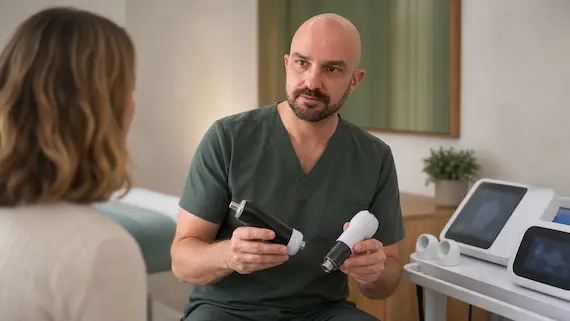
If you have been offered "shockwave therapy" for a tendon or muscle problem, it is worth asking which kind. There are two, they work differently, and...

Focused shockwave therapy, or ESWT, uses acoustic pressure waves directed at a painful tendon or soft-tissue region. It is most often considered for ...
Ready for a clearer plan for your back or musculoskeletal pain?
Your assessment focuses on understanding the likely source of your pain and the most appropriate non-surgical options for your diagnosis, with the aim of reducing pain and improving function.
Book an appointment