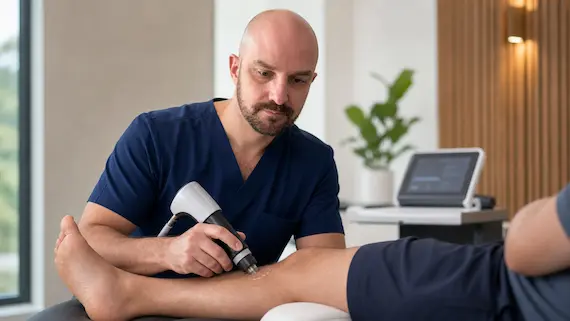
Shockwave Therapy: What to Expect at an Appointment
Focused shockwave therapy, or ESWT, uses acoustic pressure waves directed at a painful tendon or soft-tissue region. It is most often considered for ...
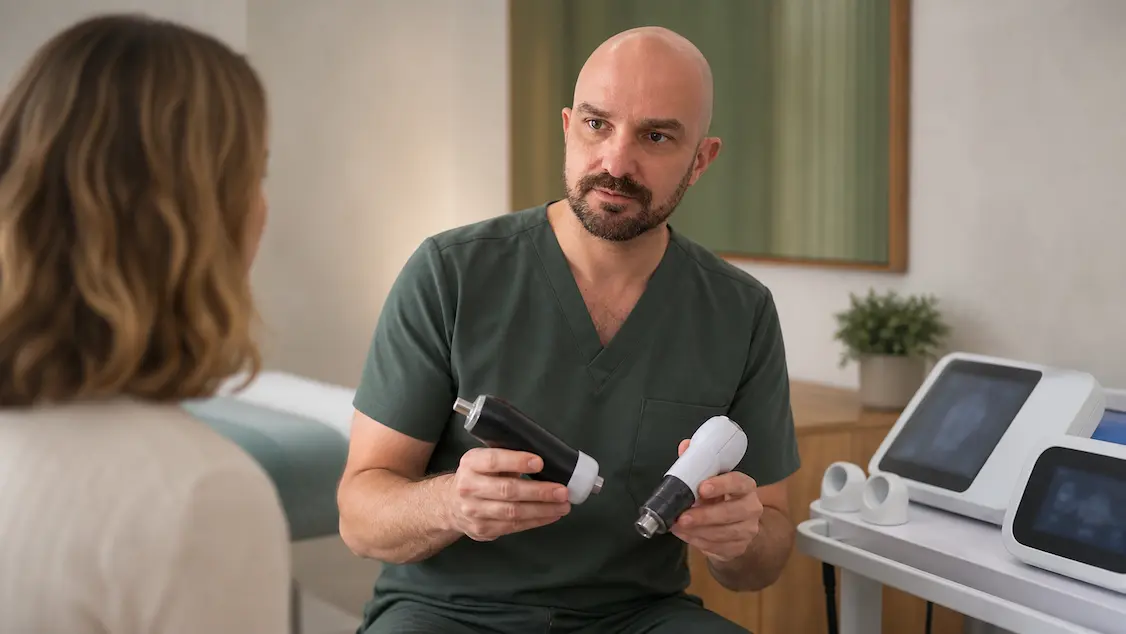
If you have been offered “shockwave therapy” for a tendon or muscle problem, it is worth asking which kind. There are two, they work differently, and they are not interchangeable — but both are routinely marketed under the single word “shockwave”.
This matters because the right choice depends on how deep your painful structure sits.
A focused device generates a true acoustic shock wave that converges at a focal point set at a defined depth inside the tissue. The energy is concentrated where the target is, not at the skin. Focused systems are piezoelectric, electromagnetic or electrohydraulic.
A radial device works ballistically. A projectile is accelerated against an applicator held against the skin, producing a pressure wave that spreads outward from the contact point. The wave is strongest at the surface and weakens as it travels deeper.
That single difference — where the energy is greatest — drives everything else.
Strictly speaking, only the focused device produces a shock wave in the physical sense. The international shockwave society has noted that it is more accurate to describe the radial output as a pressure wave. In everyday clinical language both get called shockwave, which is how the confusion started.
Because focused energy converges at depth, it suits deeper or precisely located targets: a tendon, a tendon attachment, a joint, a ligament, bone.
Because radial energy is greatest near the surface, it suits broad, superficial tissue: tender muscle and fascia. Newer radial systems are built with an extended intensity range intended to reach further than earlier radial devices, and manufacturers describe this as narrowing the gap with focused treatment. That claim currently rests on laboratory testing rather than on clinical trials comparing the two in patients, so it is a reason to keep an open mind about depth rather than a reason to treat the two as equivalent.
A few structures sit in between. The mid-portion of the Achilles tendon, for instance, lies close enough to the skin that a radial device is a reasonable option, even though it is a tendon.
Both are thought to work by mechanotransduction — cells sense the acoustic energy and respond with biological signalling, rather than the treatment simply breaking something up. Proposed effects that recur across the literature include improved local blood flow, new blood-vessel formation, reduced sensitisation of pain nerves and stimulation of tissue remodelling.
The evidence base is not evenly distributed. Focused shockwave has substantial support across chronic tendinopathy, including insertional presentations and calcific rotator cuff tendinopathy. Radial has reasonable support in plantar heel pain. Head-to-head trials comparing the two in the same condition are surprisingly scarce, which means claims that one is definitively better than the other for a given problem usually run ahead of the data.
What the evidence does show consistently is that shockwave of either type performs better when combined with a progressive loading programme than when used on its own.
If a clinic offers you shockwave, three questions are worth asking:
Many clinics own only one type of device, which is a legitimate constraint — but it should be stated rather than hidden behind the generic word.
Neither form regenerates cartilage, reverses osteoarthritis or repairs a structural tear. Neither is a treatment for a fresh injury; shockwave is used for persistent problems. And neither substitutes for working out what is actually causing the pain.
Reported adverse effects across the literature are generally minor and short-lived — local soreness, redness or bruising.
We deliver both radial and focused shockwave at our Milton clinic in Brisbane. You can read more about radial shockwave, focused shockwave (ESWT), or how shockwave fits into a staged treatment plan.
This article is general information and is not a substitute for individual assessment.
Focused shockwave therapy, or ESWT, uses acoustic pressure waves directed at a painful tendon or soft-tissue region. It is most often considered for ...
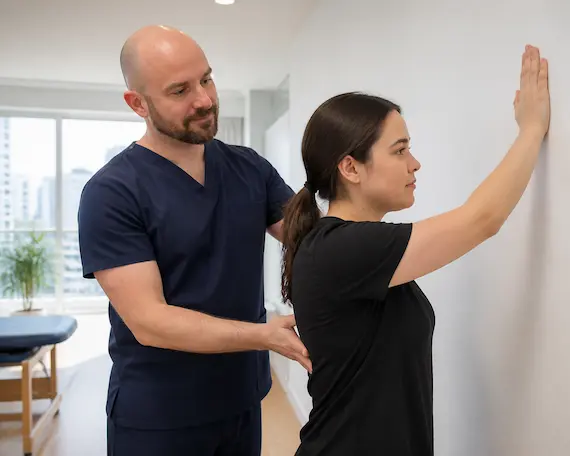
Frozen shoulder is one of the more frustrating conditions I see. It comes on without warning, hurts a great deal at night, and then stiffens to the p...
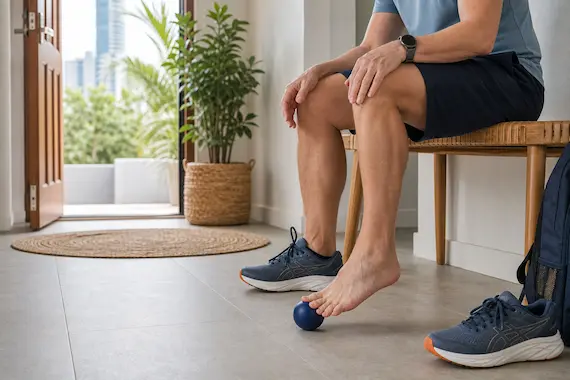
Plantar fasciitis, also called plantar heel pain, commonly causes pain under the heel or arch. It is often worst with the first steps in the morning ...
Ready for a clearer plan for your back or musculoskeletal pain?
Your assessment focuses on understanding the likely source of your pain and the most appropriate non-surgical options for your diagnosis, with the aim of reducing pain and improving function.
Book an appointment