
Osgood-Schlatter Disease: Must Young Athletes Stop Sport?
The first clue often appears halfway through netball or football training. A young athlete points to a sore bump just below the kneecap. Running, jum...


Relative energy deficiency in sport, now abbreviated REDs and still often written RED-S, describes what happens when an athlete does not take in enough energy to cover both training and the body’s everyday work. The body responds by saving energy where it can. Periods stop, testosterone falls, bone stops building, recovery slows, illness becomes more frequent and performance eventually suffers.
It most often comes to light as a sports injury: a second stress fracture in a young runner, a rower whose times have gone backwards, a dancer who cannot shake a foot injury. The injury gets treated. The reason the bone failed often does not. This guide is written for athletes, for the parents of young athletes and for coaches.
This guide is not a diet plan, and it contains no energy or weight targets. Those are individual, they belong with a sports dietitian, and numbers on a page tend to be misused. Athletes should care about nutrition and body composition. The problem comes when the energy coming in falls short of what the body needs for long enough to cause harm.
REDs affects men and women at every level, from school sport to the Olympics, and it is often accidental. A jump in training, a packed schedule or a low-carbohydrate diet can cause it without any intention to eat less. The warning signs include missed or absent periods, bone stress injuries, frequent illness, fatigue, low mood and falling performance, and in men, low libido. The contraceptive pill can hide it and does not treat it. Treatment means restoring energy, usually with a sports dietitian, a doctor, a psychologist where needed, and the coach. Bone and hormones recover over months, and the earlier it is recognised, the better the recovery.
Every day the body spends energy on two broad things: exercise, and everything else. Everything else includes the heart, brain, immune system, bone turnover, growth and repair, temperature control and reproductive hormones. Energy availability is what remains for that second list after the energy cost of training has been taken out of what was eaten.
When energy availability falls, the body does not simply burn more stored fuel and carry on. It adapts by turning down systems that are expensive to run and not immediately necessary for survival. Reproductive hormones are an early casualty, which is why periods are such a useful signal. Bone building slows. Metabolic rate falls. Some of these changes happen within days of a large shortfall.
The 2023 International Olympic Committee consensus makes an important distinction. A short spell of low energy availability, such as a heavy training block or a single competition with poor fuelling, is common and is not necessarily harmful. It becomes problematic when it is severe, prolonged or repeated, and when individual factors make that person more vulnerable. A companion paper set out a physiological model to show why two athletes with similar training and similar eating can end up with very different outcomes.
Older research used a single energy availability cut-off as if it were a diagnostic threshold. The current consensus does not rely on one number, partly because measuring energy intake and expenditure accurately outside a laboratory is very difficult. Some apps and online calculators still present a single figure as definitive. It is not.
Low energy availability has three common routes, and they often overlap.
The most common route is accidental under-fuelling. Training goes up and appetite does not keep pace. A school athlete trains before and after school with not enough time to eat in between. A shift worker fits training around a roster. An endurance athlete loses appetite after long sessions. None of this involves any intention to eat less.
The second route is deliberate restriction for performance or appearance. Athletes in sports where lightness is thought to help (distance running, cycling, climbing, jumping events), sports judged on appearance (gymnastics, dance, figure skating, diving) and weight-class sports (rowing, combat sports, horse racing) may restrict intake to reach a weight. Sometimes that is done with good intentions and poor information.
The third is disordered eating and eating disorders. In some athletes, restriction comes to be driven by anxiety, rules and body dissatisfaction. That is a health problem in its own right, it is more common in athletes than many people realise, and it is treatable.
Two less obvious contributors matter. The 2023 consensus gives more weight to low carbohydrate availability, meaning that restricting carbohydrate around training may impair health and performance even when total energy intake looks adequate. And low energy availability can occur in an athlete whose weight is stable. The body adapts by lowering its energy expenditure, so the scales do not move while hormones and bone are still being affected. A stable weight does not rule REDs out.
Any athlete can develop REDs. Some groups carry more risk.
Endurance, aesthetic, weight-class and jumping sports carry the highest risk. In track and field, reported rates of low energy availability range from 18% to 58%, highest in endurance and jumping events, and functional hypothalamic amenorrhoea (loss of periods from energy deficiency) has been reported in 60% of elite middle and long-distance runners against 23% of elite sprinters.
Australian athletes are no exception. In a study led by Rogers of 112 female elite and pre-elite athletes across eight Australian sports, 80% had at least one sign of impaired physiological function consistent with REDs, most often gastrointestinal, blood and immune problems, and about a third had signs of mental illness. That does not mean 80% had REDs. It does mean that the signs are common enough to look for routinely.
Most of the early research was in women, partly because the loss of periods made the problem easy to see. Men are affected too, with lower testosterone, reduced libido, impaired training capacity and weaker bone. Male cyclists have been studied in some detail, because cycling combines high energy demands, low bone loading and a culture that values leanness. In young male runners, those with lower energy availability had weaker bone structure at the spine and shin than non-athletes.
Adolescents are particularly vulnerable. The teenage years are when the skeleton builds most of its adult bone. Energy deficiency during that window can reduce peak bone mass, and some of that may not be fully recovered later. A young athlete who has not had a first period by around 15 needs assessment.
Masters athletes can be affected too. Older athletes who take up endurance training, often alongside a busy life and sometimes a focus on weight, can develop the same problem. The signs are easier to miss because the menstrual signal may already be absent after menopause.
These are illustrative composites drawn from common presentations, not real patients.
A 16-year-old has gone from club runner to state level in eighteen months. She trains before school most days and again in the afternoon, eats a small breakfast in the car and often misses lunch because of school commitments. Her periods, which started at 14, have stopped for five months. She presents with a painful shin that turns out to be a bone stress injury, her second in a year. Nobody has asked about her periods. Most of this is accidental under-fuelling, made worse by a schedule with no room to eat.
A 22-year-old man has a weight limit to make at selection. He has cut carbohydrate hard for six weeks. His ergometer scores have dropped, he is catching every cold in the squad, his libido is low and he feels flat all the time. His weight is where it needs to be. His blood tests show low testosterone. The cut has worked on the scales and failed everywhere else.
A 19-year-old pre-professional dancer has a foot injury that is not settling. She trains long hours, has strict rules about what she eats, feels anxious when routines are disrupted and has not had a period for over a year. She is on no contraception. This presentation needs a careful, unhurried conversation about eating, and the right psychological and dietetic care alongside the medical side.
A 52-year-old man took up cycling to lose weight and has kept going, now riding long distances most weekends and losing more weight each season. He has had two rib fractures from minor falls and is surprised to learn his bone density is low for his age. The energy deficit started as a health goal and drifted past what his training could support.
A 24-year-old female footballer is in her first season of a semi-professional program, training more than ever while working part-time. She has started the pill and her bleeds are regular. She has had three soft-tissue injuries this season, is tired all the time and has low iron. The pill has hidden the menstrual signal and the injuries have been treated one at a time.
In each case the injury or the performance problem is real and needs treating. The underlying energy problem is what decides whether it comes back.
In women, the most recognisable sign is a change in periods. They may become irregular, stop altogether, or never start. This is called functional hypothalamic amenorrhoea. The brain reduces the hormone signals that drive the ovaries, oestrogen falls, and ovulation stops. It is reversible, but it is not a harmless side effect of fitness. Low oestrogen affects bone, blood vessels and fertility.
Missing periods have other causes, including pregnancy, thyroid disease, high prolactin and polycystic ovary syndrome, so functional hypothalamic amenorrhoea is a diagnosis made only after those have been excluded.
In men, the equivalent change is a fall in testosterone. It may show as low libido, fewer morning erections, low mood, fatigue and poorer recovery from training.
Bone is where REDs most often comes to light. Bone is living tissue that is constantly being broken down and rebuilt. Energy deficiency slows rebuilding directly, and low oestrogen or testosterone adds to that. The result is weaker bone and a higher risk of bone stress injuries.
The pattern of injury matters. Bone stress injuries in bone with a lot of spongy (trabecular) structure, such as the pelvis, sacrum and the neck of the femur, are more strongly linked to low energy availability and poor bone health than injuries in the shin or foot. In a prospective study of female collegiate runners followed for up to five years, those with high cumulative risk scores had about four times the rate of these trabecular-rich injuries. In 127 young female athletes, a bone stress injury at a high-risk site was associated with signs of low energy availability and a low bone density score.
That is why a stress fracture of the pelvis or hip in a young athlete always prompts questions about energy, periods and bone density, and why a second bone stress injury anywhere does as well. See the guides to bone stress injury and foot and ankle stress fractures.
The body lowers its resting energy use, which can leave an athlete feeling cold, tired and flat. Gastrointestinal symptoms such as bloating, constipation and discomfort are common, and in the Australian study gut problems were the most frequently reported sign. Low iron, frequent colds and slow recovery from illness are also part of the picture.
The relationship runs in both directions. Early psychological signs of problematic low energy availability include mood changes, fatigue and a sense of conflict around food and training. More severe REDs is associated with anxiety, depressive symptoms and eating disorders. The same review points out that athletes are very good at playing down health problems when their sport is at stake, and that clinicians should not underestimate that drive.
REDs eventually costs performance. Training adaptation slows, strength and power plateau, concentration and coordination fall, and injuries and illness interrupt training. Athletes sometimes describe a period when they felt light and fast before things went wrong. That early phase is real, which is part of why REDs is so easy to drift into.
For athletes, the signs to watch for are:
Parents and coaches may notice a young athlete who seems to be shrinking from their sport, repeated injuries (especially stress fractures), skipped meals, leaving early to avoid team meals, eating very differently from teammates, a focus on weight or shape that seems out of proportion, or results that decline despite consistent effort.
One sign on its own does not mean REDs. Several together, or one serious one such as a hip stress fracture or no periods for three months, warrants a medical assessment.
No, and this causes a great deal of confusion.
The combined oral contraceptive pill produces a monthly bleed, but that bleed is caused by stopping the hormone tablets, not by the body’s own cycle. An athlete whose periods would otherwise have stopped can keep having a regular “period” on the pill, which hides the most useful early warning sign.
The pill also does not fix the underlying problem. Bone needs energy as well as oestrogen. In a randomised trial of 75 athletes aged 14 to 25 with irregular or absent periods, oestrogen given through a skin patch with a cyclic progestogen improved measures of bone density and structure at the shin over a year more than a combined pill did. The Endocrine Society guideline on functional hypothalamic amenorrhoea centres management on medical, dietary and mental health support from a multidisciplinary team.
None of this means athletes should stop contraception they need. It means that being on the pill does not answer the question of whether energy intake is adequate, and that the pill should not be used as a treatment for missing periods caused by under-fuelling.
There is no single test for REDs. The 2023 consensus introduced a clinical assessment tool, the REDs CAT2, which works in three steps: screening, stratifying severity and risk based on the signs present, and a final diagnosis and plan made by a doctor with the athlete and their team.
In practice, assessment covers the history, an examination, blood tests, bone density where needed and sometimes screening questionnaires.
The history covers training volume and recent changes, eating patterns and timing, any intentional weight change, menstrual history (age at first period, current pattern, contraception), injuries and illness, sleep, mood, and the pressures of the athlete’s sport and squad.
The examination looks at general health, heart rate and blood pressure, signs of rapid weight change, and examination of any injury.
Blood tests are chosen from the history. They help exclude other causes of the same symptoms, such as thyroid disease, coeliac disease and iron deficiency, and they can show hormonal and metabolic changes that support the diagnosis. In someone with absent periods, a pregnancy test comes first.
A DXA scan is considered where there have been bone stress injuries, long-standing absent periods, or other signs of poor bone health. In young athletes the result is interpreted against people of the same age, as a Z-score.
Validated screening questionnaires can help pick up risk, particularly in team settings, but they are screening tools and cannot make the diagnosis.
The CAT2 grades severity into four levels, from green through yellow and orange to red, with guidance on training and competition at each level. Most athletes are not told to stop. The level of risk decides how much training continues while recovery happens.
This is the treatment. Everything else supports it. The IOC prevention review describes identifying the source of problematic low energy availability and treating it as the cornerstone of clinical care.
How that is done depends on the cause. For accidental under-fuelling it is often practical: more food around training, better timing, adequate carbohydrate, snacks that fit a school or work day, and recognising that appetite is not a reliable guide during heavy training. For deliberate restriction it involves changing the goals, and sometimes the advice, that led to it. For disordered eating it requires specialised psychological and dietetic care.
A sports dietitian is central to this. Working with an Accredited Sports Dietitian is far more useful than following general advice, because the job is matching intake to that athlete’s training, sport and life.
Training may need to be reduced while energy availability recovers, particularly where bone is involved or the severity is high. That decision is made with the athlete and coach and is usually framed around protecting the season and the career. The CAT2 traffic-light levels help structure it.
Where eating, body image, perfectionism or pressure are part of the picture, a psychologist with experience in sport or eating disorders is part of the team. The IOC mental health review recommends an interdisciplinary approach and including mental health in both screening and treatment.
Bone responds to energy first. In one study of amenorrhoeic athletes, those whose periods returned naturally gained more bone density over a year than those given oestrogen replacement, although both did better than athletes who stayed untreated. That is a strong argument for putting the effort into nutrition and training changes.
Hormone therapy has a role when periods do not return despite a genuine trial of energy restoration, or when bone health is poor or worsening. Oestrogen given through the skin with a cyclic progestogen is preferred over the combined pill for bone in this situation. That decision is made individually, often with an endocrinologist or gynaecologist.
In men, low testosterone from energy deficiency is treated by fixing the energy deficit and adjusting training. Testosterone treatment is generally not appropriate, and athletes in drug-tested sport are bound by anti-doping rules.
Calcium and vitamin D matter for bone, and adequacy is checked, but they do not substitute for energy.
Hormones can begin to recover within weeks to months of restoring energy availability. Periods often take several months to return. Bone takes longer, because it rebuilds slowly, and in adolescents some lost bone accrual may not be fully regained. That is the main reason to act early.
Return is guided by severity, by the response to treatment and by any injury. An athlete in the green or yellow range usually continues training with adjustments and review. Orange and red levels may mean modified training or time away from competition until specific markers improve. Where a bone stress injury is present, the injury’s own return-to-running criteria apply as well.
Progress is measured by function as much as by numbers: periods returning, energy and mood improving, illness becoming less frequent, training quality coming back, and in time, bone measures stabilising or improving.
The IOC prevention review says preventing REDs is a job for the whole environment around an athlete, including the club and the coach. Its recommendations, and those of the IOC body composition review, translate into a few practical rules.
Take the emphasis off weight and leanness, especially in young and sub-elite athletes. Body composition is one of many factors in performance, and the body composition review found no single cut-off that signals a performance advantage.
Treat body composition data as confidential medical information. If it is measured at all, it should be measured infrequently, by a qualified practitioner, for a clear purpose, and never posted or compared in a group.
Teach athletes, parents and coaches about fuelling and the early signs, and make it normal to talk about periods and energy in a sports setting.
Make fuelling practical, with food available after training, time in the schedule to eat, and team travel that includes adequate meals.
Know where to refer. Coaches do not need to diagnose REDs. They need to notice when something is not right and know who to send the athlete to.
The conversation is often the hardest part.
It helps to choose a private moment, away from a bad training session and away from teammates, and to start with what has been noticed and why it matters, such as “You’ve seemed exhausted lately and you’ve had a couple of injuries this year, and I’m worried about you.” Comments about weight, shape or food tend to shut the conversation down. Some defensiveness is normal, because athletes often fear that admitting a problem will cost them their place, so it helps to make clear the goal is to keep them in the sport, healthier. Then the next step should be concrete: an appointment with a GP who understands sport, a sports dietitian, or the team’s medical staff.
Commenting on bodies, praising weight loss, or making food a team topic in a way that singles anyone out all do harm. For a parent or coach worried about an eating disorder, the Butterfly Foundation helpline can advise on how to approach it.
”Losing periods means I’m training hard enough.” It means the body is short of energy. Many of the fittest athletes in the world have regular periods.
”I’m not underweight, so it can’t be REDs.” REDs occurs at every body size. The body adapts to a shortfall by using less energy, so weight can stay stable while hormones and bone are affected.
”It only happens to women.” Men are affected too. The signs are harder to see, which makes it more likely to be missed.
”It only happens to elite athletes.” It is common in school, club and masters sport, where there is often less support around nutrition and fewer people looking for it.
”It means I have an eating disorder.” Not necessarily. Much low energy availability is accidental. Where an eating disorder is part of the picture, it is a treatable health problem, not a character flaw.
”The pill will protect my bones.” It does not replace the energy bone needs, and it can hide the warning signs.
”Calcium and vitamin D will fix it.” They matter, and adequacy is checked, but they do not correct an energy deficit.
”I’ll deal with it after the season.” Bone builds slowly and, in teenagers, the window for building it closes. Earlier treatment generally means a better recovery and fewer interrupted seasons.
The science of REDs has grown quickly, but there are real gaps. Much of the physiology comes from small studies, mostly in young, white, female athletes, and studies are hard to compare because they measure energy availability in different ways. Data in male athletes, older athletes and team sports are thinner. A 2026 review of the evidence in triathletes found that the evidence does not support universal imaging, blood testing or supplementation for every athlete, and favoured individual assessment. Testing is best guided by the history.
The REDs CAT2 is a structured clinical tool, not a validated diagnostic test with known accuracy. It helps organise assessment and decisions. It does not replace clinical judgement.
A consultation for REDs is a standard GP consultation and attracts a Medicare rebate. You must have your own regular GP. No referral letter is needed to book.
Where an eating disorder is diagnosed and meets the eligibility criteria, a Medicare Eating Disorder Plan can fund up to 40 psychological sessions and up to 20 dietetic sessions in a 12-month period. Where those criteria are not met, other Medicare arrangements may cover some allied health care, and what applies is explained at the appointment.
Sports Dietitians Australia keeps a directory of Accredited Sports Dietitians. The Butterfly Foundation provides support for anyone worried about eating, body image or an eating disorder, for themselves or someone else, on 1800 33 4673.
REDs is underdiagnosed mainly because it shows up as something else: a stress fracture, a slump in form, a tired teenager. Recognising it is the first step. The second is making it easy for an athlete to say “I haven’t had a period for six months” or “I’ve been skipping lunch to make weight”, and for that to be heard as useful information.
No one treats REDs alone. The doctor coordinates the medical side, manages any bone injury and organises tests and imaging, working with a sports dietitian, a psychologist where needed, and the coach. The risks, particularly to bone, need to be spelled out, and the aim throughout is to keep the athlete in their sport, healthier and performing better.
For an athlete with any of these signs, or a parent or coach who has noticed them, an assessment is worthwhile. The condition guide to relative energy deficiency in sport is a shorter summary, and the sports and exercise medicine section covers the injuries that often bring REDs to light, including in running, gym and strength sports and field and court sports.
The first clue often appears halfway through netball or football training. A young athlete points to a sore bump just below the kneecap. Running, jum...
Anyone who has had Achilles tendon pain knows the pattern. A walk on the flat is fine, then a hill sets it off. The first steps in the morning are st...
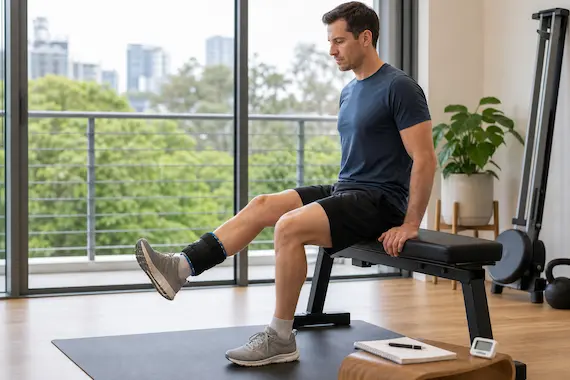
When a tendon hurts, the natural instinct is to rest it. A few days of rest can settle a flare. Weeks of it often leave the tendon weaker, and the pa...
Ready for a clearer plan for your back or musculoskeletal pain?
Your assessment focuses on understanding the likely source of your pain and the most appropriate non-surgical options for your diagnosis, with the aim of reducing pain and improving function.
You must have your own regular GP before booking. This service works alongside your GP for focused care. Booking requirements.
Book an appointment