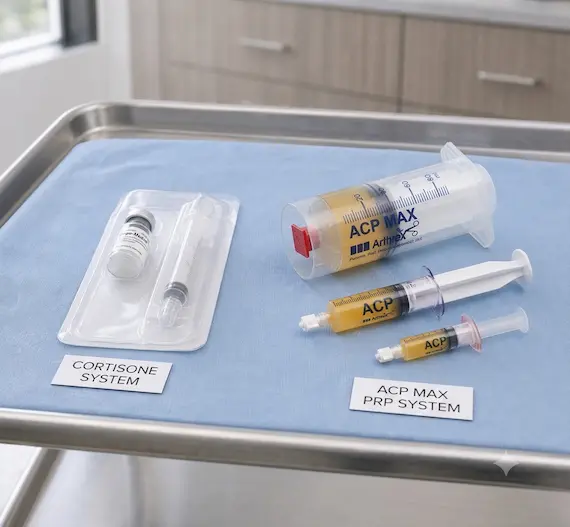
Cortisone vs PRP for Knee Osteoarthritis: What the Evidence Says
People with knee osteoarthritis who are offered an injection usually end up weighing two options: cortisone or PRP. Friends swear by one or the other...

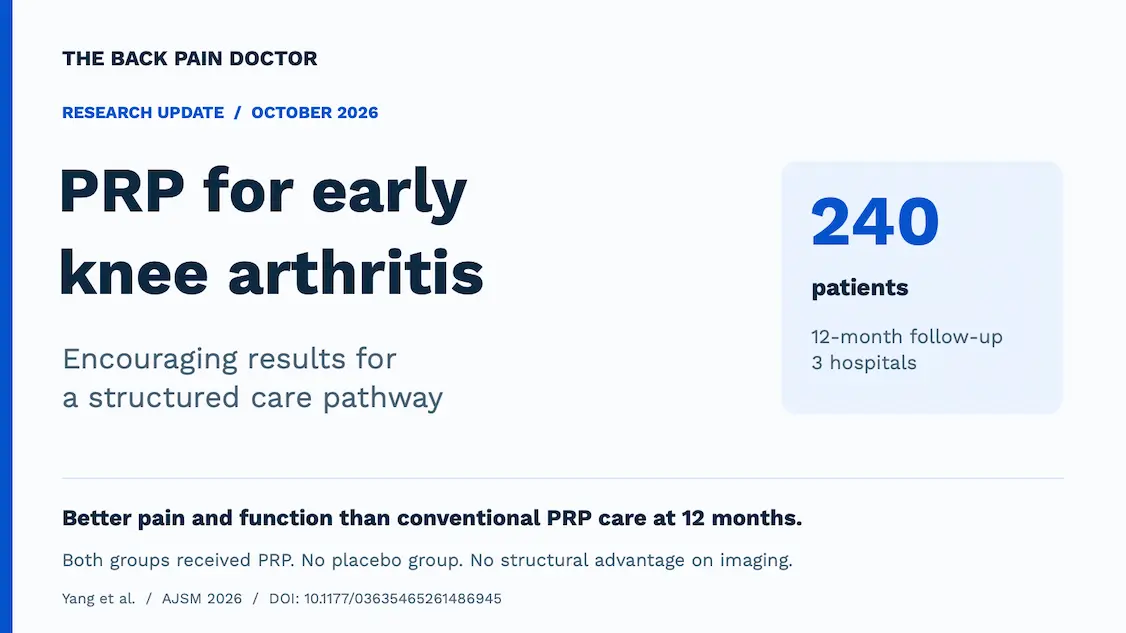
A trial published in October 2026 has found that people with early knee arthritis did better when their PRP injections were part of a carefully planned programme than when they were given in the usual, more variable way. At 12 months, the planned-care group had less pain and better knee function.
The finding is useful, with one important limit. Both groups had PRP, so the trial measures the value of the whole package of care around the injection. It does not show how much of the benefit came from PRP itself.
Yang and colleagues, writing in The American Journal of Sports Medicine, enrolled 240 people at three hospitals in China. They were aged 40 to 75 and had early knee osteoarthritis, graded I or II on the Kellgren-Lawrence X-ray scale, with symptoms that had lasted despite at least three months of standard non-surgical treatment.
Half were given a structured programme. It set clear rules for who was eligible, used a standardised PRP preparation with few white blood cells and checked the cell content of every batch. Each person had three ultrasound-guided injections a week apart, followed by staged rehabilitation and planned follow-up.
The other half had PRP the way their own doctor usually gave it, with varying preparation, injection technique and rehabilitation advice. The comparison group did not get a structured rehabilitation programme or batch quality checks. Several parts of care differed at once, which matters when reading the results.
The structured group improved more on all three main measures of pain and knee function, and more people in that group reached the study’s threshold for an improvement that patients would notice.
On the WOMAC, a 96-point arthritis score, the structured group improved by 8.6 points more than the comparison group. On the IKDC, a 100-point knee function score, the difference was 10.3 points. Both are modest differences.
Side effects were reported in 17 of 115 people in the structured group and 36 of 113 in the comparison group, about 15% against 32%. Pain after the injection was less common with the programme. One knee joint infection occurred in the trial. The study was too small to say anything about rare complications.
The trial was funded by public research grants from Sichuan Province and Yantai, and the authors reported that the funders had no role in the design, analysis or reporting.
The trial supports taking the plan around PRP seriously. When PRP is used, the way it is prepared and injected deserves attention, and the rehabilitation and review plan should be clear.
It can’t say which part of the programme made the difference. Exercise and rehabilitation improve knee arthritis on their own, and may account for much of it. The scans showed no structural advantage at 12 months, so the trial doesn’t show that PRP regrows cartilage or reverses arthritis. The results also don’t apply to advanced, bone-on-bone arthritis, which was outside the group studied.
PRP research is mixed. Some reviews, including one by Costa and colleagues, report better results than with other injections. The Australian RESTORE trial, led by Bennell, compared PRP with a salt-water injection in people with moderate knee osteoarthritis and found no meaningful difference in pain or cartilage at 12 months.
The new trial asks a different question. It shows that organised care helps people who are having PRP. Whether PRP beats a placebo is still unresolved. The cortisone and PRP comparison sets out the wider evidence.
When PRP is offered for early knee osteoarthritis, the useful questions are what improvement is realistic, what it will cost, what the risks are, and how progress will be checked. Strengthening, regular activity and weight management, where it applies, stay at the centre of care.
The message from this trial is that the way care is organised can make a real difference for people having PRP.
People with knee osteoarthritis who are offered an injection usually end up weighing two options: cortisone or PRP. Friends swear by one or the other...
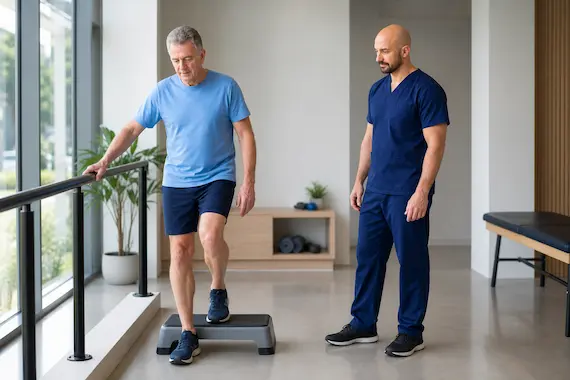
Knee osteoarthritis is one of the most common reasons people over 50 see a GP. It usually announces itself slowly: stiffness getting out of the car, ...
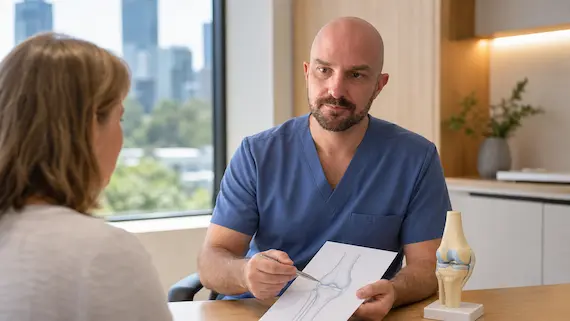
People with knee osteoarthritis know the day it happens. The knee that coped with the weekend walk is suddenly hot, stiff and sore, and it feels as t...
Ready for a clearer plan for your back or musculoskeletal pain?
Your assessment focuses on understanding the likely source of your pain and the most appropriate non-surgical options for your diagnosis, with the aim of reducing pain and improving function.
You must have your own regular GP before booking. This service works alongside your GP for focused care. Booking requirements.
Book an appointment