
Osgood-Schlatter Disease: Must Young Athletes Stop Sport?
The first clue often appears halfway through netball or football training. A young athlete points to a sore bump just below the kneecap. Running, jum...
Many people with hypermobility have spent years being told they are double-jointed, clumsy or just unlucky, and some have been told their joints are fragile and should be protected. Hypermobility is a difference in how connective tissue behaves. The most useful thing to do about it is to build strength, control and fitness steadily over months, and that is where the research, imperfect as it is, consistently points.
People with hypermobility spectrum disorder (HSD) or hypermobile Ehlers-Danlos syndrome (hEDS) often wait years for a diagnosis, hear conflicting advice, and find plenty of confident claims online that do not hold up. This guide sets out what is known, what is uncertain, and what a realistic rehabilitation plan looks like.
Being flexible is common and usually harmless. It becomes a disorder when it comes with pain, instability, injuries or other symptoms. HSD and hEDS are diagnosed by examination, and no blood test, scan or gene test confirms hEDS. The criteria are being revised, with new international criteria due in December 2026, though a diagnosis made under the 2017 criteria does not need to be redone.
Pain in hypermobility usually comes from a mix of repeated small strains, poorer joint position sense, reduced strength and a sensitised nervous system. The range of movement itself is a smaller part of it. Exercise is the main treatment. It is safe, including progressively heavier strength training, and people improve with it, though the average benefit in trials is modest and consistency over months matters more than any particular exercise. Fatigue, light-headedness on standing, gut symptoms and anxiety are common and are part of the plan. Injections, shockwave and similar procedures do not treat hypermobility, and surgery in Ehlers-Danlos syndromes has higher complication rates and is a last resort.
Joint hypermobility simply means a joint can move further than average. It is very common, particularly in children, adolescents and young women, and it usually decreases with age. A review of the field reported generalised hypermobility in roughly 11 to 26% of university-aged students and in about two-thirds or more of professional dancers. Plenty of these people never have a problem, and some find their flexibility an advantage.
Hypermobility becomes a clinical problem when it is accompanied by what are called secondary musculoskeletal manifestations: recurrent sprains, subluxations or dislocations, persistent pain, reduced joint position sense, and related features such as flat feet or mild scoliosis. At that point the 2017 international classification uses two labels.
Hypermobility spectrum disorder (HSD) describes symptomatic hypermobility that does not meet the criteria for hEDS or another specific condition. It comes in four forms: generalised (many joints), peripheral (hands and feet), localised (one joint or region) and historical (hypermobile in the past, less so now).
Hypermobile Ehlers-Danlos syndrome (hEDS) is the most common of the Ehlers-Danlos syndromes and the only one without an identified gene. It is diagnosed when a strict set of clinical criteria is met.
How common are HSD and hEDS together? Estimates vary widely with the definitions used. A 2023 review put the combined figure at around 1 in 600 to 1 in 900, and a nationwide linked-records study found about 194 diagnosed cases per 100,000 people. The American Family Physician review similarly reports registry figures of 0.13 to 0.19%. Both sources say these are likely underestimates because diagnosis is so often delayed.
The Beighton score is a nine-point bedside test: bending the little finger back beyond 90 degrees, bringing the thumb to the forearm, over-straightening the elbows and knees, and placing the palms flat on the floor with the knees straight. Each side scores separately. Because flexibility falls with age, the 2017 hEDS criteria use different thresholds: 6 or more before puberty, 5 or more from puberty to age 50, and 4 or more over 50.
A five-part questionnaire asks about past flexibility, such as whether the person could do the splits as a child or whether a shoulder or kneecap dislocated more than once. Two or more “yes” answers had a reported sensitivity of 84% and specificity of 85% for the older joint hypermobility syndrome. It is particularly useful when someone was very flexible when younger but has stiffened up.
All three of the following must be present:
If someone has symptomatic hypermobility but does not meet all three, the diagnosis is HSD.
For day-to-day musculoskeletal care, often less than people expect. The management principles for HSD and hEDS are largely the same: education, a long-term exercise programme, attention to fatigue, autonomic symptoms and mood, and careful use of medicines and procedures. The distinction matters more for family counselling, for screening (an echocardiogram is suggested when hEDS is being considered, to check the aortic root and mitral valve) and for making sure a different and more serious connective tissue disorder has not been missed.
The Ehlers-Danlos Society is running a formal review called the Road to 2026. It has scheduled updated classification criteria for all Ehlers-Danlos syndromes and HSD for December 2026, peer-reviewed results of its hEDS and HSD criteria study in the same month, and a clinician diagnostic pathway and best-practice guidance for March 2027. The review is testing an expanded joint assessment alongside the Beighton score. Early findings suggest hEDS and HSD sit on a shared spectrum. The Society states that anyone diagnosed under the earlier framework does not need to be re-evaluated. This guide will be updated once the new criteria are published.
There is no confirmatory test for hEDS. Genetic testing is used when another, gene-confirmed type of Ehlers-Danlos syndrome or a related condition is suspected, not to “prove” hEDS. Blood tests may be used to exclude other causes of joint pain or fatigue, such as inflammatory arthritis, thyroid disease or nutritional problems. Imaging is ordered to answer a specific question about a specific joint, not to diagnose hypermobility itself.
When to think beyond hEDS. Fragile skin that splits or scars badly, thin translucent skin with visible veins, easy bruising out of proportion to injury, a personal or family history of arterial rupture, bowel perforation or uterine rupture, or sudden death in a young relative should prompt specialist review for vascular Ehlers-Danlos syndrome or another type. These are rare but important.
It is tempting to assume that pain comes from joints “moving too much”. The picture is more complicated, and more hopeful, than that. Several mechanisms interact.
The first is repeated small strains. Lax ligaments and capsules allow joints to move into positions that load soft tissues unevenly. Over time, many small, often unnoticed strains can add up to persistent local pain, and larger events such as subluxations add to it.
The second is reduced joint position sense. People with HSD often have less accurate proprioception, the sense of where a joint is without looking. That makes it harder to stop a joint at the right point and increases the risk of awkward loading and injury. A meta-analysis cited in the 2023 review found an increased risk of knee injury, though not ankle injury, in hypermobile people.
The third is reduced strength. Lower muscle mass and strength are common, and more compliant tendons may transmit muscle force less efficiently. The muscles therefore have to do more work to keep a joint stable, and they fatigue sooner.
The fourth is a sensitised nervous system. Widespread tenderness and pain out of proportion to tissue findings are common, consistent with central sensitisation, the process by which the nervous system becomes more responsive to signals over time. Small fibre nerve changes have also been reported in a proportion of people with hEDS.
Finally there is the cycle of fear and deconditioning. Pain and fear of injury lead understandably to doing less. Doing less reduces strength, fitness and confidence, which makes joints feel less stable and activity more painful. This cycle is one of the main things a rehabilitation programme is designed to break.
Most of these drivers can be trained. Nobody can change the collagen they were born with, but strength, muscle stiffness, control, fitness and nervous system sensitivity all respond to graded training.
Many people with HSD or hEDS have symptoms well beyond their joints. These are real, they are common, and they affect how rehabilitation needs to be paced. Some associations are well established. Others are still being worked out, and some popular claims run ahead of the evidence.
Fatigue is reported in up to 84% of people in some series, along with unrefreshing sleep, night pain and poor concentration. Fatigue is one of the most common reasons exercise programmes stall, which is why pacing is built into the plan below.
Dizziness or a racing heart on standing, sometimes with fainting, is strongly associated with HSD and hEDS. Postural orthostatic tachycardia syndrome (POTS) is diagnosed when the heart rate rises by 30 beats per minute or more within ten minutes of standing, with symptoms and without a drop in blood pressure. How common it is depends heavily on who is studied. In a large specialist autonomic clinic cohort of 270 people with hEDS, POTS was found on tilt testing in 33%. In an online survey of 84 women with diagnosed HSD or hEDS, 58% reported a physician diagnosis of POTS (Collins Hutchinson et al., 2025). These are selected populations and should not be read as the rate for everyone with hypermobility.
The first-line measures recommended in a 2025 American Gastroenterological Association expert review are increased fluid and salt intake, exercise training and compression garments, with medicines added under specialist care when lifestyle measures are not enough. Salt and fluid advice should be worked out with a GP, particularly for anyone with high blood pressure, kidney or heart problems.
Functional gut symptoms such as reflux, bloating, constipation and early fullness, as well as pelvic floor and bladder problems, are among the strongest associations. The same 2025 expert review recommends that these be assessed in the same way as in anyone else, with testing targeted to the symptoms.
Headache and migraine, anxiety, low mood and fear of movement are common. A UK study found generalised hypermobility in 51% of adults with autism, ADHD or tic disorders, compared with about 20% in the general population, and hypermobility appeared to link neurodivergence with autonomic symptoms and pain. None of this means the symptoms are imagined. The nervous system is part of the picture and part of the treatment.
Mast cell activation syndrome (MCAS) is one example. An association between MCAS, POTS and hEDS is widely discussed, but the evidence is still limited and largely from selected clinic populations. The 2025 expert review advises against routine MCAS testing in everyone with hEDS or HSD. It recommends testing only when there are episodic symptoms affecting two or more body systems, such as flushing, hives, wheeze and abdominal cramping.
Craniocervical instability is another. Surgery to fuse the base of the skull to the neck has been promoted for some people with Ehlers-Danlos syndromes. The published support comes mainly from retrospective series reported by surgical teams who perform the operation, such as a 53-patient series with follow-up of 5 to 28 months, and there are no randomised trials. This is a major operation with permanent consequences and needs careful, independent specialist assessment.
Exercise and physiotherapy are recommended as the mainstay of care in every major review. What that recommendation rests on explains why commitment matters.
A 2014 systematic review found only four studies of exercise in the older diagnosis of joint hypermobility syndrome. All showed improvement over time, but there was no convincing evidence that exercise beat a control group or that one type of exercise was better than another. A 2021 review of six small randomised trials in hEDS, each with 20 to 57 people and lasting 4 to 8 weeks, found improvements in pain and proprioception whatever programme was used, while noting that robust trials were missing. A 2022 review of ten studies and 330 participants across Ehlers-Danlos syndromes and HSD found that all studies reported some physical or psychological improvement. Only one adverse event, which was non-serious, was possibly related to the exercise. Only two of the five randomised trials were rated high quality.
The most informative trial to date was run in Danish primary care. One hundred adults with HSD and shoulder pain or instability for at least three months were randomised to 16 weeks of either heavy, full-range shoulder strengthening (supervised twice a week) or light, mid-range exercise (supervised three times in total). Both groups trained three times a week.
At 16 weeks, shoulder function had improved more in the heavy group, by 174.5 points on a 2,100-point scale. That was a real difference, but smaller than the 252 points the authors had set as the smallest change patients would notice. There were no serious side effects. The heavy group had more temporary muscle soreness (56% against 37%) and more headaches (40% against 20%). In both groups, pain rose by less than half a point on a 0 to 10 scale during each exercise session, throughout the 16 weeks.
At one year, the difference in shoulder function had faded, though people in the heavy group felt better about their shoulder and were more likely to rate their improvement as important. Gains in strength went along with gains in function, though the link was modest.
Properly progressed strength training, taken through full range, is safe in hypermobility. That challenges the old advice to keep people with hypermobility on very light, cautious exercise.
In 21 people with hEDS or HSD and an unstable shoulder, a trial by Spanhove and colleagues found two different home exercise programmes both improved shoulder function over 24 weeks. In 169 adults with hand pain or tingling, Lindholm and Claesson found a 12-week wrist strengthening programme and a splint worn during selected activities gave similar results. In 36 people with hEDS, Benistan and colleagues found compression garments added to physiotherapy improved some balance measures at four weeks, but not pain.
A secondary analysis of the Danish trial found that higher confidence in managing one’s own condition (self-efficacy), lower fear of movement, expecting to recover and a shorter duration of symptoms were associated with better results (Dolsø et al., 2023). These are not fixed traits. They can change with education, early wins and good support, and they are built into the way a programme is delivered.
People with HSD and hEDS improve with exercise, it is safe, and heavier, progressive loading is appropriate. The average effect in trials is modest, the trials are short, and no single exercise or method has been shown to be best. In practice, the results come from doing a good programme consistently, progressing it, and keeping it going long enough to change strength, fitness and confidence. There is no passive treatment that substitutes for that.
The structure below draws on the trials above. The phases and time frames are a practical framework and have not been tested as a protocol in trials. Every programme is adjusted to the person.
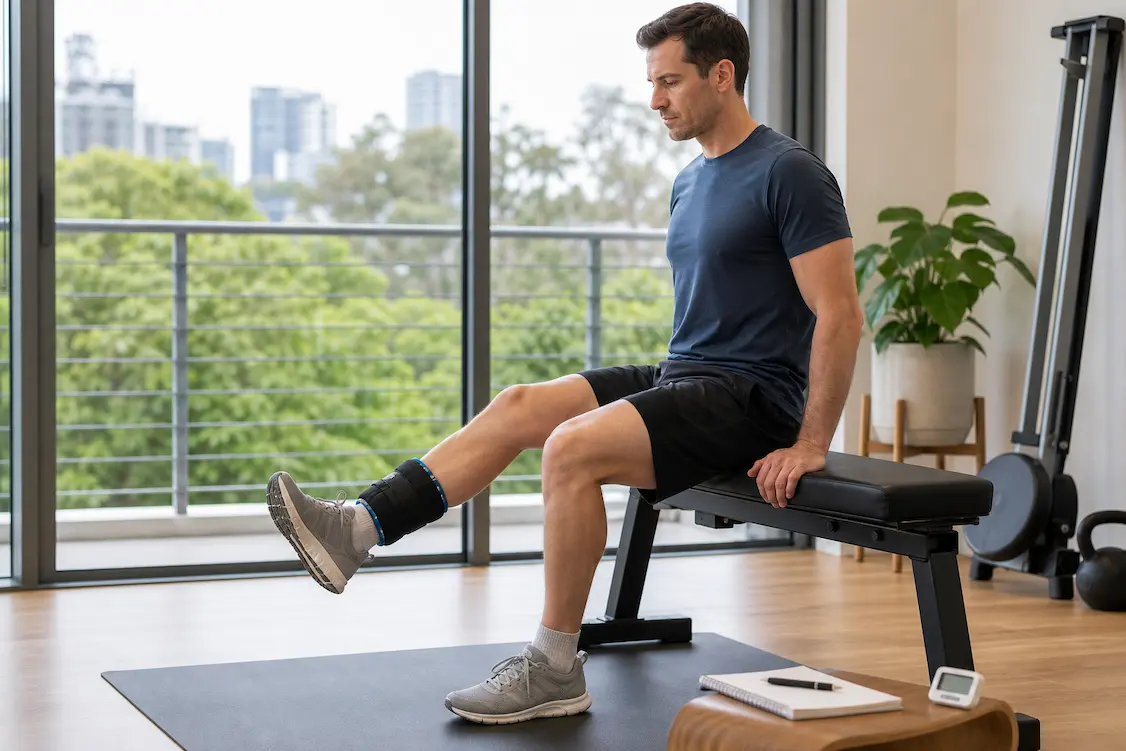
Strength comes first, and through the full range. The goal is stronger muscles that hold joints well in the positions people actually use, including the end of the range. The Danish trial used full-range, progressively heavier exercises three times a week for 16 weeks.
Control and position sense come next. Balance work, slow controlled movement and exercises that practise stopping a joint at a chosen point all help retrain proprioception.
Isometric exercise is a useful starting point. Holding a contraction without moving the joint lets muscles work hard with little joint movement. A 2023 review by Carroll describes it as a good way to begin.
Stretching should target what is tight. Many hypermobile people have some truly tight muscles, often the hamstrings, calves or hip flexors, alongside very lax joints. Those are the muscles to stretch, leaving already mobile joints alone.
Fitness matters as well as strength. Exercise training is part of the first-line management of orthostatic symptoms, as well as general health. Where standing makes symptoms worse, seated or lying options such as a recumbent bike, rowing machine or swimming are often a better starting point.
Some soreness is expected. In the Danish trial, more than half of the heavy-training group had temporary muscle soreness. Mild, short-lived soreness is expected and is not a sign of damage. Pain that is sharp, escalating, or lasting more than a day or two is a reason to adjust the load.
A common pattern is to do a lot on a good day, pay for it for several days, then do very little until the next good day. Pacing means setting a baseline amount of exercise and activity that can be managed on a bad day as well as a good one, then building up in small steps. It sounds slow. It is usually faster than the alternative.
The first phase, foundations, covers roughly the first four to six weeks. It means understanding the diagnosis and why exercise matters, and setting a baseline that can be repeated. Start isometric and low-load strength work for the most symptomatic regions, add balance and control work, and begin a short aerobic habit. Address sleep, hydration and orthostatic symptoms early. The aim is consistency, not intensity.
The second phase, building capacity, runs from roughly week six to week 16. Resistance is progressed steadily, exercises move through more range, control and balance work gets harder, and aerobic sessions lengthen. Most people train three times a week, with supervised sessions to check technique and progress the programme. This is the phase the trials studied.
The third phase, load for life, starts at about four months. The clinical programme gives way to training that fits the person’s life, whether that is gym work, Pilates, swimming, running, team sport or a physical job. The goal is to keep going. Hypermobility is lifelong, and the strength and fitness gained are kept only by continuing to use them.
Progress is measured in months and is usually uneven. A flare does not mean the programme has failed.
Setbacks are part of living with hypermobility. A written flare plan, agreed in advance, makes them less disruptive. It usually means cutting back on exercise without stopping, often to the previous level for a few days, with short-term pain relief agreed with a GP, heat or cold, gentle movement and relaxation. The plan sets a clear point to return to the full programme and lists the reasons to seek review.
Many people with recurrent subluxations learn to manage them, and the joint often returns to place on its own or with gentle movement. Seek urgent care if a joint will not go back, if a limb becomes numb, cold, pale or weak, if there is obvious deformity, or if the injury followed significant trauma, as there may be a fracture.
Medicines play a supporting role. Reviews recommend an approach similar to other persistent pain conditions: paracetamol, anti-inflammatory medicines and topical anti-inflammatories used judiciously, certain antidepressant medicines used at low doses for pain, and avoiding opioids. Some of these medicines can worsen light-headedness on standing, and anti-inflammatories that affect platelets are best avoided by people who bruise easily. Medicine choices are individual and best made with a GP.
Braces, taping and splints can help in specific situations, such as protecting an unstable joint during a demanding task or settling a flare. In one large trial, a wrist splint worn during selected activities performed about as well as a wrist strengthening programme for hand symptoms. They are tools to support activity, and they do not replace building strength.
A 2024 systematic review found that the most helpful psychological interventions in HSD and Ehlers-Danlos syndromes were those delivered alongside physiotherapy in outpatient or community settings. These improved both physical and psychological aspects of pain, though larger trials are still needed. Small studies of multidisciplinary programmes that included cognitive behavioural therapy reported less anxiety, catastrophising and fear of movement. Psychological support is not a suggestion that pain is imagined. It is one of the more useful tools for living well with a long-term condition.
No injection, shockwave, platelet-rich plasma, prolotherapy or similar procedure has been shown to treat hypermobility itself, and these treatments are not part of the recommended management in the reviews above. People with Ehlers-Danlos syndromes are also more prone to bruising, bleeding and a reduced response to local anaesthetic, so the risk side of any procedure needs extra care. A separate, clearly diagnosed problem, such as a specific tendon condition, is assessed on its own merits, with these considerations in mind.
Surgery may be needed for specific structural problems, but outcomes in Ehlers-Danlos syndromes are less predictable. In a retrospective review of 120 people with Ehlers-Danlos syndromes who had 320 orthopaedic operations at a major specialist hospital, complications were recorded in 91% of cases with follow-up. The most common were persistent pain, ongoing subluxation or dislocation, instability, hardware pain and infection. This was a single-centre retrospective study and is likely to overstate the risk for some operations. Even so, the authors recommend careful planning by an experienced multidisciplinary team. In practice, surgery is usually considered only after a proper, well-supported trial of rehabilitation.
Hypermobility is not a reason to avoid sport. Many elite dancers and athletes are hypermobile. The goal is to build the strength and control the activity demands, and to progress training load gradually.
At work, some people need adjustments, such as varying posture, pacing physical tasks, or using equipment that reduces end-range loading. Occupational therapy can help.
A healthy body weight reduces joint load, and good sleep reduces pain sensitivity and fatigue. Avoiding nicotine and limiting alcohol are recommended.
Hypermobility in children is assessed differently, and the Ehlers-Danlos Society published a separate paediatric framework in 2023. Children with joint pain should be assessed by their GP or paediatric team. This guide is written for adults.
Good care for hypermobility is built around active rehabilitation. It starts with a thorough history and examination, confirming or reconsidering the diagnosis, screening for features that need other specialist input, and agreeing realistic goals. From there a progressive exercise programme is built with the person, with physiotherapy, exercise physiology, psychology or other services brought in as needed, and progress is reviewed over time.
Through a GP Chronic Condition Management Plan, eligible patients can access up to five Medicare-rebated allied health services, such as physiotherapy or exercise physiology, per calendar year. For most people with HSD or hEDS, these sessions are best used to set up, check and progress a programme that the person then carries on independently.
This approach works best for people ready to make regular exercise a long-term part of their week. Procedures are not offered as a treatment for hypermobility itself.
Joint pain with unusual flexibility that is affecting work, sleep or activity, repeated subluxations or dislocations, light-headedness, a racing heart or fainting on standing, persistent fatigue, gut or bladder symptoms alongside joint problems, or a family history of Ehlers-Danlos syndrome or of arterial or organ rupture are all worth raising with a GP.
Call triple zero (000) or go to the nearest emergency department for sudden severe chest, back or abdominal pain, fainting during exercise, sudden weakness or numbness, or a dislocated joint that will not go back or leaves the limb cold, pale or numb.
HSD and hEDS are real, common and often misunderstood conditions. The diagnosis is clinical, the criteria are being updated, and the extra-articular symptoms deserve attention. The treatment with the strongest and most consistent support is a long-term, progressive exercise programme that builds strength, control and fitness. It is safe, including heavier strength training, and it works best when it is done consistently over months alongside good pacing, sleep and support. Procedures are not a shortcut, and surgery is a last resort. The research is still catching up with how many people live with this, and this guide will be updated as the new international criteria and evidence are published.
The first clue often appears halfway through netball or football training. A young athlete points to a sore bump just below the kneecap. Running, jum...

Relative energy deficiency in sport, now abbreviated REDs and still often written RED-S, describes what happens when an athlete does not take in enou...

New mothers are often surprised by where the aches of early parenthood turn up. For a good number it is not the back. It is the wrist, on the thumb s...
Ready for a clearer plan for your back or musculoskeletal pain?
Your assessment focuses on understanding the likely source of your pain and the most appropriate non-surgical options for your diagnosis, with the aim of reducing pain and improving function.
You must have your own regular GP before booking. This service works alongside your GP for focused care. Booking requirements.
Book an appointment