
Calf Pain: Muscle Strain or Blood Clot?
Calf pain after a walk, run or gym session is often a muscle strain, but not every painful calf is a sports injury. A deep vein thrombosis (DVT) can ...


Creatine has moved from the gym to the medicine cabinet. Once thought of as a supplement only for bodybuilders and sprinters, it is now being studied as a tool for something many of my patients care about a great deal: holding on to muscle and strength as they get older. If you have read a headline suggesting creatine is good for your bones, your brain and your muscles all at once, it is worth separating what the evidence supports from what is still uncertain.
This article is a plain-English summary for patients. It is general information, not a personal recommendation.
Creatine is a natural compound your body already makes and stores, mostly in skeletal muscle, where it helps supply quick energy for short, hard efforts. You also get it from food, particularly red meat and fish. Your body produces roughly a gram a day on its own, and a typical diet adds a little more. Supplementing simply tops up the amount your muscles store.
The form used in almost all the good-quality research is creatine monohydrate. It is cheap, well studied, and there is no reliable evidence that the newer, more expensive forms work any better.
The most consistent finding across the research is that creatine helps most when it is combined with resistance training, and less so on its own.
A 2026 systematic review and meta-analysis of creatine in postmenopausal women, led from Edith Cowan University in Western Australia, pooled seven randomised trials involving 608 women (average age around 62). It found small but meaningful gains in lean mass (about 0.4 kg on average) and in leg-press strength (about 7.5 kg) when creatine was combined with resistance training. Importantly, the benefit appeared when women took at least 5 grams a day and did the strength work. Trials using low doses (3 grams or less) without training showed no measurable effect.
That last point matters. Creatine is not a substitute for exercise. A separate 2026 review of supplementation combined with exercise in women across different life stages found that exercise alone reliably improved musculoskeletal health, and that adding supplements produced only selective strength gains rather than large across-the-board improvements. The training does the heavy lifting; creatine is a modest add-on.
Australian context. In Australia, creatine is regulated by the TGA as a listed complementary medicine, not a prescription drug, and it is not subsidised on the PBS. It should never be viewed as a replacement for the muscle-strengthening activity that national guidelines already recommend on at least two days a week. If you are not yet doing regular resistance training, that is the higher-value place to start.
This is where marketing tends to outpace the data. It is biologically reasonable to hope creatine might help bone, because muscle and bone are closely linked and decline together in a pattern clinicians now call osteosarcopenia. A 2026 review on that topic lists creatine among nutritional strategies that may support bone and muscle alongside the established mainstays of resistance exercise and adequate protein.
However, when researchers actually measure bone mineral density, the results have been disappointing so far. The postmenopausal meta-analysis found bone density was unchanged overall, and the broader women’s health review likewise found no significant effect on bone mineral density or bone mineral content. So while creatine may help you build the muscle and strength that indirectly protect against falls, the current evidence does not show it thickens bone. If bone health is your concern, DXA screening and proven osteoporosis management remain the priority.
You may also have seen claims about creatine and thinking or memory. A 2026 systematic review found that five of six studies reported a positive association between creatine and cognition in older adults, particularly for memory and attention, but the authors rated most of the studies as low quality and called for proper clinical trials. This is best described as an emerging and genuinely interesting area, not a settled one. It is not a reason on its own to start creatine.
More broadly, preserving skeletal muscle is increasingly recognised as central to healthy ageing and maintaining independence, and creatine appears in that conversation as one small, low-cost tool among many.
For most healthy people, creatine monohydrate has a strong safety record. Across the trials above, side effects were mild and no more common than with placebo, and measures of kidney function did not change. This is consistent with long-standing sports nutrition position statements, which have found no evidence of harm to the kidneys in healthy individuals at standard doses.
A few practical caveats:
If you and your GP decide creatine is reasonable for you, the typical evidence-based approach is straightforward: creatine monohydrate at 3 to 5 grams a day, taken consistently. A short high-dose “loading” phase is optional and mainly speeds up how quickly your muscles fill; it is not necessary. Creatine only earns its keep when it sits alongside regular resistance training and adequate protein, not in place of them.
Speak with your GP if you are losing strength or muscle, have had a fall or a fragility fracture, are worried about osteoporosis, or simply want a personalised plan for staying strong as you age. Supplements are a minor part of that picture. Assessing your muscle, bone and overall risk, and building a safe, progressive strength and loading program, is where the real benefit lies.
This article is general information only and is not a substitute for individual medical advice. Supplements can interact with medical conditions and medications. Please discuss your own situation with your GP or an appropriately qualified health professional before making changes.
Calf pain after a walk, run or gym session is often a muscle strain, but not every painful calf is a sports injury. A deep vein thrombosis (DVT) can ...
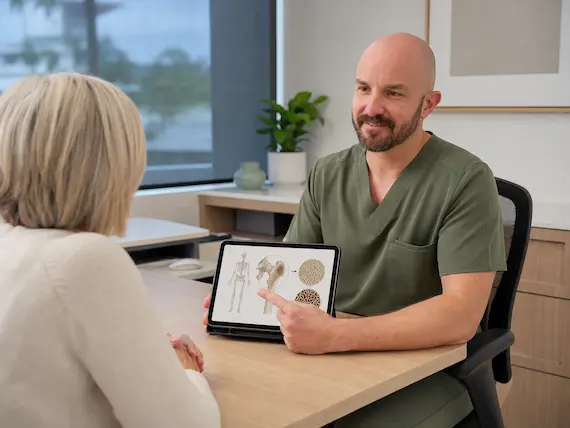
A bone density scan — usually called a DXA or DEXA scan — is one of the main tests used to assess osteoporosis. It can be very useful, but it...

After a hamstring strain, the safest answer to “When can I run again?” is not a fixed number of days. A better decision uses the injury pattern, ...
Ready for a clearer plan for your back or musculoskeletal pain?
Your assessment focuses on understanding the likely source of your pain and the most appropriate non-surgical options for your diagnosis, with the aim of reducing pain and improving function.
Book an appointment