
Back Pain Red Flags: When to Go to Emergency
Call triple zero (000) or go to the nearest emergency department now if back pain is accompanied by new loss of bladder or bowel control, diffi...


Calf pain after a walk, run or gym session is often a muscle strain, but not every painful calf is a sports injury. A deep vein thrombosis (DVT) can cause similar pain and may become dangerous if part of the clot travels to the lungs. You cannot reliably rule out a blood clot from one symptom or a home test.
The useful question is not simply “How much does it hurt?” It is whether there was a clear injury, what else has changed in the leg, whether clotting risk is higher than usual, and whether urgent assessment is needed.
A calf strain is an injury to the gastrocnemius or soleus muscles at the back of the lower leg. It often begins during a specific movement such as accelerating, jumping, changing direction or pushing off uphill.
Common features include:
Those clues make a strain more plausible, but they do not prove it. An Achilles tendon rupture, nerve-related pain such as sciatica, a fluid-filled cyst behind the knee and other conditions can also cause calf symptoms.
A DVT forms in a deep vein, most often in one leg. Healthdirect advises immediate medical review for signs such as a red or swollen leg. Concerning features can include:
Risk can also be higher with a previous DVT, active cancer, pregnancy or the early period after birth, oestrogen-containing medication, a plaster cast or reduced mobility. A clot can still occur without an obvious risk factor, and some DVTs cause few symptoms.
Pain after exercise does not automatically make a clot impossible. The timing, swelling, medical history and examination all matter.
There is no reliable “squeeze test” or movement you can perform at home to exclude DVT. Clinicians combine the history and examination with a validated clinical probability tool. Depending on that probability, testing may include a D-dimer blood test and an ultrasound of the leg veins.
The NICE diagnostic pathway uses this stepwise approach because symptoms alone are not accurate enough. An ultrasound for suspected DVT is different from imaging used to map a muscle tear: it examines blood flow and whether a deep vein can be compressed normally.
If a clot is a genuine possibility, the safer step is timely medical assessment rather than waiting to see whether stretching, massage or rest changes the pain.
Seek prompt medical assessment if a calf becomes newly swollen, red, warm or tender, particularly when there was no clear injury or when a clotting risk factor is present.
Call triple zero (000) for chest pain, sudden shortness of breath, coughing up blood, a racing heartbeat, marked light-headedness or fainting. These can be symptoms of a pulmonary embolism and require emergency care.
Severe pain after an injury, rapidly increasing swelling, numbness, a pale or cold foot, or pain that seems out of proportion also needs urgent assessment. Acute compartment syndrome is uncommon, but delaying care can threaten the limb.
Most calf strains are managed without surgery. Early care usually aims to settle the initial pain while keeping safe movement where possible. Rehabilitation then rebuilds calf strength, endurance and the ability to tolerate faster or spring-like loading.
Progress is better judged by function than by a fixed calendar date. Useful milestones may include comfortable walking, repeated calf raises with good control, near-symmetrical strength and a graded return to the demands of work, running or sport. Symptoms during the session and the following day help guide how quickly load increases.
Recovery time varies with the muscle and tissue involved, the size of the injury, previous calf problems and the activity you are returning to. Imaging is not automatic for every strain, but ultrasound or MRI may help when the diagnosis is uncertain, the injury appears substantial or progress is not following the expected course.
A clear pull during activity followed by local pain and weakness often points towards a calf strain. Unexplained one-sided swelling, redness, warmth or tenderness deserves prompt medical assessment for DVT, especially when clotting risk is higher. Chest pain or breathlessness is an emergency.
When it is a strain, the longer-term answer is usually graded rehabilitation rather than complete rest. When the pattern is unclear, getting the diagnosis right comes first.
Call triple zero (000) or go to the nearest emergency department now if back pain is accompanied by new loss of bladder or bowel control, diffi...
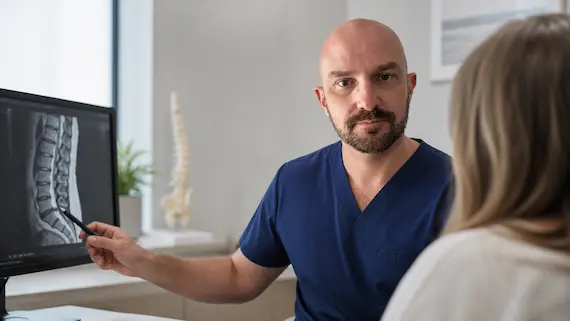
Short answer: for most people with new low back pain, no — an MRI is not needed, and getting one too early can do more harm than good. This surpr...
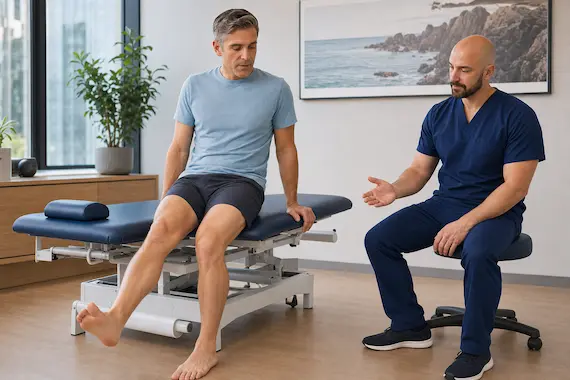
Sciatica describes pain related to irritation of a lumbar nerve root. It is often felt in the buttock, thigh, calf or foot, and may come with pins an...
Ready for a clearer plan for your back or musculoskeletal pain?
Your assessment focuses on understanding the likely source of your pain and the most appropriate non-surgical options for your diagnosis, with the aim of reducing pain and improving function.
Book an appointment