
Trigger Finger: Why Does Your Finger Catch or Lock?
If a finger clicks, catches or becomes stuck as you bend and straighten it, the problem may be trigger finger. The name sounds dramatic, but it u...


Carpal tunnel syndrome does not automatically mean you need surgery. When symptoms are mild or intermittent, a neutral-position wrist splint at night and attention to aggravating activities can be reasonable first steps. Surgery becomes more important to discuss when numbness is constant, hand strength is declining, the muscles at the base of the thumb are wasting, or acceptable non-surgical care has not controlled the problem.
The useful decision is not simply “surgery or no surgery”. It is to confirm that the median nerve at the wrist is actually the source, judge how severely it is affected and choose a plan that protects hand function without overstating what any treatment can guarantee.
Carpal tunnel syndrome occurs when the median nerve is compressed as it passes through a narrow space at the wrist. Typical symptoms include tingling, numbness, burning or pain affecting the thumb, index finger, middle finger and thumb-side of the ring finger. Symptoms often wake people at night, and shaking the hand may briefly settle them.
The little finger is usually spared. Numbness centred on the little finger, pain starting in the neck, or symptoms affecting the whole arm may point to another explanation, such as ulnar nerve compression or a cervical nerve-root problem. More than one problem can also occur at the same time.
As compression progresses, people may notice reduced dexterity, difficulty with buttons, a weaker pinch or grip, or dropping objects. Weakness and wasting of the thumb muscles are more concerning than occasional night-time tingling because they can indicate more advanced nerve dysfunction.
Not everyone needs a scan or nerve-conduction study. The 2024 American Academy of Orthopaedic Surgeons guideline supports a structured clinical assessment called the CTS-6 in place of routinely ordering ultrasound or nerve-conduction testing for every typical presentation. It also advises against MRI as a routine diagnostic test for carpal tunnel syndrome.
Testing can still be useful when the pattern is unclear, another nerve problem is possible, symptoms are severe or persistent, or objective information would change a surgical decision. Nerve-conduction studies assess how electrical signals travel through the median nerve. Ultrasound can show the nerve and nearby structures, but neither test should be interpreted without the symptoms and examination.
Blood tests or other investigations may be considered when pregnancy, diabetes, thyroid disease, inflammatory arthritis or another health condition could be contributing. A test result should answer a clinical question rather than replace one.
For mild or intermittent symptoms without progressive weakness, a trial of non-surgical care is often reasonable. This may include:
The evidence for splinting is modest rather than certain. A 2023 Cochrane review found limited and inconsistent evidence overall, although night splints may improve some people’s global sense of recovery and have no known long-term harms. A splint is therefore a reasonable low-risk trial for selected mild-to-moderate presentations, not a guaranteed fix.
A corticosteroid injection may reduce symptoms for a period and can sometimes help when night splinting is insufficient or a temporary window of relief is useful. The 2024 AAOS guideline concludes that corticosteroid injection does not provide long-term improvement. Healthdirect similarly notes that symptoms often return after weeks or months. The role of an injection should therefore be discussed as short-term symptom management, not permanent nerve decompression.
PRP, hydrodissection, shockwave and several other proposed treatments do not have convincing evidence of long-term benefit for carpal tunnel syndrome. The AAOS guideline specifically reports no long-term benefit from PRP and no long-term improvement from hydrodissection or shockwave. Availability of a procedure is not the same as evidence that it is the right procedure.
Carpal tunnel release creates more room for the median nerve by dividing the ligament forming the roof of the tunnel. It is usually a day procedure, often performed under local anaesthetic. The aim is to relieve pressure, reduce symptoms and limit further nerve damage; recovery and the degree of improvement vary between people.
A surgical opinion is more important when:
Healthdirect warns that long-standing severe compression can cause permanent numbness, weakness or muscle wasting, and late surgery may not reverse established nerve damage. That does not mean every symptom needs urgent surgery. It means progressive neurological change should not be managed with repeated short-term treatments alone.
The 2024 Cochrane review found that surgery probably produces a higher rate of clinical improvement than splinting at six to 12 months, but average differences in symptom and function scores were small, and evidence about harms was uncertain. Comparisons between surgery and corticosteroid injection were also uncertain. A decision should therefore consider severity, duration, previous care, work and daily demands, surgical risks and the person’s priorities.
Arrange prompt review if numbness is constant, weakness is worsening, objects are being dropped repeatedly, or the thumb muscles appear smaller. An assessment is also sensible when symptoms are atypical, follow an injury, affect both hands alongside other neurological symptoms, or do not improve as expected.
Sudden arm weakness, facial droop, difficulty speaking, severe chest pain or other signs of a medical emergency are not typical carpal tunnel symptoms. Call triple zero (000) if these occur.
Many people with mild, intermittent carpal tunnel symptoms can reasonably begin with a neutral night splint and review of aggravating tasks. These measures may help, but the supporting evidence is limited and injections do not reliably provide long-term improvement.
Surgery is not automatic, yet it should not be postponed indefinitely when sensation or strength is progressively being lost. The practical takeaway is to confirm the diagnosis, judge the severity and match the least invasive reasonable option to the risk of ongoing nerve damage and the impact on everyday life.
If a finger clicks, catches or becomes stuck as you bend and straighten it, the problem may be trigger finger. The name sounds dramatic, but it u...
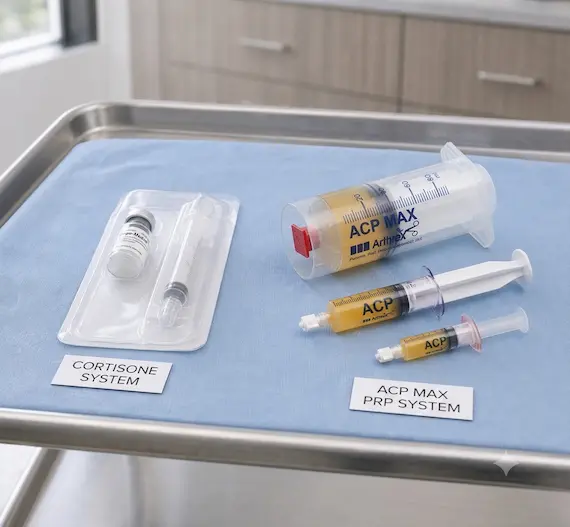
If you have knee osteoarthritis and have been offered an injection, you may be weighing up cortisone against PRP (platelet-rich plasma). They...

Cortisone injections are commonly used for musculoskeletal pain. They can be very helpful in the right setting, but they are often misunderstood.Co...
Ready for a clearer plan for your back or musculoskeletal pain?
Your assessment focuses on understanding the likely source of your pain and the most appropriate non-surgical options for your diagnosis, with the aim of reducing pain and improving function.
Book an appointment