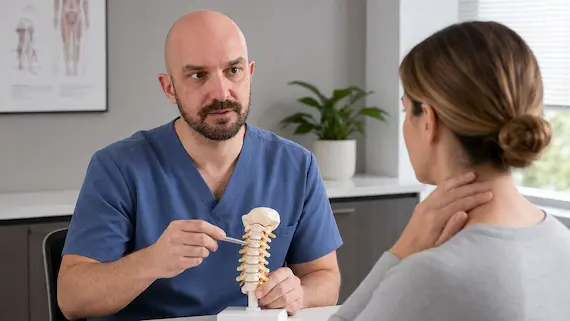
Neck Pain: Understanding the Causes, Symptoms, and Treatments.
Neck pain is a common issue that can impact your daily life, from the ability to work to the quality of your sleep. This article sets out the common ...


Neck pain and dizziness often occur together. That does not automatically mean tight neck muscles are causing the dizziness.
The neck provides the brain with information about where the head sits in relation to the body. Pain, injury or muscle fatigue can disturb that information. This gives us a plausible link between the neck and balance. The clinical evidence is less certain. Common problems such as benign paroxysmal positional vertigo (BPPV), vestibular migraine, medication effects and a fall in blood pressure can produce dizziness and neck tension at the same time.
I think the useful question is not “Are my neck muscles tight?” It is “What type of dizziness is this, and is there evidence that the neck is contributing after other causes have been assessed?”
People use the word dizziness for several different experiences:
The distinction matters. Brief spinning when rolling over in bed is typical of BPPV. Light-headedness after standing points towards blood pressure or circulation. Recurrent vertigo with headache, light or sound sensitivity may fit vestibular migraine. A vague sense of unsteadiness that tracks closely with neck pain may leave more room for a cervical contribution.
None of these descriptions makes the diagnosis on its own.
Balance depends on the brain comparing information from the inner ears, eyes and body. The upper neck is part of this system. Muscle spindles and joint receptors report the position and movement of the head relative to the trunk.
Human anatomical work has found a high density of muscle spindles in the longus colli, one of the deep muscles at the front of the neck. Other deep neck muscles also contain specialised regions rich in these receptors. This makes biological sense. Small errors in head position matter when the brain is trying to keep vision stable and the body upright.
Laboratory experiments show that changing neck muscle input can alter balance and position sense. Vibration applied to the neck muscles produces measurable postural responses. In a small study of nine healthy adults, fatiguing the neck and shoulder muscles made participants less accurate when returning their head to a neutral position.
These experiments show that neck muscle signals matter. They do not show that everyday muscle tightness is a common cause of dizziness.
Dizziness is common in people with persistent neck pain. A 2023 study of 133 patients attending a secondary-care neck clinic found that 43% reported concurrent dizziness. Those patients had more postural sway, greater neck-related disability and lower physical and mental quality-of-life scores than patients without dizziness.
Research after whiplash also supports an association. In a study of 102 people with persistent whiplash-associated disorder, the group with dizziness made larger errors when trying to return the head to centre after rotation. Their average error was 4.5 degrees after right rotation, compared with 2.9 degrees in the group without dizziness. They also reported more neck pain and disability.
This is a correlation. Several explanations remain possible:
The direction of cause is often impossible to establish from an observational study.
Cervicogenic dizziness is usually described as dizziness or unsteadiness associated with neck pain or dysfunction after other causes have been excluded. Some researchers propose a sensory mismatch: distorted information from the neck conflicts with information from the eyes and inner ears.
The mechanism is plausible, but there is no accepted gold-standard test. In 2022, the Bárány Society, the leading international vestibular organisation, concluded that evidence for a causal link between neck pathology and vertigo was lacking. It did not propose diagnostic criteria for routine clinical use.
A 2025 multidisciplinary perspective took a more permissive position. Its authors argued that altered cervical proprioception may contribute in some patients, while agreeing that the diagnosis remains difficult and that existing tests lack specificity.
The disagreement is important. “Cervicogenic dizziness” should not become a shortcut that stops the search for a vestibular, neurological, cardiovascular or medication-related cause.
There is no single muscle knot, scan or bedside test that proves the neck is causing dizziness.
Assessment starts with the timing and character of the episodes. It should cover hearing symptoms, headache and migraine features, recent infection or trauma, medication changes, falls, faintness, palpitations and neurological symptoms. Examination may include blood pressure lying and standing, eye movements, hearing and balance tests, a neurological examination and positional testing for BPPV.
The neck examination can then look at pain, movement, muscle function and the ability to relocate the head accurately. Cervical torsion and head-neck differentiation tests try to change neck input while limiting head movement in space. Recent work suggests they may help identify an additional neck contribution, but responses can also occur in people with vestibular disorders. They are supporting findings, not a verdict.
A cervical MRI does not diagnose cervicogenic dizziness. Disc and joint changes are common in people without dizziness, particularly with age. Imaging is useful when the history or examination suggests a specific structural problem and the result would change management.
A cervical contribution becomes more plausible when:
It becomes less plausible when dizziness occurs without neck symptoms, when true spinning is triggered by rolling in bed, or when attacks match a migraine, fainting or inner-ear pattern.
Head movement aggravates many vestibular conditions. Feeling dizzy when turning your head does not, by itself, make the neck the cause.
Some trials report improvement after neck treatment, but the evidence needs careful reading.
A 2022 systematic review found moderate-certainty evidence that manual therapy probably reduced symptoms labelled cervicogenic dizziness in the short term. Evidence for combining manual therapy with exercise was very uncertain. A 2025 meta-analysis reached a more cautious conclusion: benefits for dizziness impact and intensity were supported by low or very low certainty evidence.
There is also some evidence for neck-specific exercise after whiplash. In a 2024 secondary analysis of 140 people with chronic whiplash-associated disorder, dizziness improved over time in both exercise groups. The trial did not include a no-treatment comparison, many participants still reported dizziness at 15 months, and the authors suggested that balance or vestibular exercise may need to be added.
This does not support the claim that releasing one tight muscle will fix dizziness. If assessment suggests that the neck contributes, a reasonable rehabilitation plan may include:
The program should match the diagnosis and the person’s triggers. Self-prescribed neck exercises are not a substitute for assessment when the cause of dizziness is unclear.
Call triple zero (000) or seek emergency care for sudden dizziness or vertigo with any of the following:
New dizziness after significant head or neck trauma also needs assessment. A whiplash injury and a concussion can occur together.
See your GP if dizziness is new, severe, recurrent or unexplained, even without emergency features. Do not drive, cycle or use machinery while dizzy.
Neck muscles are part of the balance system, and neck pain, altered position sense and dizziness are associated in clinical studies. That is not proof that tight muscles are the cause. The strongest current position is that a cervical contribution is possible in selected patients, but it remains a diagnosis made only after more common and important causes have been considered.
Treatment should follow the diagnosis. When the neck is part of the problem, active rehabilitation may help. When the dizziness is due to BPPV, migraine, blood pressure, medication or another condition, treating muscle tension alone misses the target.
Neck pain is a common issue that can impact your daily life, from the ability to work to the quality of your sleep. This article sets out the common ...

Weight-loss injections are everywhere at the moment. Medications in the GLP-1 family, such as semaglutide (sold as Ozempic and Wegovy) and tirzepatid...

After a hamstring strain, the safest answer to “When can I run again?” is not a fixed number of days. A better decision uses the injury pattern, ...
Ready for a clearer plan for your back or musculoskeletal pain?
Your assessment focuses on understanding the likely source of your pain and the most appropriate non-surgical options for your diagnosis, with the aim of reducing pain and improving function.
Book an appointment