Back Pain Doctor
Ankle Sprain
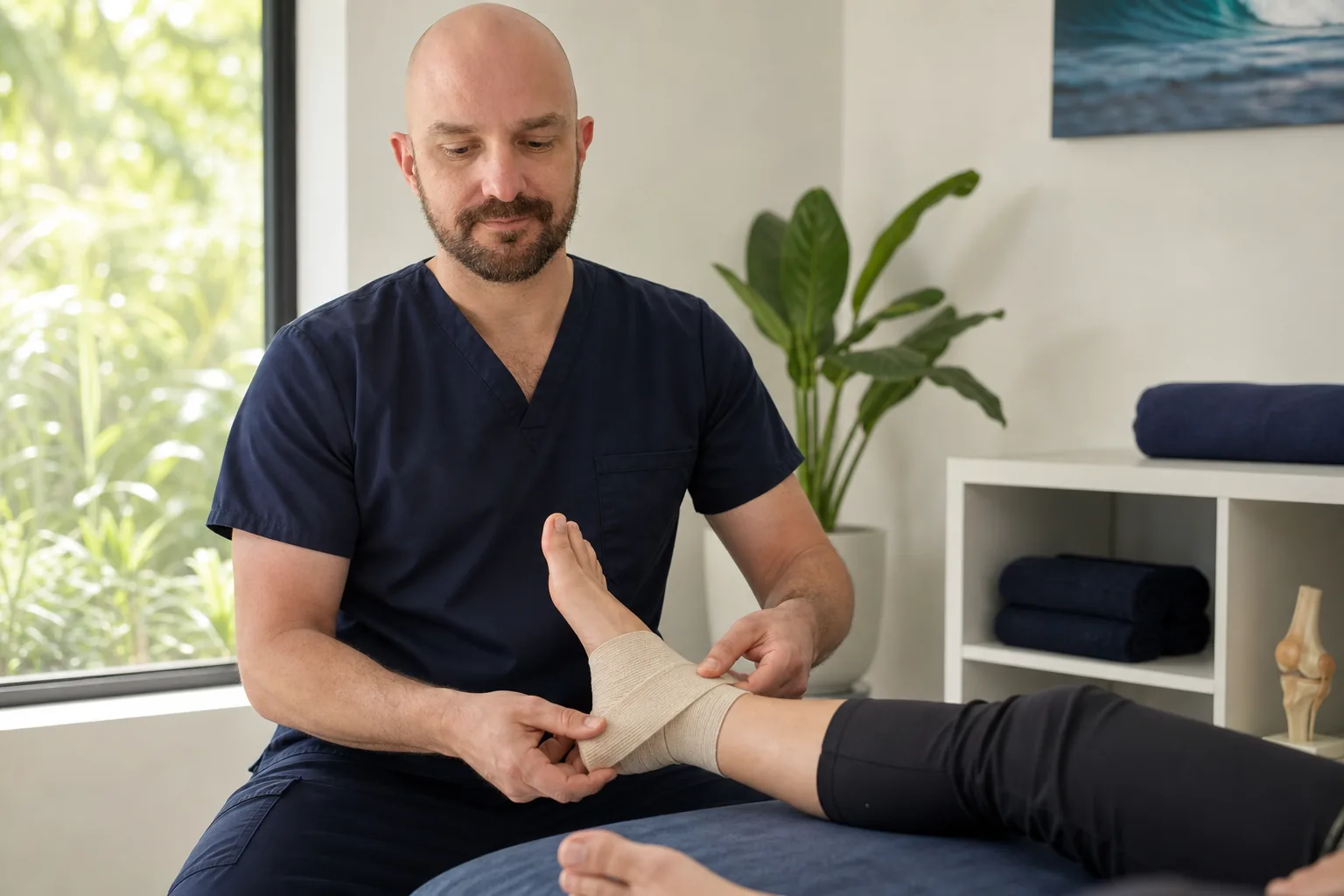
Written by Dr Joshua Hatch, Musculoskeletal GP, RACGP Fellow, Diploma in Musculoskeletal Medicine (FSEM UK).
An ankle sprain occurs when the strong ligaments supporting the ankle are stretched beyond their limits and tear. Around 90% involve the ligaments on the outside of the ankle, typically from the foot rolling inward during a twist, trip, or awkward step on an uneven surface. Sprains range from tiny tears (Grade 1) through partial tears (Grade 2) to a complete tear with instability (Grade 3).
Nearly all ankle sprains — even complete ligament tears — heal well without surgery when they are protected early and then rehabilitated properly. Treatment follows a staged approach: settling the initial pain and swelling with relative rest, ice, compression and elevation and early weight-bearing as comfortable; then restoring movement, strength and balance; and finally a graded return to normal and sporting activity, sometimes with taping or bracing at first. Depending on severity this takes from around two weeks to a few months.
Our role is to assess the injury, check for anything that needs an X-ray (such as difficulty weight-bearing or bony tenderness), and guide your rehabilitation so the ankle regains its strength and stability. Completing that rehabilitation matters — incomplete recovery is the most common cause of ongoing instability and repeat sprains — and we are clear about the uncommon situations where a surgical opinion is warranted.
Common symptoms
- Pain, both at rest and with weight-bearing or activity
- Swelling and bruising around the ankle
- Tenderness when the injured area is touched
- A feeling of instability or that the ankle is giving way
Commonly seen in
Evidence for twelve treatment options in ankle sprain
This is not a fixed ladder or a package of treatments. Every option is assessed independently against this diagnosis, including treatments with limited direct research that may still be reasonable for a clearly defined tissue target. The evidence level, likely benefit, risks, cost and alternatives are weighed at consultation.
Foundation — diagnosis, education and rehabilitation
The part of care with the broadest relevance. For many people it is enough on its own; other options are judged against it, not automatically added after it.
Diagnosis, education and progressive rehabilitation Working out what is driving the pain, explaining what your imaging does and does not mean, and building a graded loading plan you can actually follow. Core care
What it involves
Assessment to identify the likely pain source, an explanation of what the diagnosis means, adjustment of the loads that aggravate it, and a progressive strength and conditioning plan — with weight management where that is clinically relevant.
What the evidence shows
Move it, within reason, rather than rest it. Pooling 22 studies, functional treatment beat immobilisation on return to sport, return to work, swelling, range of motion and patient satisfaction (Kerkhoffs, Arch Orthop Trauma Surg 2001). An overview of 46 systematic reviews found strong evidence for early mobilisation and moderate evidence for exercise (Doherty, Br J Sports Med 2016), and the international guideline prefers supervised exercise over passive modalities, reserving surgery for those who do not respond (Vuurberg, Br J Sports Med 2018). Exercise-based rehabilitation roughly halves the odds of doing it again within twelve months (Wagemans, PLoS One 2022). One honest caveat: in 503 patients with simple grade 1 to 2 ankle sprains, adding supervised physiotherapy to good advice produced no clinically important benefit (Brison, BMJ 2016).
Pairing reviewed 2026-09-02.
Where it fits for you
For a straightforward sprain or strain, clear advice and a graded return are usually enough, and you do not need to buy a course of anything. Supervised rehabilitation earns its place where the injury is more severe, where it keeps recurring, or where the demands you are returning to are high.
Muscle and symptom-modifying options
Useful only when the examination identifies the tissue they target or when short-term pain control creates a useful rehabilitation window.
Wet needling and trigger point injection (trigger point injection) A fine needle into a tender band of muscle, with a small volume of dilute glucose solution injected through it. Only if relevant
What it involves
The needle is placed into the tender muscle band and a small volume of 5% glucose with 0.02-0.08% lignocaine is injected. Often done in the same visit as your assessment, and usable where the tender area sits deeper. Dry needling — the same technique with nothing injected — is not offered here.
What the evidence shows
Trigger-point injection reviews address confirmed myofascial pain and find heterogeneous, generally low-certainty results; they do not establish the technique as treatment for the underlying diagnosis. Condition reviewed: ankle sprain.
Evidence source: Debrosse et al., trigger-point injection systematic review (2022)
Pairing reviewed 2026-08-30.
Where it fits for you
For ankle sprain, this may be considered only when examination finds a separate tender muscle band reproducing part of the pain. It does not treat the primary pathology and is used to help movement or rehabilitation.
Ultrasound-guided injections Guidance means we can see the needle reach the target. What goes into the needle depends on the diagnosis. Only if relevant
What it involves
The injection is performed under ultrasound so the needle can be watched into the target structure. What is injected is decided by the diagnosis — and corticosteroid is used sparingly, for the reasons set out below.
What the evidence shows
Ultrasound improves needle-placement accuracy, but guidance is not a treatment in itself: benefit depends on a valid injectable target and what is injected. Condition reviewed: ankle sprain.
Evidence source: Oo et al., ultrasound-guided injection systematic review (2024)
Pairing reviewed 2026-08-30.
Where it fits for you
For ankle sprain, an ultrasound-guided injection is considered only when there is a specific diagnostic question or a separate joint, bursa, sheath or nerve target. The injectate and purpose are stated before treatment.
V-ACTOR vibration therapy (vibration therapy) Low-frequency vibration applied over tender muscle. Not a shockwave, despite sharing the machine. Plausible — no studies
What it involves
A vibration handpiece is moved over the tender muscle and fascia for a few minutes. It runs from the same STORZ MASTERPULS icon console as radial shockwave but is a separate handpiece delivering a different, gentler form of energy. No needles, no anaesthetic, no downtime.
What the evidence shows
No published clinical trial of this device in this condition. It is a vibration handpiece delivered from the same console as radial shockwave, and the rationale is myofascial rather than tendon- or bone-directed.
Pairing reviewed 2026-08-30.
Where it fits for you
A comfort measure used within a session where muscular tightness is limiting movement. Never the reason for the appointment, and not a substitute for the treatments that do have evidence.
Energy-based treatment options
Radial pressure wave, focused shockwave and EMTT have different targets and different evidence. They are assessed separately rather than treated as one category.
Radial or focused shockwave? Read the overviewRadial shockwave (radial pressure wave) Broad treatment across tender muscle and fascia, close to the surface. Only if relevant
What it involves
A handpiece is moved over the tender tissue while ballistic pressure pulses are delivered, using a transmitter head chosen for the tissue — including heads shaped for fascia and for the muscle either side of the spine. The pulse is strongest at the skin and weakens with depth, so this is mainly a myofascial treatment, though it can reach deeper in some areas. No anaesthetic, no downtime, usually a course of sessions about a week apart.
What the evidence shows
Shockwave reviews in myofascial pain report a possible benefit but mix protocols and often mix radial pressure wave with focused shockwave; that evidence cannot be transferred to the underlying diagnosis. Condition reviewed: ankle sprain.
Evidence source: Wu et al., shockwave for myofascial pain review (2022)
Pairing reviewed 2026-08-30.
Where it fits for you
For ankle sprain, radial pressure wave may be considered for a distinct superficial muscle or fascial component. It is not used as evidence of benefit for the primary diagnosis.
Focused shockwave (ESWT) A true shock wave converging at depth — for tendon, joint, ligament and bone. Only if relevant
What it involves
A focused system generates an acoustic shock wave that converges at a focal point set at a defined depth, concentrating the energy where the target is. This is the form we use for tendon, joint, ligament and bone. Typically four to six sessions about a week apart, no anaesthetic and no formal downtime.
What the evidence shows
The shockwave evidence is in chronic, load-related problems. There is no established role in an acute injury.
Pairing reviewed 2026-08-30.
Where it fits for you
Not part of early management. May become relevant if the problem becomes chronic.
EMTT (magnetotransduction therapy) High-energy magnetic pulses applied over the area. Painless, no contact. Plausible — no studies
What it involves
You sit with the applicator positioned over the area for a short session. Painless, no gel or contact required, and usually delivered as a course — commonly alongside shockwave.
What the evidence shows
There are no published randomised trials of EMTT in this condition, or in any musculoskeletal condition, that we can point to. The supporting work is laboratory work: EMTT increased tenocyte proliferation, migration and collagen expression in cultured human tendon cells (Mancini, Int J Mol Sci 2025). The nearest human evidence for a related electromagnetic therapy is negative — a randomised trial of pulsed electromagnetic field therapy added to eccentric exercise for Achilles tendinopathy found no improvement in outcome scores or tendon neovascularity over eccentric exercise alone (Ko, Orthop J Sports Med 2024).
Pairing reviewed 2026-08-30.
Where it fits for you
Offered only as an adjunct alongside treatment that does have evidence, never as the plan itself, and only after that gap is explained. Much of the EMTT literature is manufacturer-affiliated, which is part of why we describe it this way.
Biologic and joint injection options
Each injection is assessed independently for the named diagnosis. Cost, uncertainty, likely benefit, risks and alternatives are part of the decision.
Platelet-rich plasma (PRP) Your own blood, concentrated and injected under ultrasound guidance. Not offered for this
What it involves
Blood is taken from your arm, spun to concentrate the platelets, and injected into the target under ultrasound guidance in the same appointment.
What the evidence shows
Tested, and it does not change the outcome that matters. In a double-blind, placebo-controlled trial of 37 people with severe ankle sprains, PRP produced no difference in pain or Lower Extremity Functional Scale scores against a saline injection (Rowden, J Emerg Med 2015). Two further randomised trials in grade II sprains found an early advantage that did not last: PRP over the anterior talofibular ligament was better at eight weeks but identical to rigid immobilisation alone by 24 weeks (Blanco-Rivera, Foot Ankle Surg 2019), and in 83 patients the same eight-week advantage had gone by six and twelve months (Zhang, Front Bioeng Biotechnol 2022). That is evidence of absence, not absence of evidence.
Pairing reviewed 2026-09-02.
Where it fits for you
Not offered for an ankle sprain. Ligament healing and a graded return to load do the work, and an injection buys at most a few weeks of head start that the control groups caught up with anyway.
Prolotherapy (dextrose) A course of dextrose injections into and around the structure and its attachments. Beat saline on balance, not pain
What it involves
Hypertonic dextrose is injected at the tender ligament and tendon attachments, and into the joint where relevant, usually as a series of treatments a few weeks apart.
What the evidence shows
Two randomised trials have tested dextrose prolotherapy against saline injections in a long-standing ankle sprain, both in people whose ankle had stayed painful or unstable for months rather than in a fresh sprain. In the larger, 114 people with chronic ankle instability had four injections of 15% dextrose or saline into the anterior talofibular ligament over 16 weeks. At one year the main instability score (the Cumberland Ankle Instability Tool) was no different between the groups, but the dextrose group did better on a balance test (about 4.3 points on the Star Excursion Balance Test at 52 weeks) and had fewer repeat sprains; no procedure-related adverse events were reported (Sit, Arch Phys Med Rehabil 2025). In the smaller, 27 people with a chronic anterior talofibular ligament sprain had ultrasound-guided 15% dextrose or saline alongside a home physiotherapy program; pain scores were no different between the groups at 12 weeks, both groups improved, and only tenderness to pressure was better with dextrose (Wu, Arch Phys Med Rehabil 2025). An uncontrolled study of 25 people with chronic ankle ligament injury reported large gains after two injections of 12.5% dextrose around the nerves and fascia, a different technique with no comparison group (Kazempour Mofrad, Anesth Pain Med 2022). One case of a painful nerve injury (complex regional pain syndrome) after prolotherapy for a lateral ankle sprain has been reported (Kim, Medicine 2021). No trial in a recent sprain was found. PubMed search, 14 October 2026: prolotherapy, dextrose, hypertonic glucose or hyperosmolar with sprain, ankle instability, collateral ligament or syndesmosis terms (21 records), and prolotherapy with ligament, ankle, wrist, finger, thumb or soft-tissue injury terms (121 records, all screened), each with randomised-trial and systematic-review passes.
Pairing reviewed 2026-10-14.
Where it fits for you
Not for a fresh sprain, which settles with a graded rehabilitation program. Can be discussed for an ankle that keeps giving way or stays sore months later despite a completed balance and strengthening program, with the trial results stated as they are: steadier balance and fewer repeat sprains, but no clear difference in pain or in the main instability score. The rehabilitation program remains the treatment.
Viscosupplementation (hyaluronic acid) A gel-like injection into an arthritic joint. Widely used, and genuinely contested. Not used here
What it involves
One or a short series of hyaluronic acid injections into the joint under ultrasound guidance.
What the evidence shows
Not a treatment for a sprained ankle. Viscosupplementation is an injection into a joint for a problem inside that joint, and a sprain is an injury to the ligaments outside it. One research group has trialled hyaluronic acid injected around the sprained ligaments, not into the joint: in 158 athletes it gave less pain at day eight and a return to sport at 11 days against 17 with a placebo injection (Petrella, Clin J Sport Med 2007; Phys Sportsmed 2009). That is a different procedure from the one in this row, nobody else has repeated it, and a meta-analysis of 19 randomised trials of hyaluronic acid in soft-tissue problems found no second sprain trial (Khan, Sports Health 2022).
Pairing reviewed 2026-10-05.
Where it fits for you
Not offered for an ankle sprain. Hyaluronic acid is considered only for a problem inside a joint, such as arthritis.
Nerve-targeted options
Relevant when examination identifies a superficial neuropathic pattern or a compressed peripheral nerve—not simply because pain is present.
Lyftogt perineural therapy (perineural injection therapy) A series of small dilute dextrose injections just under the skin, over tender superficial nerves. Chronic instability only
What it involves
Small injections of low-concentration dextrose, usually 5%, placed just beneath the skin along tender superficial nerves. Given as a series of short sessions.
What the evidence shows
Tested, but in the long-standing sprain rather than the fresh one, and without a control group. Twenty-five people with chronic ankle instability after ligament injury had two sessions of extra-articular neurofascial 12.5% dextrose a month apart: Cumberland Ankle Instability Tool scores rose from 1.9 to 21.8 and pain fell from 6.1 to 1.2 out of 10 by six months (Kazempour Mofrad, Anesth Pain Med 2022). There was no comparison group, so time and rehabilitation are not separated from the injection. Where the same injectate was put into the ligament instead and compared against saline it did not help pain: in 27 people with a chronic anterior talofibular ligament sprain, 15% dextrose was no better than normal saline on pain or ankle function over 12 weeks, with only pressure pain threshold favouring it at 12 weeks (Wu, Arch Phys Med Rehabil 2025). A randomised trial of 114 people is under way (Sit, Trials 2022; ChiCTR2000040213). There is also a harm report at exactly this site: a woman developed complex regional pain syndrome after injury to a small skin nerve on the outer ankle following prolotherapy for a lateral sprain, still allodynic a month into treatment (Kim, Medicine 2021).
Pairing reviewed 2026-09-28.
Where it fits for you
Not part of treating a new sprain. Occasionally worth discussing much later, where the ankle keeps giving way and the skin over the outer ankle is tender and hypersensitive, and only once a proper balance and strength programme has had a fair trial.
Ultrasound-guided nerve hydrodissection Fluid placed around a nerve to free it from the surrounding tissue. Only if relevant
What it involves
Under ultrasound, fluid is placed in the plane around the nerve to separate it from the tissue that is tethering or compressing it.
What the evidence shows
Hydrodissection evidence is concentrated in ultrasound-confirmed peripheral nerve entrapment, especially carpal tunnel syndrome; no direct evidence was identified for this diagnosis itself. Condition reviewed: ankle sprain.
Evidence source: Buntragulpoontawee et al., hydrodissection injectate review (2021)
Pairing reviewed 2026-08-30.
Where it fits for you
For ankle sprain, hydrodissection may be considered only if ultrasound and examination identify a separate compressed or tethered peripheral nerve. It is not treatment of the primary diagnosis.
This is general information only and suitability is assessed individually. Treatments with limited or condition-dependent evidence may still be discussed, but only with clear explanation of the uncertainty, the expected benefit, risks, cost and alternatives. Red flags, progressive neurological symptoms or suspected serious pathology require a different pathway.
Every treatment above is described in full on the non-surgical treatments page, including what each one is used for and what the evidence supports. Ratings apply to the named diagnosis; an adjacent muscle, tendon, joint or nerve problem is assessed as a separate target. The method behind the ratings, and the treatments we do not offer, are set out on the evidence page.
Corticosteroid injection is reviewed separately for each diagnosis.
Cortisone reliably reduces pain in the short term, and that can be genuinely useful when pain is stopping you sleeping or moving enough to rehabilitate. Beyond that window the picture changes. A systematic review of 41 randomised trials and 2,672 participants found that corticosteroid injection reduced pain in the short term but that the effect reversed at intermediate and long term; in pooled analysis for lateral epicondylalgia the short-term effect was large (SMD 1.44, 95% CI 1.17 to 1.71) while no intervention was favoured at 26 weeks (-0.40, -0.67 to -0.14) and at 52 weeks (-0.31, -0.61 to -0.01) (Coombes, Lancet 2010). In a randomised trial in lateral epicondylalgia, 83 per cent of the corticosteroid group had completely recovered or much improved at one year against 96 per cent given a placebo injection, and recurrence ran at 54 per cent against 12 per cent; adding physiotherapy made no significant difference at one year (Coombes, JAMA 2013). In joints, repeated corticosteroid injections have been associated with cartilage loss. It does not repair anything.
So we do not build treatment plans around it. Where an injection is the right call, we review the specific diagnosis and target, discuss what is being injected and why, keep the number low, and pair it with the loading work that changes the longer-term course.
When we would still consider it
- Pain severe enough to block rehabilitation
- A clear inflammatory or bursal target on imaging
- A specific short-term goal — a trip, a procedure, a return to work
- Diagnostic use, where the response tells us where the pain is coming from
When a cortisone injection is worth doing, and when it is not
Other foot, ankle & lower leg conditions
Pain in the same area can come from more than one source, and the label matters less than what the examination and history point to. These are the other guides for this region.
Related articles
Shorter articles that answer the questions patients ask most often about this.
Frequently asked questions
How do I know if it is sprained or broken?
What should I do straight after a sprain?
Why do some ankles keep spraining?
Ready for a clearer plan for your back or musculoskeletal pain?
Book an assessment with Dr Joshua Hatch.
Your assessment focuses on understanding the likely source of your pain and the most appropriate non-surgical options for your diagnosis, with the aim of reducing pain and improving function.
Book an appointment